



 14.69°C Kathmandu




.jpg)
Sat, Oct 24, 2026
Money
Provinces struggle to spend development budgets as billions remain idle
Weak project preparation, staff shortages and poor implementation continue to hold back capital spending.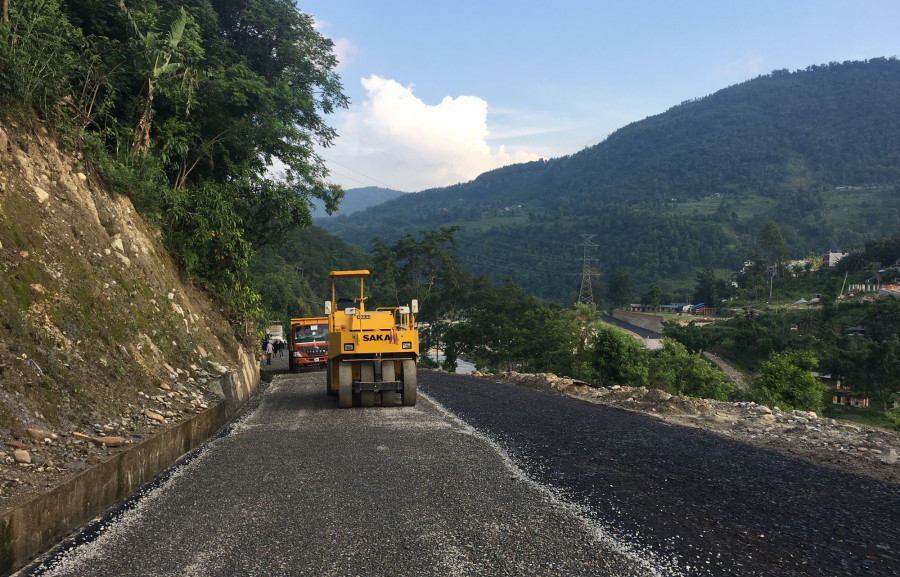
bookmark![]()
Arjun Shah, Parbat Portel, Pratap Bista, Krishna Prasad Gautam, Ghanshyam Gautam, Seema Tamang, Ajit Tiwari & Deepak Pariyar
Published at : August 4, 2026
Updated at : August 4, 2026 09:55
Kathmandu/butwal/pokhara/biratnagar/dhangadhi/hetauda/janakpur/surkhet
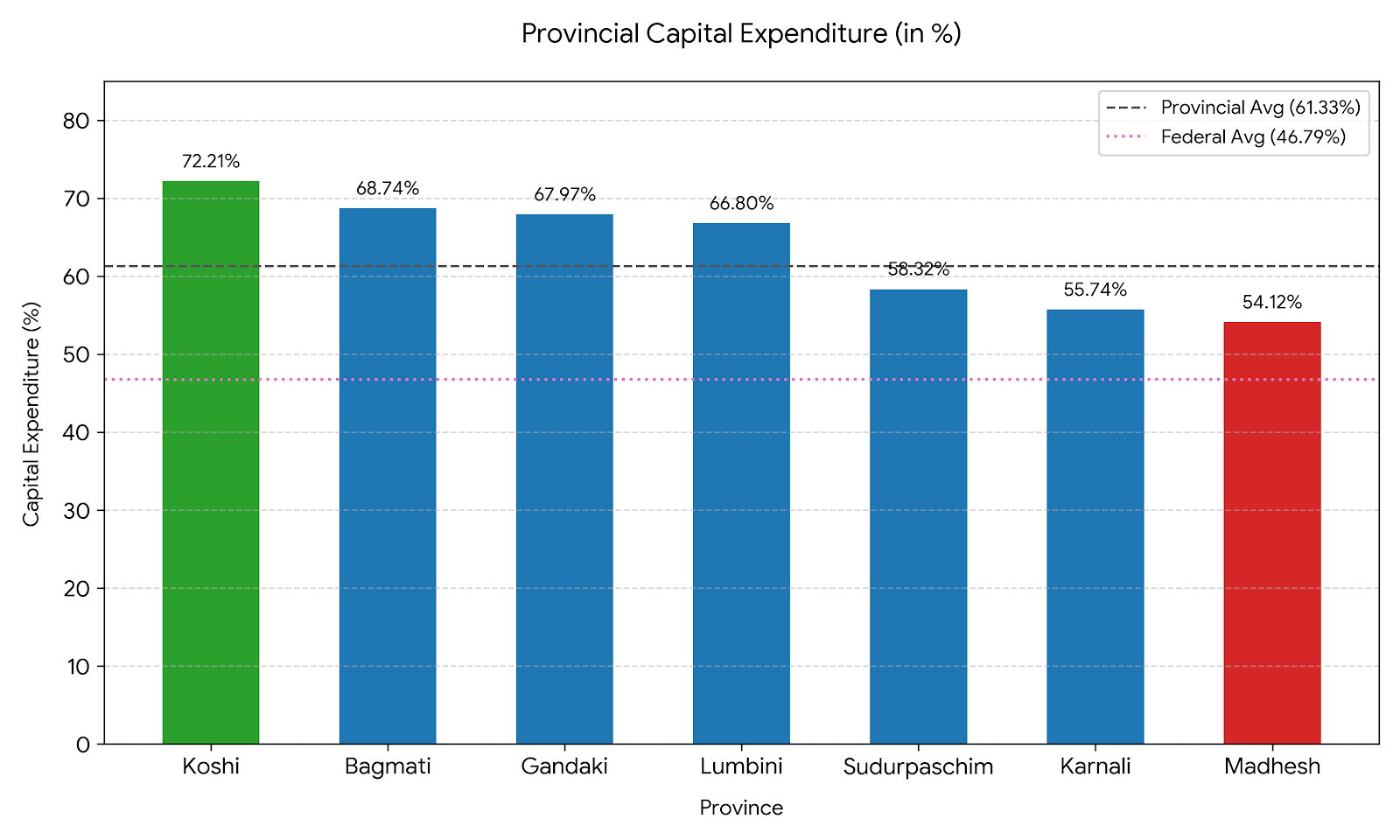
Nepal’s seven provincial governments spent only an average of 61.33 percent of their capital budgets last fiscal year, continuing a long-running struggle to turn development allocations into actual projects.
Although provinces performed better than the federal government, which spent only 46.79 per cent of its capital budget during the same period, economists say the figures reflect a broader failure across all levels of government to translate public spending into economic activity.
Since the introduction of federalism, provincial governments have typically spent only around 55 to 60 percent of their allocated development budgets, according to various studies. Despite occasional improvements, implementation has remained weak, with delays in project preparation, procurement hurdles and shortages of technical staff continuing to limit spending.
Provincial governments have blamed last year’s political disruptions, including the Gen Z protests, the March House of Representatives elections and the subsequent change in government, for slowing budget execution. But economists say those factors do not fully explain the poor performance.
“The Gen Z movement and the election affected the federal government more than the provinces,” said Prakash Kumar Shrestha, former vice-chair of the National Planning Commission. “The main problems are weak preparation, poor project selection, lack of manpower and insufficient commitment to implementation.”
He said governments often announce ambitious budgets without completing the groundwork needed for execution.
“Ministries start preparing procedures, guidelines and procurement documents only after the new fiscal year begins, delaying implementation,” Shrestha said.
The continued inability of governments to spend development funds has also affected the wider economy, he said.
“When capital expenditure remains weak, government money stays idle instead of circulating through the economy,” Shrestha said. “The demand that should be generated through public investment does not happen.”
Koshi leads, Madhesh falls behind
Among the seven provinces, Koshi recorded the highest capital expenditure at 72.21 percent, while Madhesh had the lowest at 54.12 percent.
Bagmati spent 68.74 percent of its capital budget, followed by Gandaki at 67.97 percent, Lumbini at 66.80 percent, Sudurpaschim at 58.32 percent and Karnali at 55.74 percent.
Officials in several provinces cited political uncertainty and administrative challenges for the lower spending.
In Lumbini, the provincial government spent Rs15.68 billion of the Rs23.47 billion allocated for capital projects, using 66.80 percent of its development budget.
Ramji Prasad Ghimire, spokesperson for the provincial government and health minister, said the Gen Z protests, election-related activities and weak coordination between federal and provincial governments affected implementation.
“The protests created uncertainty at the beginning of the budget implementation period,” Ghimire said. “The change in government, political activities, the election code of conduct and elections also affected spending.”
Gandaki spent Rs12.98 billion of its Rs19.09 billion capital budget, while Koshi spent Rs12.38 billion of its Rs17.15 billion allocation.
Koshi’s spending pattern showed how heavily provinces rely on end-of-year payments. The province had spent only 45.5 percent of its total budget by June 14 but pushed spending sharply in the final weeks of the fiscal year, when nearly Rs10 billion was released in about 25 days.
Bagmati recorded the strongest overall budget execution among the larger provinces, spending 68.58 percent of its total budget. It used Rs28.64 billion of its Rs41.66 billion capital allocation.
Staff shortages and procurement delays
In Karnali, officials blamed a shortage of technical personnel and delays in project preparation for the province’s weak performance.
The province spent only Rs11.13 billion, or 55.74 percent, of its Rs19.98 billion capital budget.
“Development spending is repeatedly affected by delays in securing project approvals, late authorisation, procurement problems and shortages of technical employees,” said Ratna Subedi, provincial controller of accounts in Karnali.
Karnali has nearly 2,900 sanctioned government positions, but around 28 percent remain vacant, according to the Office of the Chief Minister and Council of Ministers. The shortage is particularly severe among technical staff, with nearly 40 percent of technical positions unfilled.
Officials also pointed to the impact of the Gen Z protests, which they said disrupted government operations for almost two months.
Thirty-eight government buildings were damaged during the unrest, and reconstruction work has yet to begin.
Binod Kumar Shah, spokesperson for the Karnali government and minister for land management, agriculture and cooperatives, said coordination with the federal government weakened after the protests.
“Coordination with the interim government was difficult for three to four months,” Shah said. “The festival season and then the federal elections further slowed government work.”
Final-year spending remains the norm
Sudurpaschim spent Rs11.56 billion, or 58.32 percent, of its Rs19.83 billion capital budget.
Officials said rising prices of petroleum products and construction materials affected infrastructure work.
“We thought capital spending might not cross 55 percent, but fortunately it reached around 62 percent,” said Rajendra Kumar Hamal, secretary at the Ministry of Economic Affairs.
He said election-related activities and the Gen Z protests also disrupted the spending schedule.
Madhesh recorded the weakest performance, spending only Rs16.97 billion of its capital budget, equivalent to 54.12 percent.
Finance Minister Yuvaraj Bhattarai said the province deliberately reduced spending on small projects, unnecessary programmes and budget transfers.
Karnali and Madhesh’s performance also reflected a wider national trend: governments continue to spend more easily on salaries, administration and routine expenses than on infrastructure and development.
Shrestha said the problem is not limited to provinces but exists from the federal government to local authorities.
“Governments at all levels need to complete project preparation before the budget is introduced,” he said. “Otherwise, even a large budget becomes contractionary because the money does not reach the economy.”
He said Nepal’s governments frequently announce expansionary budgets but fail to execute them, limiting their impact on growth.
“On paper, the budget may look large,” Shrestha said. “But if implementation is weak, the economy does not receive the intended boost.”
Arjun Shah
Arjun Shah is the Kailali correspondent for Kantipur Media Group.
Parbat Portel
Parbat Portel is the Jhapa correspondent for Kantipur Publications.
Pratap Bista
Pratap Bista is the Bagmati Province Bureau Chief for Kantipur Publications.
Krishna Prasad Gautam
Gautam is the Karnali bureau coordinator of the Kantipur Publications.
Seema Tamang
Seema covers business and economy for Kantipur Publications.
Ajit Tiwari
Ajit Tiwari is the Madhesh Province bureau coordinator for Kantipur Publications.
Deepak Pariyar
Deepak Pariyar is the Kaski correspondent for Kantipur Publications.




Most Read from Money

Why does an hour long flight to Dhangadhi cost more than a flight to New Delhi?
Nepal travel agents threaten to stop selling Thailand trips over visa rules
Malaysia rejects Nepal’s demand to open recruitment to all manpower agencies
No school, but a graduation cap for women dairy farmers
Nepal arrests four medical service providers as Malaysia recruitment row deepens
Editor's Picks




E-PAPER | October 24, 2026

×