



 14.81°C Kathmandu
Sat, Oct 24, 2026
Money
Depositors of ‘troubled’ cooperatives to get money back but those having cash in other institutes unsure of refund
More than an estimated 500 institutions across the country have stopped returning deposits even though they have not been officially classified as ‘problematic’.
bookmark![]()
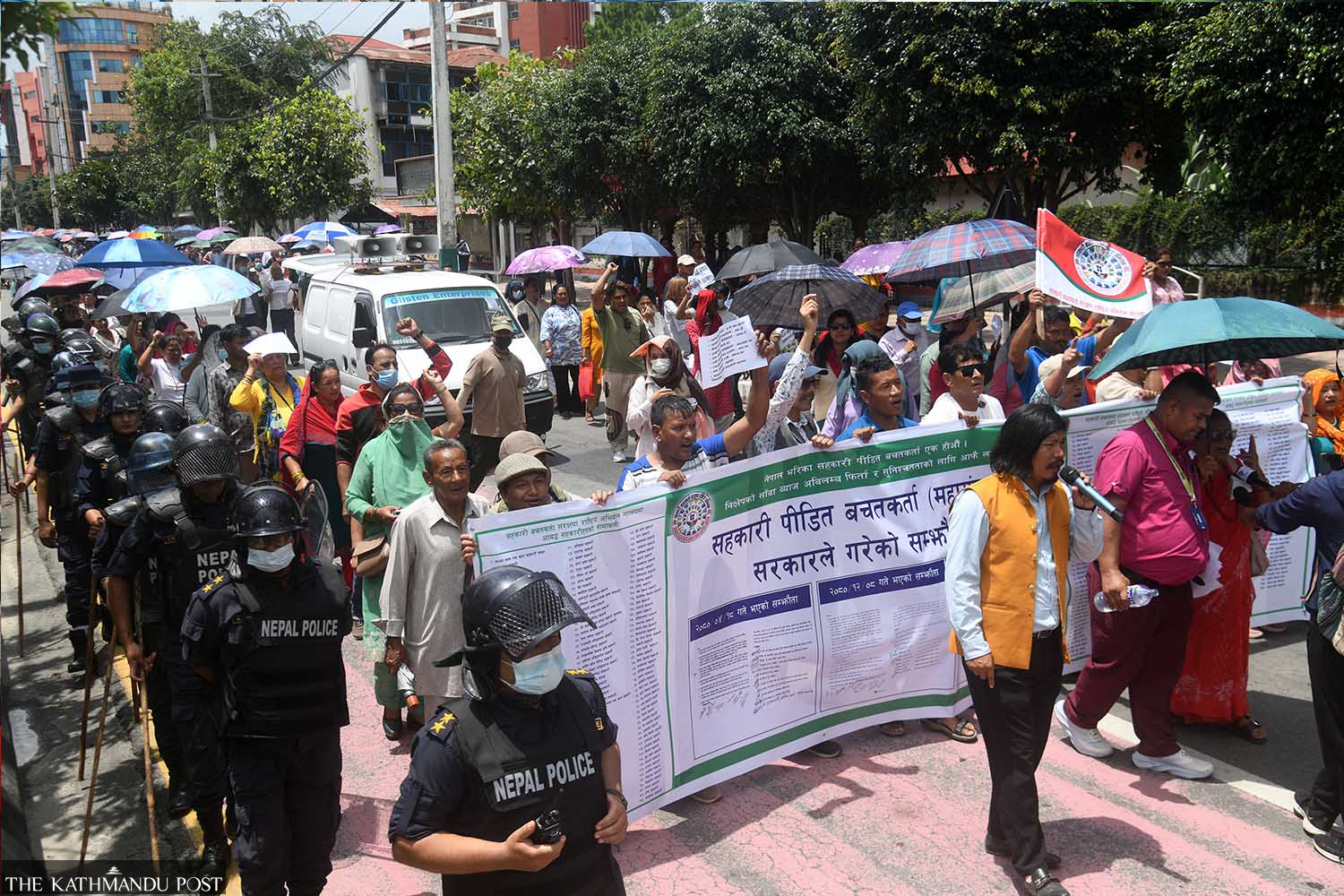
People who lost their savings to credit coopeatives demonstrate in Kathmandu demanding their money back, on July 27. The protesters oppose the government’s decision to classify depositors as small and large, saying the distinction has left many of them without repayments while only small depositors have been paid. Deepak KC/TKP
Yagya Banjade
Published at : August 4, 2026
Updated at : August 4, 2026 09:10
Kathmandu
The government has begun returning savings to depositors of officially declared troubled cooperatives since mid-May, offering long-awaited relief to thousands of victims. Yet the move has done little to address the plight of depositors whose money remains trapped in hundreds of other crisis-hit cooperatives that have not been formally declared as “troubled” by the authorities.
Although the government has prioritised deposit refunds through the Problematic Cooperatives Management Committee for institutions formally declared troubled, victims and experts say the policy excludes a far larger number of cooperatives that have collapsed, whose operators have disappeared and whose members have been protesting for years with no clear path to recovering their savings.
The federal government has so far declared 23 cooperatives troubled, while Bagmati Province has listed five and Koshi Province one. However, organisations representing cooperatives victims estimate that more than 500 institutions across the country have stopped returning deposits even though they have not been officially classified as problematic. As a result, depositors of those institutions remain outside the government's refund programme.
Kushal KC, central president of the National Campaign for the Protection of Cooperative Depositors, said victims from 619 cooperatives are affiliated with the campaign and more than 500 of which are effectively in crisis.
“As of today, more than 500 cooperatives that have failed to return depositors' money have not been declared troubled. Many of their operators have absconded, yet the government says it will only refund deposits from officially declared troubled cooperatives,” said KC. “The government has remained silent about the rest. It must introduce a policy that also guarantees refunds for depositors of these institutions.”
Victims argue that the current refund process is neither comprehensive nor fair. Although the management committee says it has prioritised small depositors with savings of up to Rs10,000, many affected families say the distribution lacks transparency and clear criteria.
“Depositors are dissatisfied because the process has not been just. The available funds belong equally to all depositors. Whatever amount is recovered should be distributed proportionately instead of paying some people in full while others receive nothing,” said KC.
He said the absence of publicly available standards has created confusion among victims and warned that if recovered assets ultimately prove insufficient, policymakers responsible for designing the distribution mechanism should bear responsibility.
Complaints received by the National Cooperatives Regulatory Authority also indicate that the problem extends well beyond the cooperatives formally recognised as troubled.
Keshav Raj Bhattarai, director of the authority, said the regulator has received 894 complaints against more than 800 cooperatives during the fiscal year 2025-26, with another five complaints already registered in the current fiscal year.
“Most complaints concern the failure to return deposits. Others involve excessive interest and penalties or the failure to release collateral even after borrowers have repaid their loans,” said Bhattarai.
According to him, action has begun on around half of the complaints through requests for records, verification of documents and discussions with relevant institutions.
The authority has referred cases involving 33 cooperatives to other agencies for further legal action. It has also ordered the freezing of movable and immovable assets and imposed foreign travel restrictions on operators, committee members and employees associated with 17 cooperatives. Asset freezes and travel bans have already been completed in nine cases, while additional information has been sought from relevant agencies regarding 45 others.
Bhattarai said the authority had recommended in April that the government declare 16 cooperatives “troubled”. However, the Ministry of Land Management, Cooperatives and Poverty Alleviation returned the proposal in June, asking the authority to complete procedures required under the Cooperatives Ordinance, including freezing assets and restricting foreign travel before making such declarations.
After completing those legal procedures, the authority submitted fresh recommendations covering nine cooperatives for declaration as troubled.
Former Supreme Court justice Gauri Bahadur Karki, who chaired the 2014 Commission of Inquiry on Problematic Savings and Credit Cooperatives, said the country's cooperatives crisis is deeper than the number of institutions officially declared troubled suggests.
“The declared institutions are not the only ones facing problems,” said Karki. “Many more cooperatives have collected savings from the public and their operators have disappeared. Resolving the cooperative crisis has never become a genuine priority for successive governments.”
The Karki-led commission had identified 130 problematic cooperatives more than a decade ago. Its report estimated that those institutions owed the public Rs11.41 billion, including principal and interest.
Karki said the report had warned the government years earlier that weak regulation and poor oversight were allowing widespread abuse of public savings, but effective reforms never followed. “The government must either demonstrate that there are no additional crisis-hit cooperatives beyond those already declared troubled or listen seriously to the thousands of victims protesting on the streets,” he said.
According to Karki, people continue to be defrauded by cooperatives almost every year because regulatory failures remain unresolved. “In several cases, including the network associated with GB Rai, some cooperatives appear to have been established primarily to deceive depositors,” he said. “Without effective supervision, operators freely misused public savings, and the state's response has remained inadequate.”
Experts say the continuing collapse of savings and credit cooperatives reflects long-standing weaknesses in governance rather than isolated financial failures. Many institutions collected billions of rupees from ordinary citizens before becoming insolvent or their managers disappeared. Although no official nationwide estimate exists, victims' groups believe billions of rupees remain trapped in failed cooperatives, most of them savings and credit institutions, while some multi-purpose cooperatives also continued accepting deposits and issuing loans in practice despite operating under broader mandates.
Rs88 billion misappropriated by 40 cooperatives
Ramesh Prasad Pokharel, acting chairman of the National Cooperatives Federation, said there is still no official count of cooperatives unable to return public savings. Based on informal assessments, however, he estimates that around 300 cooperatives are already in serious difficulty, while many others are heading in the same direction.
“Those responsible for embezzling depositors’ money must be compelled to repay it,” said Pokharel. “The institutions should be identified and their own resources, assets and human resources used to recover loans and gradually return depositors’ savings.”
He argued that the current approach, under which the federal government and a few provincial governments first declare cooperatives troubled before initiating refunds, is unlikely to provide a sustainable solution.
“It would be more effective if the authorities worked directly from the offices of troubled cooperatives, using their own records and assets to recover loans and repay depositors,” Pokharel said. “Trying to solve every problem from a single central office may only create further delays.”
Ramesh Chaulagain, former expert member of the National Cooperatives Authority, also acknowledged that there is no verified figure for the number of crisis-hit cooperatives that have yet to be declared troubled ones.
“At present, only the 23 cooperatives declared troubled by the federal government and six others listed by Bagmati and Koshi provinces officially fall into that category,” he said. “But complaints from across the country indicate that many more institutions have stopped returning members’ savings.”
Former National Cooperatives Federation chairman Minraj Kandel likewise estimated that around 200 cooperatives have failed to return deposits despite not being formally declared troubled. “The government currently has no mechanism to refund depositors of institutions that remain outside the official list,” said Kandel.
Surya Bahadur Thapa, who chaired the parliamentary special committee on cooperative savings embezzlement, said his panel had investigated 40 cooperatives although its original mandate covered only 29 institutions.
“The committee found many more cooperatives that had misappropriated public savings than those officially declared troubled. Yet there is still no clear legal arrangement for returning the money of depositors in these institutions,” said Thapa.
He said the committee had recommended adopting a system similar to that used by Nepal Rastra Bank when commercial banks become financially distressed.
“When a bank fails, the central bank assumes responsibility for management, recovers loans and protects depositors,” said Thapa. “A similar framework should apply to cooperatives. If recovery proves impossible, liquidation should begin without unnecessary delay.”
He questioned the effectiveness of the revolving fund proposed to finance refunds, arguing that loan recovery has remained weak. “The government has spoken loudly about returning savings, but progress has been limited,” he said. “Most of what is happening now simply continues work initiated by the previous committee.”
Minister for Land Management, Cooperatives and Poverty Alleviation Pratibha Rawal said the government has already begun refunding deposits in officially declared troubled cooperatives while preparing both short-term and long-term strategies for other cooperatives that have not yet received that status.
“The National Cooperatives Regulatory Authority is investigating complaints, collecting evidence and evaluating cooperatives that have failed to return deposits,” said Rawal. “However, the authority does not have a mandate to refund money.”
The minister said discussions are underway on whether responsibility to refund money should also be assigned to the Problematic Cooperatives Management Committee.
“The government has already started returning savings to declared troubled cooperatives. For cooperatives that are heading towards crisis, we are exploring several options to protect depositors,” said Rawal. She acknowledged that legal proceedings have often recovered only a fraction of the assets needed to compensate victims.
“In many cases, assets have been hidden inside and outside Nepal,” Rawal said. “The government is therefore working on long-term measures that take all these complexities into account.”
The scale of cooperatives fraud is also reflected in police records. Over the past decade, police have arrested 669 people in connection with cooperatives funds embezzlement while 1,540 suspects remain absconding.
The arrests followed 258 complaints lodged by 24,224 victims. Police investigations have resulted in more than 100 criminal cases, with over 1,300 defendants facing prosecution. Courts have determined claims exceeding Rs2 billion in cases already filed. More than three dozen cases have ended in convictions, around 60 remain under trial and several others await decisions on appeals by government prosecutors.
Successive governments have repeatedly acknowledged problems in the cooperatives sector and formed committees to recommend reforms. Since 1967, at least 14 separate commissions or task forces have been formed. While some of their recommendations have been partially implemented, the underlying weaknesses remain unresolved.
As public confidence has declined, experts warn that the credibility of Nepal’s cooperatives movement—and a significant pillar of the country's financial system—continues to erode.
A report by the parliamentary special committee led by CPN-UML lawmaker Thapa concluded that 40 cooperatives operating in major cities had liabilities of Rs87.89 billion, including Rs71.30 billion in public deposits. The report found that prospects of recovering loans, investments and non-banking assets were weak.
It also found that 13 of the 22 officially troubled cooperatives had illegally issued loans worth Rs21.38 billion, while 18 other controversial cooperatives had extended loans totalling Rs32.41 billion. Six of those cooperatives alone had provided loans worth Rs6.85 billion to individuals and entities linked to Gorkha Media Network.
The committee concluded that Rs655.4 million deposited by members of Suryadarshan Cooperative in Pokhara, Supreme Cooperative in Butwal, Sahara Cooperative in Chitwan, Sano Paila Cooperative in Birgunj and Swarnalaxmi Cooperative in Kathmandu had been diverted to Gorkha Media Network. None of those cooperatives has yet been declared officially troubled.
The Thapa-led committee recommended legal action against Gorkha Media chairman Gitendra Babu (GB) Rai, former managing director and former home minister Rabi Lamichhane, and operators Chhabilal Joshi and Kumar Ramtel. All four face charges of fraud, forgery, money laundering and organised crime. Rai remains absconding, while cases against Lamichhane, Joshi and Ramtel are pending before the courts.
Refunds begin only for officially declared troubled cooperatives
The Problematic Cooperatives Management Committee says it has returned or settled Rs710 million belonging to around 11,000 depositors since beginning the refund process in May. The amount includes Rs210 million paid in cash and Rs500 million settled through account adjustments.
According to the committee, it has refunded almost all verified deposits of up to Rs10,000, except for about 1,500 depositors of Shiva Shikhar Multipurpose Cooperative. It has also begun providing up to Rs25,000 every quarter for elderly depositors, single women and people suffering from life-threatening illnesses to help cover medical expenses.
Yagya Banjade
Banjade covers government finance, banking, capital markets, and the economy for Kantipur Daily.





Most Read from Money

Why does an hour long flight to Dhangadhi cost more than a flight to New Delhi?

Nepal travel agents threaten to stop selling Thailand trips over visa rules
Malaysia rejects Nepal’s demand to open recruitment to all manpower agencies

No school, but a graduation cap for women dairy farmers
Nepal arrests four medical service providers as Malaysia recruitment row deepens
Editor's Picks




E-PAPER | October 24, 2026

×