Nepal, India seek breakthrough in stalled Pancheshwar project
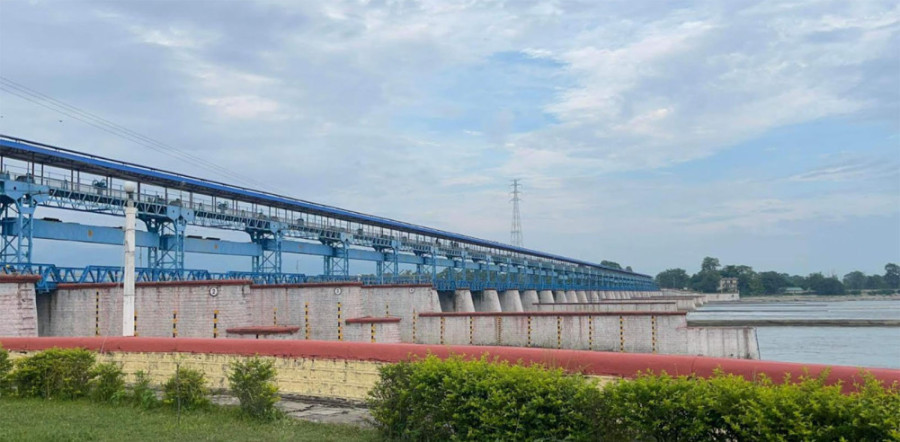
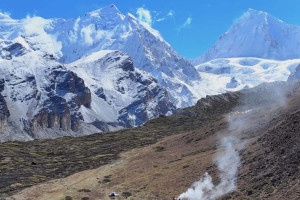
After a four-year gap, Nepal and India will revisit disputes over water sharing, benefits and investment as they seek to finalise the Pancheshwar DPR.Sarada Barrage on the Mahakali, Nepal’s western frontier river with India. Post file photo
Nepal and India will discuss the long-delayed Pancheshwar Multipurpose Project and other issues related to the Mahakali Treaty at a bilateral water resources meet scheduled for the first week of September, the first such meeting in four years.
The meetings of the India-Nepal Joint Committee on Water Resources (JCWR) and the Joint Standing Technical Committee on Water Resources (JSTCWR) will also take up the proposed link canal from the Tanakpur Barrage to the Nepal border, among other issues.
The Tanakpur-Mahendranagar link road, irrigation water supply to the Dodhara Chandani area, the Saptakoshi High Dam Multipurpose Project, and the Sunkoshi-Kamala Storage-cum-Diversion Scheme too are on the agenda. The two sides will also review the progress of the Joint Committee on the Koshi and Gandak Projects and the Joint Committee on Inundation and Flood Management.
Sushil Chandra Acharya, joint secretary at the Ministry of Energy, confirmed that the Pancheshwar project will be on the agenda of the September meetings.
According to senior officials, the meetings are being held after India expressed its readiness to resolve outstanding differences and move forward with the implementation of the Mahakali Treaty during Foreign Minister Shisir Khanal’s visit to India in June.
"Both sides are exchanging their proposed agendas for the overall water resources discussions as well as Pancheshwar-related issues," a senior government official told the Post. "The agendas are being finalised.”
Multiple sources involved in preparations for the upcoming meeting say the Indian side appears more positive than in previous rounds about finalising the Detailed Project Report of the multipurpose project.
Nepal has been informally urging the Indian side not to delay the project any further. Some concrete progress on the project is expected, another government official told the Post.
The project has remained stalled for decades due to a lack of political will, inconsistent approaches, disagreements over cost-sharing and water benefits, energy pricing concerns, environmental issues, and the inability to develop a long-term implementation plan.
Both sides have now concluded that key modalities related to investment, water and energy benefits, irrigation coverage, and flood control, among other issues, need to be reassessed, with Nepal and India presenting their respective positions.
During informal discussions between officials from both sides, Nepal has proposed a 30:70 cost-sharing ratio with India, while India maintains that it will bear only 65 percent of the project cost, not 70 percent.
Nepal and India signed the Mahakali Treaty in 1996 and have since held several rounds of discussions at various levels to finalise the DPR, determine the project cost, settle benefit-sharing arrangements, and resolve technical issues.
“It is all about the benefits of the project after its execution. India would gain greater irrigation and flood control benefits compared to Nepal. So our position is that investment should be made in proportion to the benefits each country receives,” knowledgeable sources told the Post. “From the 50:50 investment model that was discussed initially, it has now come to 65:35. We believe 70:30 is justifiable.”
Officials involved in finalising the meeting agendas said the two sides are almost on the same page regarding investment in electricity generation. However, water sharing remains a major point of contention.
“As India is the major beneficiary, it should naturally put more money into the overall project,” the source said.
During the last meeting held on September 21–22, 2022, the two countries comprehensively reviewed the bilateral water-sector cooperation between India and Nepal, including the implementation of Mahakali Treaty, Saptakoshi-Sunkoshi Project and cooperation in areas of flooding and inundation.
The meeting agreed to take forward the Saptakoshi high dam project through further studies which take into consideration the planned upstream projects, submergence area as well as other social, environmental and technical aspects. The Joint Team of Experts is expected to meet soon.
On the Pancheshwar project, India’s state-owned Water and Power Consultancy Services (WAPCOS) Ltd submitted the draft DPR in 2016 after merging separate project reports prepared by the two countries. Later a team of joint expert groups was constituted to review and revisit the report prepared by WAPCOS. Now the upcoming meeting will discuss the same amended report jointly prepared by the team of experts.
However, the two countries still have several issues to resolve, particularly regarding water sharing and the assessment of benefits for both sides. The DPR was later reviewed by a joint team of experts, which submitted a revised draft of the report.
In the upcoming meeting, both sides will discuss the revised DPR submitted by the Joint Expert Group (JEG).
According to officials, Nepal’s comments to the JEG have focused on clearly defining water-sharing arrangements, including how much water each side will be entitled to use. The proposal also includes details on the irrigation systems through which Nepal and India would utilise the project’s water.
According to hydrological studies, the Mahakali river has an average annual water availability of 18 billion cubic metres (bcm). Of this, 13 bcm is currently being used—12 bcm by India and one bcm by Nepal. India draws seven bcm of the 12 bcm from the upper Sarada barrage, built on the India-Nepal border, mainly for irrigation in Uttar Pradesh. The remaining 5 bcm comes from the lower Sarada barrage, located about 150 km downstream on the Indian side.
Nepal’s position is that the 5 bcm drawn from the lower Sarada barrage should be considered part of India’s existing water use. However, India wants it to be treated as part of its future water entitlement after the Pancheshwar dam is constructed.
“If the 5 bcm becomes part of future usage, India will effectively not get anything when the dam comes up,” an official familiar with the negotiations said, explaining the Indian position and the point where negotiations have remained stuck.
The Pancheshwar Multipurpose Project—first conceived as part of the Mahakali Treaty signed by Nepal and India in 1996—envisages the construction of two hydropower plants with a combined installed capacity of 5,040 megawatts and a 315-metre-high dam to meet the power and irrigation needs of both countries.
Officials familiar with the developments said both sides could reach an understanding once the disagreement over water sharing is resolved, additional water discharge to India is agreed upon, and the cost-benefit analysis is completed.
Issues including the costs and benefits of flood control, water availability in the Mahakali river, calculation of downstream benefits, water availability in the Chandani-Dodhara area, and other legal matters will be discussed during the meeting.
Former Energy Secretary and former Chief Executive Officer of the Pancheshwar Multipurpose Project, Madhu Prasad Bhetuwal, said key issues related to the sharing of irrigation and flood control benefits, as well as the quantum of water rights, remain unresolved.
“When I was in office, there was no agreement on how the monetary benefits would be divided between India and Nepal, nor on the quantum of water rights—how much would belong to Nepal and how much to India,” he said. “Hopefully, these issues will now be settled so that the DPR can move forward.”
The treaty concerning the Sarada Barrage, Tanakpur Barrage, and the Pancheshwar Project on the Mahakali river was signed on February 11, 1996, by Nepal’s then Prime Minister Sher Bahadur Deuba and India’s then Prime Minister PV Narasimha Rao. Following the agreement, commonly known as the Mahakali Treaty, the two countries began the process of jointly developing the Pancheshwar Multipurpose Project through bilateral investment.
The treaty stated that the project’s DPR would be finalised within six months. Nepal’s Parliament ratified the Mahakali Treaty in October 1996, approving the agreement to develop the project. The two countries agreed to share investment based on their respective utilisation of the project’s water resources, with India expected to contribute around 65 percent and Nepal around 35 percent of the investment. At the time, the estimated cost of the project was around US$3 billion.
More than two decades after the agreement, the project’s actual cost has still not been recalculated at current prices. The two countries also remain divided over investment-sharing. Nepal maintains that India should contribute a larger share because it stands to gain greater irrigation benefits, while India argues that investment should follow the previously agreed cost-sharing formula regardless of how benefits are distributed. As a result, the DPR remains unsettled.
Anil Giri is a Chief Sub Editor covering diplomacy, international relations and national politics for The Kathmandu Post. Giri has been working as a journalist for more than two decades, contributing to numerous national and international media outlets.




 15.03°C Kathmandu