Nepal’s climate diplomacy faces a test of delivery
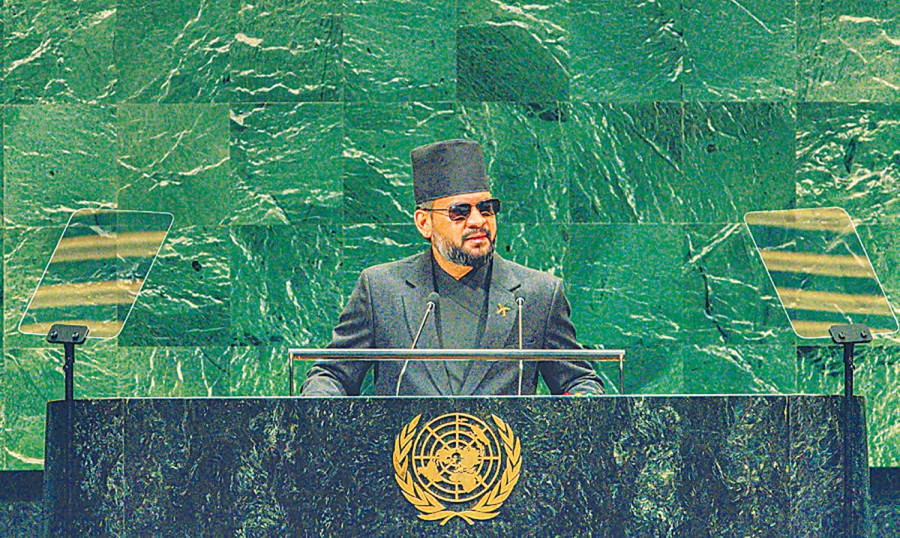
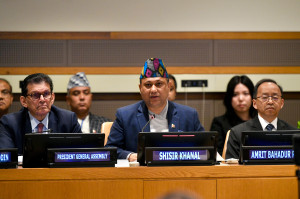
Even as Tuvalu secures a $36 million climate grant, Nepal’s high-level push for climate justice has yet to bring tangible financial support.Prime Minister Balendra Shah appealed to the international community about Nepal’s climate urgency during his United Nations General Assembly speech last month. Courtesy of prime minister’s secretariat
Tuvalu, a Pacific island with around 11,000 people, has secured a $36 million grant from the Green Climate Fund (GCF), the world’s largest multilateral climate fund, for coastal adaptation.
Nepal, despite top level diplomatic engagements from the United Nations to Tuvalu, is yet to get anything close. On Tuesday, Foreign Minister Shisir Khanal visited the island nation and proposed a “Sagarmatha to Sea” alliance. Through his address in the 81st session of the UN General Assembly last month, Prime Minister Balendra Shah appealed to the international community about Nepal’s climate urgency following the devastating floods.
The diplomatic push did not stop there. Finance Minister Swarnim Wagle attended the annual meeting of the Asian Infrastructure Investment Bank in India, traveled to Qatar, and is now returning from a US visit, where he met World Bank officials. Speaker DP Aryal and Agriculture and Environment Minister Gita Chaudhary have also traveled to different countries to lobby for Nepal's cause.
Yet for a country bearing the heavy cost of the climate crisis, the visits, pleas, and lobbying are yet to deliver visible results.
GCF Executive Director Mafalda Duarte told the Post that “days like today in Tuvalu remind us that climate finance is working; that the system is working.”
“Tuvalu shows what is possible when leadership is backed by lasting finance. A strong replenishment is how the international community can match the ambition already being shown across the Pacific and help more countries build a future in which their people can remain, prosper, and choose their own path,” said Duarte in an email conversation with Post.
As Tuvalu celebrates a concrete climate-finance commitment, Nepal is trying to turn the devastation caused by the Bhotekoshi flood into a stronger international case for climate justice and financial support ultimately.
The flood has brought renewed attention to Nepal’s longstanding argument that countries with low historical greenhouse-gas emissions are facing some of the most severe consequences of a warming planet. The government and civil-society groups have increasingly linked the disaster to the broader international debate over climate-related loss and damage.
During the upcoming 2026 annual meetings of the International Monetary Fund and the World Bank in Bangkok from October 12 to 18, members of civil society are planning to demonstrate in front of the event premises, seeking a grant for Nepal.
“We are going to meet the World Bank’s president. We will also hold a demonstration seeking climate justice and compensation for Nepal. We don’t want a loan,” said Arjun Bhattarai, president of NGO Federation Nepal who is coordinating the event in Bangkok.
Bhattarai said Nepal’s campaign is still falling short of what is needed to negotiate effectively.
“But the government’s response is poor,” he said. “First, our preparation is not enough; second, we have to form a team of experts from Nepal and abroad where we can conduct skilful negotiation.”
For a country seeking climate finance from a complex international system, he argues, political statements alone will not be enough.
“Nepal is a least developed country, so it needs experts from outside so that we can effectively negotiate with India, China, the EU, and other countries,” Bhattarai said. Preliminary assessments indicate that the flood caused extensive damage to private property, roads, bridges, hydropower infrastructure, businesses, and local livelihoods. The amount Nepal is seeking internationally would represent only a fraction of the estimated losses.
Badri Baral, country director of Winrock International, a development non-profit, said Nepal has at least succeeded in putting the issue at the highest political level. The problem now is what follows.
“Nepal’s engagements at prime ministerial and ministerial levels in the United Nations and its sidelines were fine, but we need a follow-up of those statements and positions,” he said.
“Any response should be felt and realised. Otherwise, we will not receive any substantive assistance. We need resource commitment, and the international community should list us as a priority country.”
To strengthen that claim, Nepal needs to work within the standards developed by international climate institutions, including the United Nations Framework Convention on Climate Change (UNFCC) and the Green Climate Fund, he said.
“We have to customise them and should submit them to international organisations and platforms and raise a strong voice for climate justice. This can only make our claim valid and authentic,” Baral said.
Nepal’s advocacy has also gained significance from its participation in international discussions on the legal responsibilities of states in relation to climate change. The country has consistently emphasised the principles of equity, historical responsibility, and the disproportionate impacts of climate change on vulnerable nations.
Yet securing compensation from specific high-emitting countries remains legally and politically difficult.
Establishing a direct chain between global emissions, climate change, a particular extreme event and specific economic losses requires substantial scientific and legal evidence. International loss-and-damage financing also does not operate simply as a system in which a country is declared legally liable and ordered to pay compensation.
Former chief secretary Shankar Das Bairagi, who also served as foreign secretary and ambassador to the UN, believes Nepal’s attempt to bring the “mountain to sea” agenda to the international stage can strengthen its position.
But he says Nepal cannot fight for climate justice alone.
“One single country cannot fight for climate justice; it needs collective and combined efforts,” said Bairagi. The government, he said, should form a negotiation team that can chart out a clear strategy and position and forge an alliance with like-minded nations.
“Earlier for us, the climate issue was a technical one and never became a part of our diplomatic agenda. Now it has become a diplomatic component,” Bairagi said.
With the prime minister’s address and the foreign minister making climate vulnerability one of Nepal’s diplomatic priorities, the issue has now moved into the mainstream of foreign policy, he said.
But political visibility alone will not secure climate finance.
“We cannot afford to move alone on climate issues. We need a coalition and group negotiations are always effective, result-oriented, and fruitful,” Bairagi said.
Anil Giri is a Chief Sub Editor covering diplomacy, international relations and national politics for The Kathmandu Post. Giri has been working as a journalist for more than two decades, contributing to numerous national and international media outlets.




 17.95°C Kathmandu