Seven questions explain the Supreme Court’s constitutional bench dispute
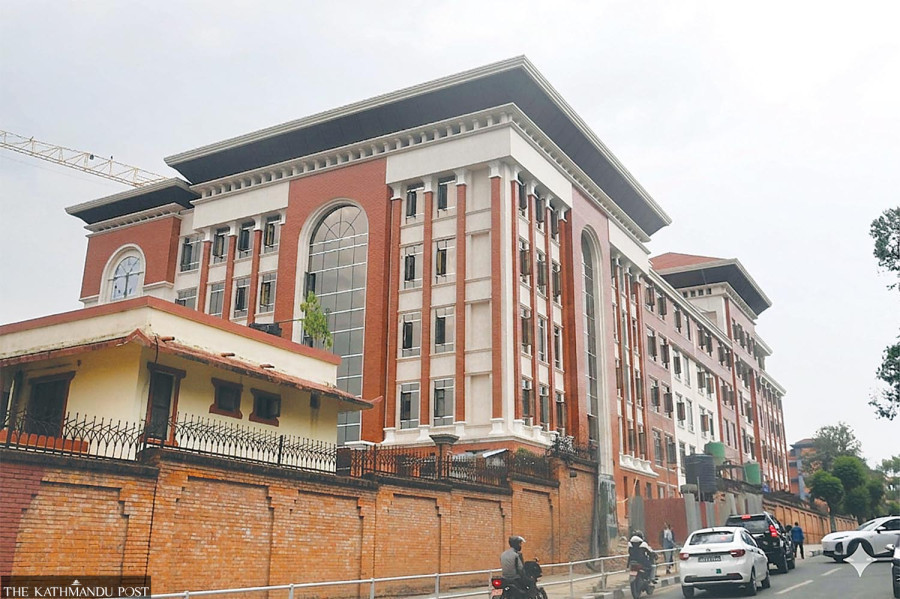
Justice Hari Prasad Phuyal’s objection has revived questions over seniority, judicial discretion and how the five-member bench should be formed. The Supreme Court building. Post File Photo
The Supreme Court’s constitutional bench could not sit on Wednesday after Justice Hari Prasad Phuyal objected to his inclusion in the five-member bench formed by Chief Justice Manoj Kumar Sharma.
But Phuyal’s objection went beyond his own inclusion. He questioned how justices should be selected for the constitutional bench, what role seniority should play and whether the chief justice should have discretion to pick justices.
Here is a look at the dispute in seven questions and answers.
What is the dispute about?
In simple terms, the dispute is over how justices should be selected for the constitutional bench.
On Wednesday, Chief Justice Sharma formed a five-member bench comprising himself and Justices Sapana Pradhan Malla, Phuyal, Nahakul Subedi and Abdulajeej Musalman. The justices then went to the chief justice’s chamber, where Phuyal questioned why he had been selected for the bench after not being included in it previously.
Phuyal argued that the Supreme Court has followed a practice of considering seniority when forming the constitutional bench. Selecting justices on some occasions while leaving them out on others, he said, could give the appearance of ‘pick and choose’.
He therefore argued that the full court should establish a clear procedure for forming the bench.
Sharma, however, maintained that the Constitution itself gives the chief justice the authority to appoint four justices to the bench and that a separate full-court decision is not required for that purpose.
The dispute, therefore, is not over whether the chief justice has the constitutional authority to form the bench. The central question is what criteria and procedure should guide the exercise of that authority.
What is the constitutional bench?
The constitutional bench is a specialised bench within the Supreme Court established under Article 137 of the Constitution. It consists of five justices, including the chief justice. The chief justice selects the other four justices from a roster recommended by the Judicial Council.
Before the Constitution was promulgated in 2015, constitutional disputes were heard by a special bench of the Supreme Court. The 2015 Constitution created a separate constitutional bench for such cases. The first constitutional bench was formed on December 8, 2015.
The bench mainly deals with three types of disputes.
First, it hears challenges to laws alleged to be inconsistent with the Constitution. If a Nepali citizen challenges a law, or part of a law, as unconstitutional, the case is heard by the constitutional bench.
Second, it settles disputes over the jurisdiction of the federal, provincial and local governments. In Nepal’s federal system, disagreements over which level of government has authority over a particular matter fall within its jurisdiction.
Third, it hears disputes relating to the election and eligibility of members of the Federal Parliament or provincial assemblies.
The chief justice can also refer a case pending before the Supreme Court to the constitutional bench if it raises a serious question of constitutional interpretation.
The bench therefore deals with issues that go beyond ordinary litigation, including the interpretation of the Constitution and questions with wider implications for the functioning of the state.
Why is there no lottery system for the constitutional bench?
A ‘cause list’ is the schedule on which cases are listed for hearing before a bench. The Supreme Court publishes daily and weekly cause lists. According to the court, the daily list is published by 10am each morning, while the weekly list is published on Fridays.
A lottery system is currently used to assign cases to the Supreme Court’s regular benches. The system was introduced to reduce judicial discretion in assigning cases and make the process more transparent and predictable.
The constitutional bench, however, is governed by a different arrangement. The Constitution provides for a five-member bench headed by the chief justice, with the other four justices appointed by the chief justice. There is therefore no system under which justices are randomly selected from the entire Supreme Court through a lottery, as happens with regular benches.
The Constitution does not, however, spell out detailed criteria for how the chief justice should select those four justices. It does not specify how much weight should be given to seniority, whether the same justices should remain on the bench or how frequently its composition should change.
That lack of a clear framework has repeatedly fuelled disputes over the formation of the constitutional bench.
Where does the issue of seniority come in?
Over the years, the Supreme Court has developed a practice of taking seniority and the roster of eligible justices into account when forming the constitutional bench. But neither seniority nor the roster is an explicit, mandatory requirement under the Constitution.
This creates a tension between two principles.
On one hand, the chief justice has the constitutional authority to appoint the four justices. On the other, there are demands for a stable and predictable method of selecting justices for the bench.
The issue raised by Phuyal on Wednesday was essentially about the predictability of that process.
If, during the same chief justice’s tenure, a justice is included on one occasion but excluded on another, Phuyal’s argument is that there should be a clear basis for those decisions.
His position is that the court needs an institutionally accepted procedure rather than relying primarily on the individual discretion of the chief justice.
Has there been a similar dispute before?
Yes.
In 2021, during the tenure of then-Chief Justice Cholendra Shumsher JB Rana, the formation of the constitutional bench became contentious during hearings on the dissolution of the House of Representatives.
Questions were raised over the participation of certain justices, forcing the bench to be reconstituted.
The dispute eventually extended beyond the constitutional bench. Differences between Supreme Court justices over Rana’s leadership and working style intensified, eventually leading to justices refusing to sit on his benches.
It was during this period that the Supreme Court decided to introduce the lottery system for assigning cases to regular benches.
Did that resolve the problem?
Not completely.
During the tenure of Chief Justice Prakash Man Singh Raut, the court again debated how the constitutional bench should be formed. Raut proposed introducing the lottery system for the constitutional bench as well.
The proposal failed to win consensus during a full-court discussion. The court subsequently returned to the practice of forming the bench from the roster of eligible justices while giving consideration to seniority.
In other words, the Supreme Court has considered three broad approaches at different times: a lottery system, seniority and the chief justice’s discretion. But it has yet to settle on a permanent method accepted by all sides.
Why does the current dispute matter?
Wednesday’s events have revived an old question: If the chief justice has the constitutional authority to form the constitutional bench, what rules should govern the exercise of that authority?
Former Supreme Court justice Ananda Mohan Bhattarai told Kantipur that the chief justice’s constitutional authority cannot be denied. But the fact that the exercise of that authority repeatedly leads to disputes, he said, suggests that the system itself needs to be reconsidered.
“We need to think about why the constitutional bench has repeatedly become controversial and find a way out,” Bhattarai said. “The chief justice should convene a full-court meeting and work with everyone to find a solution and consider alternatives.”




 22.3°C Kathmandu