



 14.8°C Kathmandu

Sat, Oct 17, 2026
National
Nepal’s migrant labour system runs through manpower agencies. So do many of its abuses
Recruiters say flawed government policies and weak regulation are to blame, while officials accuse agencies of routinely violating foreign employment laws.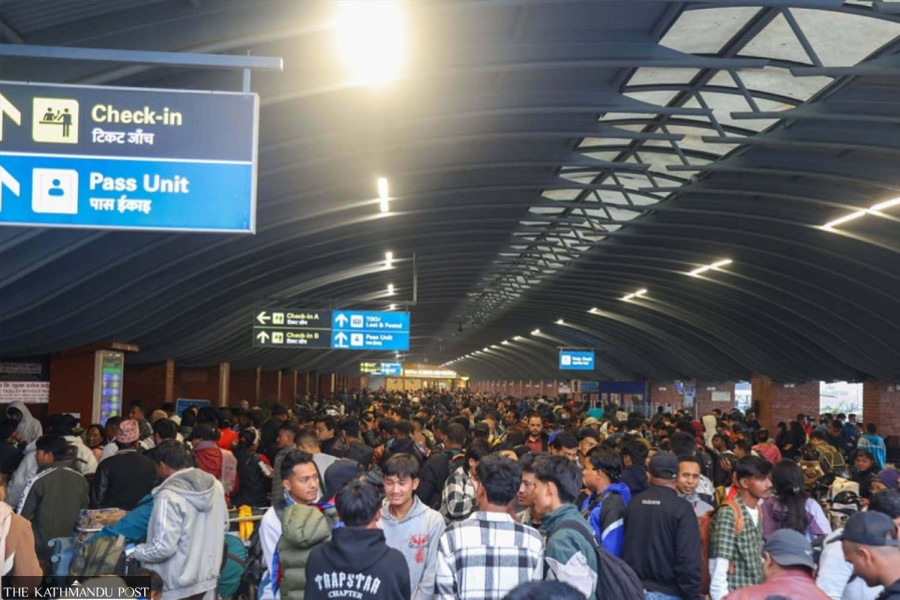
bookmark
Hom Karki
Published at : August 9, 2026
Updated at : August 9, 2026 09:49
Kathmandu
Private recruitment agencies are the main gateway to overseas employment for Nepalis, handling about two-thirds of workers who leave the country for jobs abroad. Yet the manpower companies that connect hundreds of thousands of workers with foreign employers remain at the centre of criticism over Nepal’s troubled labour migration system.
Why are manpower agencies, which sit at the centre of Nepal’s labour migration system, so persistently accused of wrongdoing?
Mira Acharya, director general of the Department of Foreign Employment, sees manpower agencies as one of the main areas where the country’s foreign employment laws are routinely violated.
“Manpower agencies play an important role in managing unemployed young people. They have also invested millions of rupees in security deposits to operate their businesses,” said Acharya, who has headed the department for the past seven months. “But they have not complied with the law. Every provision introduced to regulate foreign employment is being violated.”
The department has taken action against 771 manpower agencies in recent months for charging illegal fees, fraud, exploiting workers, using intermediaries and failing to remain accountable to workers. Around 1,200 of the agencies licensed to recruit Nepali workers are currently active.
Acharya said manpower agencies were reacting strongly even though the government had so far enforced only a handful of provisions in the Foreign Employment Act intended to protect migrant workers.
“Many provisions have not been implemented at all. So far, only the provision related to recruitment fees has been enforced. We will now examine how workers are selected,” she said. “Agencies are bringing demand letters indiscriminately. There is fierce and unhealthy competition among them.”
Around 500,000 young people enter Nepal’s labour market every year. Many cannot find stable, decent-paying jobs that can meet their families’ basic needs. Those who do find work are often employed in the informal sector, where social security and post-employment benefits are largely absent.
Nepal’s minimum monthly wage was raised to Rs19,550 from mid-July last year, but it remains below estimates of a living wage. With decent employment in short supply, many Nepalis turn to foreign employment instead.
Two-thirds of migrant workers use manpower agencies
In the last fiscal year, 406,404 Nepalis left the country after obtaining new labour permits for foreign employment. About 66 percent, or 268,990 workers, went through manpower agencies. Another 31.6 percent travelled independently, while only about two percent went through government-to-government recruitment programmes for jobs in South Korea and Israel.
Around 3.5 million Nepalis are believed to be working abroad, accounting for more than 12 percent of the country’s population. Nearly six million labour permits have been issued over the past decade.
The money these workers earn through hard labour overseas has become a pillar of Nepal’s economy. Remittances account for more than a quarter of the country’s gross domestic product and sustain millions of families while supporting communities and the wider economy.
Since the Department of Foreign Employment began keeping records of labour permits, 11.15 million labour approvals had been issued by the end of the last fiscal year, over 32 years. The figure includes workers who obtained renewed permits and those who travelled abroad multiple times.
But the scale of migration has also exposed workers to widespread abuse.
According to Equidem, an international human rights organisation focusing on workers, while many Nepali migrant workers and their families have benefited from opportunities abroad, thousands face deceptive recruitment practices, exploitation, unpaid wages, unsafe working conditions and violations of basic rights both before departure and during their time overseas.
Nepal introduced its “free visa, free ticket” policy in 2016, under which employers in destination countries are supposed to bear the major costs of recruitment. But the policy is widely flouted.
“The ‘free visa, free ticket’ policy has been widely violated. Although Nepal and destination countries have agreed on a model under which employers bear the recruitment costs, it is not being implemented in practice,” said Rameshwar Nepal, Equidem’s South Asia director. “Workers are lied about wages, the nature of their jobs and working conditions.”
But Nepal said manpower agencies should not be made the sole scapegoats for abuses in the recruitment system.
“Manpower agencies are not going to pay them out of their own pockets when employers do not pay the costs associated with recruiting workers. Changes to employment contracts are also not entirely within the control of manpower agencies,” he said. “The employer must be ethical. The state also needs to use labour diplomacy to make employers comply, while regular monitoring is necessary on the Nepali side.”
Purna Chandra Bhattarai, an expert on labour administration, said manpower agencies had come under greater criticism because of poor governance in Nepal’s foreign employment sector.
“Cases of fraud, unpaid wages and workers being stranded tend to dominate the discussion. That has overshadowed the contribution of manpower agencies,” he said. “What this sector needs is good governance, competitive and independent businesses, and effective monitoring.”
Recruiters push back against criticism
Dik Bahadur Khatri (Kumar), president of the Nepal Association of Foreign Employment Agencies, said recruiters were being blamed for failures stemming from policies adopted by both Nepal and destination countries.
“The state has not clearly defined what costs a worker should pay, or how much a manpower agency should be allowed to charge for finding a job overseas and providing the service,” he said. “Can a company established to make a profit really provide every service free of charge?”
Khatri said the government itself was responsible for the failure of the ‘free-visa, free-ticket policy’.
Although workers are officially supposed to pay only Rs10,000 in service fees, they often have to spend between Rs200,000 and Rs500,000 to secure jobs abroad, he said.
He accused the government of failing to properly regulate the sector.
“In countries where the government has not set a minimum wage, the salary agreed between the employer and worker is what is actually enforced. Yet the Nepal government unilaterally sets a wage for workers going to those countries,” Khatri said. “It does not negotiate with the destination country to ensure that the wage is implemented. Instead, it puts pressure only on manpower agencies.”
Nepal must secure the cooperation and agreement of destination countries if it wants its policies to be enforced, he said.
“Signing a labour agreement is not enough. Nepal needs the destination country’s cooperation to implement the policies it has adopted,” Khatri said.
Manpower agencies halt recruitment
Manpower agencies stopped sending workers abroad from Friday, saying they could no longer operate under the existing system.
They are demanding amendments to the Foreign Employment Act, 2007, and a transparent fee structure based on the actual cost of recruiting and sending workers overseas.
“The free-visa, free-ticket policy is not practical to implement. The absence of a clear and scientific system for service fees has encouraged informal transactions. There is no mechanism to control airfares,” Khatri said. “Signing labour agreements does not mean everything is automatically in order. You cannot improve the system by trying to control every step.”
The association has also called for the full automation of both pre-approval and final labour approval procedures.
It is demanding that manpower agencies be allowed to receive interest earned on the cash deposits they are required to maintain, and that illegal transactions, including loan sharking and informal high-interest lending, be brought under control.
It has also called for migrant workers to be linked with banks and financial institutions and provided with collateral-free or concessional loans.
The Ministry of Youth, Labour and Employment has urged recruitment agencies to resume regular operations and comply with the recruitment process.
“The labour ministry is conducting internal work to determine the service fee. We have already prepared a draft amendment to the Foreign Employment Act incorporating issues that need to be addressed through legislation,” said Pitambar Ghimire, spokesperson for the ministry. “The draft has been circulated to other ministries for their suggestions before it is finalised. We are committed to reforming the labour sector.”
Hom Karki
Hom Karki is a reporter with two decades experience covering migrant workers issues and the Nepali diaspora. He was previously based in the Gulf for Kantipur Daily.




Most Read from National

Flood sweeps away houses, bridges in Gorkha

Torrent of black mud and rocks engulfs settlements along Budhigandaki

From blankets to handmade dolls, two foreign women bring comfort to flood survivors
British Gurkha veterans issue ultimatum to Nepal government over long-standing grievances

Budhi Gandaki flood washes away three bridges in Gorkha
Editor's Picks

Constitutional Bench caught in seniority, ‘pick and choose’ dispute

A Dom boy’s long road to becoming a doctor
From blankets to handmade dolls, two foreign women bring comfort to flood survivors

News Analysis: When institutional defence exposes institutional fault lines

It’s a bird … it’s a plane … it’s the Indian ambassador’s farewell tweets
E-PAPER | October 17, 2026

×