Can AI fake a Nepali voice convincingly? Here’s what the experts say
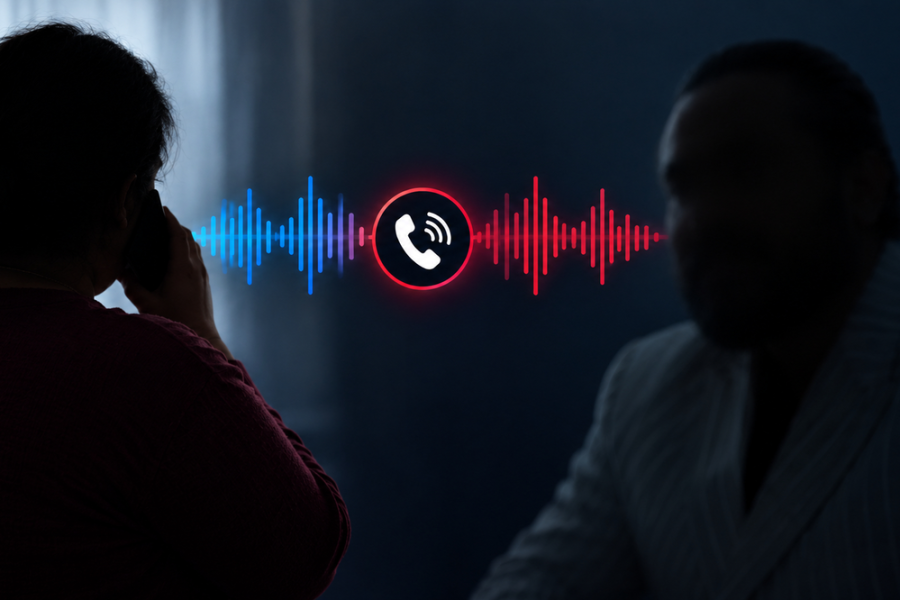
As Nepalis debate the authenticity of viral recordings allegedly featuring a sitting lawmaker, experts explain how convincingly AI can mimic Nepali speech and how forensic analysis can verify the audio. AI-generated image
When a controversial audio recording involving a public figure surfaces in Nepal, one common response has been to dismiss it as AI-generated. AI is indeed being used to create fake voices and videos that spread misinformation. But how can we determine whether a recording is genuine or fabricated? And how convincingly can AI now mimic Nepali speech, including its regional accents and linguistic nuances?
These questions have resurfaced after several media outlets recently published an audio recording allegedly featuring Rastriya Swatantra Party lawmaker Khagendra Sunar using abusive language and threatening a woman.
The controversy has reignited debate over whether AI-generated speech can be reliably distinguished from the real thing, and whether today’s AI tools can convincingly reproduce Nepali speech, including profanity and insulting remarks.
Here’s what AI experts say about how voice cloning works, how accurately it can mimic Nepali speech and how to assess whether a disputed recording is genuine or fabricated.
What is AI voice cloning?
AI voice cloning uses computer technology to generate speech that closely resembles a particular person’s voice, speaking style and emotional expression. An AI model learns to imitate features such as vocal tone, pronunciation, speaking speed and expressiveness.
According to Rojesh Shikhrakar, director of AI education and talent development at Fusemachines, a US-based enterprise AI and agent technology company, various tools available online can clone a voice from a short recording.
“Someone’s voice can be cloned using short audio clips from publicly available podcasts, webinars or social media,” he said. “With current technology, AI can generate new speech in a similar style from just three to 10 seconds of clear audio.”
More complex, extended conversations require more audio data to train a model, Shikhrakar said, putting the minimum at around three minutes or more.
Basic tools can clone a voice within seconds, but developing a sophisticated, high-quality Nepali voice model from scratch can take hours or weeks. Training a fully customised, high-quality model for Nepali may require powerful servers and multiple graphics processing units (GPUs), potentially taking several weeks.
How can genuine and AI-generated voices be distinguished?
For ordinary listeners, distinguishing a genuine recording from an AI-generated one can be difficult, particularly when the audio contains only a short sentence or exchange. Longer recordings, however, may reveal inconsistencies if listeners pay close attention, Shikhrakar said.
One way to assess a recording is to listen for natural emotional expression. AI-generated speech can struggle to sustain the subtleties of human emotion throughout a lengthy conversation.
“People pronounce the same word slightly differently in different situations, but AI can repeat the pronunciation and rhythm of a word in the same way,” Shikhrakar said.
Unnatural pauses, uneven transitions between sentences and an unusual flow of speech can also raise suspicions that a recording has been generated artificially. However, these features alone cannot establish whether an audio clip is fake.
Short recordings are particularly difficult to assess because they offer fewer opportunities to identify inconsistencies. Even a longer recording should not be judged solely by how convincing or unnatural it sounds.
How do forensic laboratories examine cloned voices?
Establishing the authenticity of audio for legal or technical purposes requires specialised tools and forensic analysis. Digital forensic analysts examine an audio file’s waveform and spectrogram, a visual representation of sound frequencies.
These representations allow analysts to examine the distribution of frequencies, pitch and acoustic energy. AI-generated speech may exhibit irregularities in its fluctuations and rhythm compared with natural speech, although no single characteristic provides conclusive proof.
Shikhrakar said specialists can also use speaker-similarity analysis and models based on vector embeddings to compare acoustic features across recordings and assess whether two samples are likely to contain the same speaker’s voice.
Several AI detection tools are available online, including ElevenLabs, Resemble AI, SynthID and TrueMedia. However, their results are not definitive.
“Current detection tools can provide estimates ranging from 70 to 98 percent, but they cannot offer a 100 percent guarantee,” Shikhrakar said. “Sometimes these tools misclassify genuine voices as AI-generated or identify AI-generated speech as genuine.”
Such errors can have serious consequences when a disputed recording is used to make allegations against a public figure or other individual.
Investigators may also use specialised speaker-recognition software to compare a suspicious recording with verified samples of the person’s voice. These systems analyse a speaker’s distinctive acoustic characteristics, sometimes described as a vocal fingerprint.
Voice-cloning systems may leave subtle digital artefacts, including faint robotic-sounding fluctuations, that are difficult for ordinary listeners to detect. Forensic tools can help identify these irregularities.
Experts can additionally examine features of natural speech, including breathing, subtle sounds produced by the movement of the tongue and lips, and changes in emotional expression. Although AI systems can reproduce many of these characteristics, they may not always capture them consistently. Such features can help analysts assess whether a recording sounds natural or artificially generated.
Digital metadata can provide further clues. Investigators may examine information about the recording device, file format, creation date and editing history to determine whether a file has been altered and whether AI-generated content may have been involved.
Why audio verification requires multiple methods
AI detection tools should not be the sole basis for deciding whether a recording is genuine. Establishing authenticity requires several independent lines of evidence and a careful examination of the circumstances surrounding the recording.
Police and investigators can compare a disputed audio clip with call detail records (CDRs), call timings, location information and other available telecommunications data. They can also examine the words, expressions, catchphrases and speaking styles commonly used by the person whose voice appears in the recording, Shikhrakar said.
The stronger approach is to cross-check individual findings against independent sources and methods. When multiple lines of evidence support the same conclusion, investigators can assess the recording’s authenticity with greater confidence.
No single detection tool, acoustic feature or metadata entry should automatically be treated as conclusive.
How convincingly can AI clone Nepali speech?
Voice cloning in Nepali is not yet as seamless as it is in English, Shikhrakar said. Although tools such as ElevenLabs and Resemble AI support Nepali, their output can still sound slightly unnatural or carry an accent reminiscent of Hindi.
Producing clear, natural-sounding Nepali speech requires suitable training data. According to Shikhrakar, developing a high-quality model may require 100 to 200 hours of good-quality Nepali audio.
The quality of the recording, the training data and the model itself can all affect how convincingly an AI system reproduces a person’s speech. A convincing voice imitation does not, by itself, establish that the words attributed to that person were actually spoken.
Useful technology, growing risks
The use of AI voice cloning and related technologies has expanded in Nepal. According to Shikhrakar, IT companies and individual users are adopting the technology for tasks such as using AI agents in meetings and producing audio content without recording a human voice for every segment.
The technology is also being used in music, including AI-generated recreations of older Nepali songs.
But its use in social and political disputes has raised concerns about deception and reputational harm.
Some time ago, a video featuring an old clip of Indian Prime Minister Narendra Modi went viral on social media after an AI-generated voice was added to make it appear that he had said, “Nepal needs Gagan Thapa.”
Rastriya Swatantra Party leader Swarnim Wagle also lodged a complaint with the Cyber Bureau of Nepal Police, alleging that a fake version of his voice and a deepfake video had been created to damage his reputation.
In another case, an audio recording lasting nine minutes and 13 seconds allegedly captured then Minister for Federal Affairs and General Administration Raj Kumar Gupta negotiating a bribe with an intermediary over the appointment of the chair of the Kaski Land Commission and the transfer of a land revenue office chief. After the recording surfaced, Gupta denied that he was the person heard in it, claiming it had been fabricated using AI.
More recently, RSP lawmaker Khagendra Sunar has denied that he is the person heard using abusive, threatening and obscene language towards a woman in a recording circulated publicly. He has claimed that the audio was fabricated using AI and other technology.
These cases illustrate the difficulty of assessing disputed recordings in an environment where AI can be used both to manufacture convincing evidence and to cast doubt on genuine material.
As the technology becomes more accessible, blindly believing or immediately dismissing every provocative audio or video circulating on social media is equally unwise.
Shikhrakar stressed the importance of critical thinking among both media organisations and the public.
“Whenever an audio recording or news report provokes intense anger or confusion, people should immediately ask themselves: ‘Is this true?’” he said.




 16.45°C Kathmandu