



 14.8°C Kathmandu

Sat, Oct 17, 2026
National
Concerns grow over foreign employment as Nepali agencies halt process
The suspension will disrupt Nepali youths’ migration for jobs abroad and could affect remittance inflows, a key source for Nepal’s economy.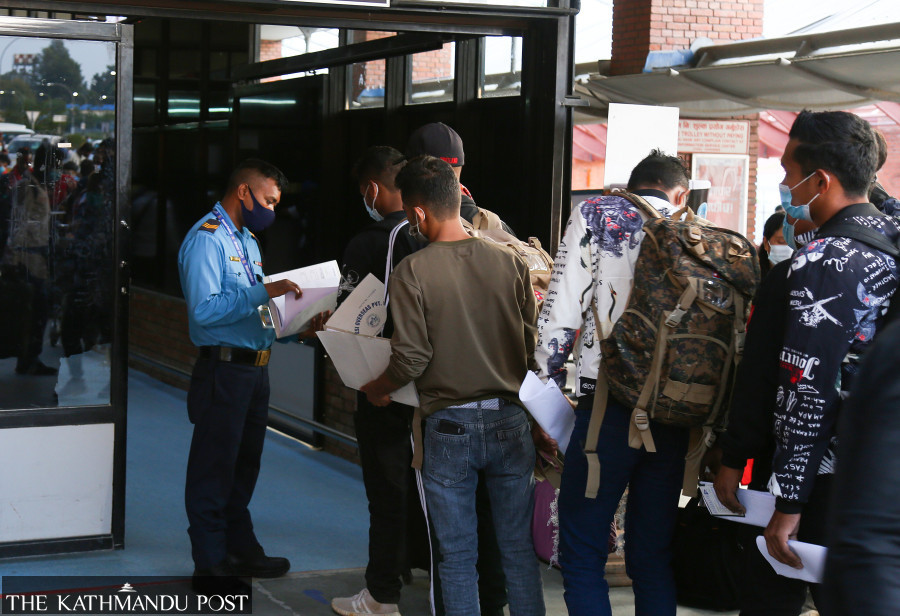
bookmark
Hom Karki
Published at : August 8, 2026
Updated at : August 8, 2026 07:18
Kathmandu
The Nepal Association of Foreign Employment Agencies has halted the process for Nepalis’ labour migration starting Friday, pressing the government to address its demands.
The 15-point charter seeks the withdrawal of disciplinary action against 771 manpower companies and the introduction of a scientific service fee structure, among other demands.
The association made the announcement after the 15-day ultimatum it had issued to the Ministry of Youth, Labour and Employment ended without the government addressing the concerns.
The Department of Foreign Employment had taken action against hundreds of recruitment agencies for allegedly charging workers fees beyond the government-set ceiling, sending workers to destination countries through Indian airports without approval, and failing to employ workers in destination countries according to contract agreements.
Association officials have warned that member agencies will not participate in the institutional labour approval process for sending workers abroad until their demands are addressed.
The decision to halt the deployment of migrant workers will affect hundreds of thousands of Nepali youths who rely on labour markets in the Gulf countries, Malaysia, and parts of Europe for employment opportunities and a better future. The move will also affect remittance inflows, a major contributor to Nepal’s economy, with annual receipts equivalent to around a third of the country’s gross development product.
Dik Bahadur Khatri (Kumar), president of the association, said that although foreign employment has become one of the major pillars of Nepal’s economy, the sector is facing a crisis due to policy inconsistencies, impractical regulations and a lack of timely reforms. The number of workers receiving new labour approvals declined by 99,553 last fiscal year compared to the previous year, a drop of 19.7 percent.
“Since 1993-94, the foreign employment sector has brought in large amounts of remittances, helping keep the economy afloat. It has boosted foreign currency reserves and contributed to reducing the trade deficit. Around 64 percent of Nepali households are directly or indirectly linked to this sector,” Khatri said. “However, practical policies have never been introduced to properly manage it.”
The agencies have called for amendments to the Foreign Employment Act, 2007, arguing that the government should introduce a transparent service fee structure based on the actual costs involved in recruiting workers. They said the current “free visa, free ticket” policy is impractical to implement and that the absence of a clear fee mechanism has encouraged informal transactions and complicated business operations.
Of the 406,404 Nepali workers who received new labour approvals and went abroad for employment last fiscal year, 268,990—or around 66 percent—processed through manpower companies. Around 31.6 percent made individual arrangements, while only about 2 percent used government channels for migration.
The association has also demanded intervention to control airfares to labour destinations, prevent artificial shortages and simplify the verification of demand letters from new destination countries. It has called for improved access to labour markets in European countries, South Korea under the E-9 system, Japan through the Specified Skilled Worker programme, and better management of foreign employment opportunities for female domestic workers.
The group has sought worker-friendly labour agreements with destination countries, separate mechanisms to handle institutional and individual complaints, and full automation of demand letter verification, pre-labour approval and final labour approval processes.
The agencies have also urged the government to use diplomatic channels to address what they described as monopolistic practices in worker recruitment in various countries. They have opposed requirements such as Saudi Arabia’s Skill Verification Programme and biometric system, the UAE’s police certificate verification process, and recruitment-related monopolies in Malaysia.
The association has demanded the appointment of labour attachés and labour counsellors in countries with more than 5,000 Nepali workers, a halt to issuing new manpower licences, and the issuance of new licences only when required based on clear standards.
It has also sought the return of interest earned on cash deposits maintained by foreign employment agencies, stricter action against illegal transactions and excessive interest lending, and access to collateral-free or subsidised loans for migrant workers through banks and financial institutions.
The ministry has urged recruitment agencies to follow established procedures. “The ministry is working internally on determining the service fee. A draft amendment to the Foreign Employment Act has already been prepared to address issues requiring legal changes and has been sent for inter-ministerial consultations before finalisation,” said Pitambar Ghimire, spokesperson for the ministry. “We are committed to improving the labour sector.”
If the suspension continues for an extended period, thousands of workers who have already received labour approvals and are preparing to leave for jobs abroad could be affected.
Stakeholders say any disruption in foreign employment could have wider economic consequences, as remittances remain a major source of foreign exchange for Nepal. Nepal received Rs2.12 trillion in remittances in the first 11 months of the last fiscal year, a 38.2 percent increase compared to the same period a year earlier, according to the Nepal Rastra Bank.
The Joint Trade Union Coordination Centre, the umbrella body of Nepal’s trade unions, has opposed any service fee arrangement that increases the financial burden on workers.
“The government should not retreat from determining service fees because of the manpower agencies’ protest. We do not accept a policy that places recruitment costs and service fees on workers,” said Binod Shrestha, chairperson of the coordination centre.
“All costs related to worker recruitment should be borne by employers. If manpower companies stop sending workers, the government should explore alternatives, including using state mechanisms.”
Shrestha said foreign employment that forces workers to take high-interest loans is unsustainable. “If workers have to carry a debt burden just to get employment and spend years repaying it, such employment cannot be considered beneficial,” he said. “We need quality jobs, and the government should focus on creating such opportunities within Nepal.”
Hom Karki
Hom Karki is a reporter with two decades experience covering migrant workers issues and the Nepali diaspora. He was previously based in the Gulf for Kantipur Daily.




Most Read from National

Flood sweeps away houses, bridges in Gorkha

Torrent of black mud and rocks engulfs settlements along Budhigandaki

From blankets to handmade dolls, two foreign women bring comfort to flood survivors

British Gurkha veterans issue ultimatum to Nepal government over long-standing grievances

Budhi Gandaki flood washes away three bridges in Gorkha
Editor's Picks

Constitutional Bench caught in seniority, ‘pick and choose’ dispute

A Dom boy’s long road to becoming a doctor
From blankets to handmade dolls, two foreign women bring comfort to flood survivors

News Analysis: When institutional defence exposes institutional fault lines

It’s a bird … it’s a plane … it’s the Indian ambassador’s farewell tweets
E-PAPER | October 17, 2026

×