World awaits status of missing climbers, including Nirmal Purja
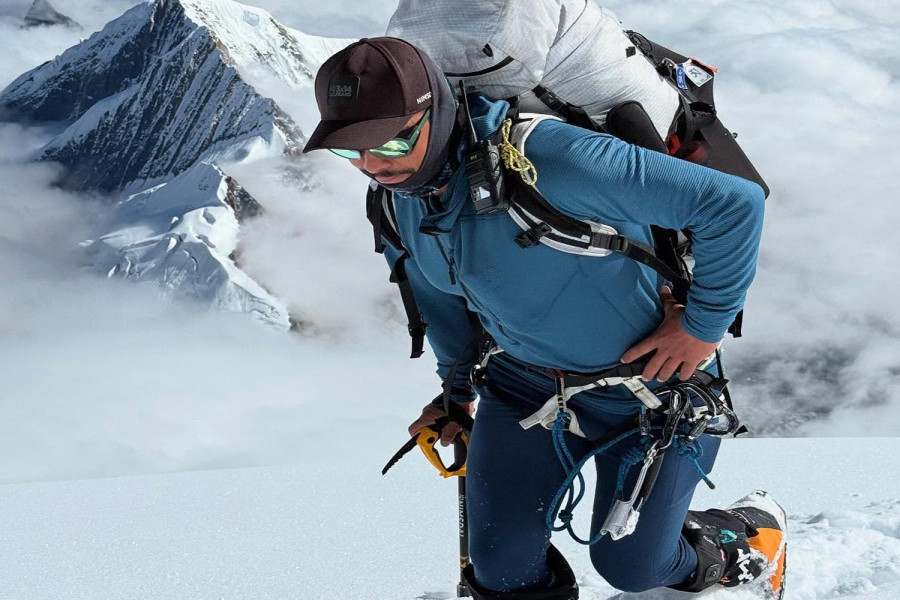
Following the recovery of two bodies, seven climbers were spotted via aerial drone footage on Broad Peak. But the search team says they can’t verify the identities of most of them — or confirm if they are still alive. Photo: Courtesy of Nirmal Purja's Facebook
Rescue teams on Pakistan’s Broad Peak located six additional climbers by drone late Friday, a day after an avalanche swept away a 10-member climbing team that included Nirmal Purja, the Nepali mountaineer known as “Nimsdai”.
The discovery brings to nine the number of climbers who have either been found or sighted, more than 30 hours after the Thursday morning avalanche, though Pakistani authorities had not released full identifications by Friday evening. The condition of the tenth climber remained unknown.
Three bodies had already been recovered earlier Friday by a ground and helicopter operation: Nepali climber Pur Bahadur Gurung, Omani climber Nadhira Al Harthy, found intact, and a single leg belonging to American climber Mallory Geis. The six additional climbers located by drone late Friday afternoon had not been identified as of late Friday evening.
Among those whose status is unknown is Purja, one of the most recognisable figures in modern mountaineering, who completed a self-described Project Possible in 2019. He climbed all 14 of the world’s eight-thousanders in six months and six days, shattering a previous record by more than seven years.
The avalanche struck Purja and his team around 9 am on Thursday at roughly 6,600 metres, between Camp 2 and Camp 3, as they pushed towards the summit of the 8,051-metre peak, the world’s 12th-highest mountain, in Pakistan’s Karakoram range. The climbers included six Nepalis and four foreign climbers, drawn from several expedition outfits: three from Seven Summit Treks, three from Purja’s own team, two from Imagine Nepal, and one each from Pakistan and the United States, according to Thaneshwar Guragain, Seven Summit Treks’ general manager. The climbers had radioed base camp that morning to say they were heading up. No alarm was raised until evening, when the team remained out of contact.
The first sign that something had gone wrong came from GPS tracking data, according to Changdawa Sherpa, an expedition leader with Seven Summit Treks who has been coordinating the search from Pakistan. “The GPS track showed people coming straight down from above 7,000 metres,” he told the Post. “That’s when I understood the situation wasn’t good.”
A tracking device carried by Purja himself had continued to show movement until Friday morning. Purja’s location appeared to shift downhill immediately after the avalanche.
By the time Changdawa was alerted, around 9 pm on Thursday, it was too dark to mount a rescue operation. Search teams resumed at first light Friday, with a Nepali guide and local Pakistani staff hiking roughly 90 minutes from base camp to reach the site, where they recovered the first two bodies by mid-morning. A Pakistani Army helicopter later ferried the bodies down for transport to hospital.
Rescue operations in Pakistan have moved more slowly than they typically would in Nepal, Guragain said, since they are run mainly by the military rather than the immediate private helicopter response Nepal allows. Helicopters on Broad Peak are limited and subject to lengthy clearance procedures, meaning an effective rescue could not proceed until weather cooperated. Asked about the odds of finding the missing climbers alive, Guragain said hope was narrowing sharply.
The search stalled through the middle of the day as poor visibility limited aerial searching. It resumed in the afternoon when a Chinese climbing team on a nearby K2 expedition, led by Mingma G Sherpa of Imagine Nepal, flew a drone over the debris field. Within hours, the drone had located six more climbers — four in a rough line and two nearby, according to Changdawa, who said he was able to identify two of his own company’s Sherpas by their clothing from the drone images.
Recovering the climbers spotted by drone will likely require lowering rescuers from a helicopter on a long line, a high-risk operation given the terrain and thin infrastructure on the mountain. Unlike Everest, Broad Peak has no permanent camps or communication relays above base camp and this has slowed both the search and the flow of reliable information, Changdawa said. “It’s not like Everest,” he said. “Communication out there is very limited.”
Pakistani authorities deployed army personnel, helicopters, drones and ground crews to the mountain starting Friday morning, while Nepal's government said its Foreign Ministry, tourism authorities and embassy in Islamabad were coordinating with Pakistani counterparts. The Alpine Club of Pakistan, in a statement, called the initial reports of the avalanche “deeply concerning” and said the governments of Nepal and Pakistan are both engaged in the mission to support the search and rescue operation. Seven Summit Treks has since called off its remaining expeditions on both Broad Peak and K2. “It wouldn’t be right to take on further risk after an accident this large,” Changdawa said.
Additional Sherpas were expected to gather at Broad Peak on Saturday to assist local teams with the recovery operation, Changdawa said, adding that avalanche deaths on Broad Peak have historically involved one or two climbers at a time. “Losing an entire team like this at once — this is the first time we've seen anything like it,” he said.
Suraj Kunwar is a senior correspondent with over two decades experience covering Aviation, Tourism and Mountaineering. He received the IFJ Tolerance Award in 2005.




 23.3°C Kathmandu