



 16.72°C Kathmandu
Sat, Oct 17, 2026
Sports
What old newspapers reveal about Kathmandu’s World Cup fever in the 80s and 90s
A look at how newspapers chronicled football fever in Kathmandu before the internet age—from Maradona heartbreak and excitement over NTV to fears of loadshedding.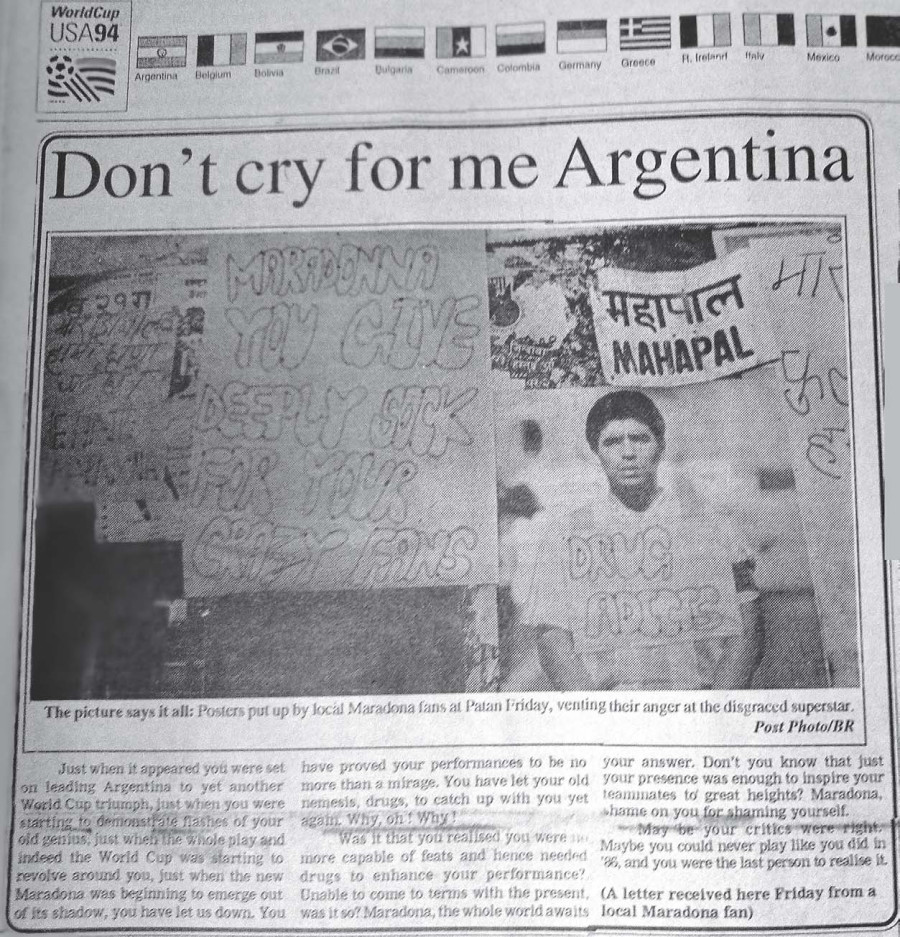
bookmark![]()
A snippet from the July 9, 1994 edition of The Kathmandu Post daily. Photo: Courtesy of Prawash Gautam
Prawash Gautam
Published at : June 10, 2026
Updated at : June 10, 2026 11:25
Kathmandu
“Thank you for the nice coverage to the preparations for the ensuing World Cup football in Mexico,” writes Lalit Shrestha from Chhetrapati, Kathmandu in a letter to the editor titled “Mexico ‘86” to The Rising Nepal (TRN) on May 27, 1986. “The news about the different teams, their aspirations, strengths and weaknesses that appear almost daily in your paper are also informative. However, we also hope that you will maintain the coverage also when the games actually start on May 31. As we do not own any TV sets, we have pinned all our hopes on TRN.”
Today, in Kathmandu, with the FIFA World Cup 2026 just around the corner, fans flaunt jerseys of favourite teams and hairstyles of favourite stars. Football lovers enjoy matches from big screens at restaurants and public spaces in Kathmandu’s core as much as from smart TV sets at homes and live streams on smart phones. And, on Twitter, Facebook and TikTok, enthusiasts engage in heated discussions and minute analysis of stars, teams, matches, faults, goals.
But, what moments defined Kathmandu's World Cup experience in the 1980s and 1990s?
In 1986, in what was a defining moment of Kathmandu’s World Cup experience, television was just emerging in the Kathmandu scene and was a luxury while newspapers served as a major source of information on the World Cup. Turn over the newspapers from the periods of 1982 to 1998 World Cups and, just like the letter to the editor, from their pages spill Kathmandu’s World Cup moments much different from today.
In that pre-internet, pre-digital age, the only two dailies disappoint Kathmandu with no coverage of the World Cup; NTV telecasts World Cup to Kathmandu’s excitement and thrill, but there are important issues and disrupted matches due to loadshedding; Maradona is suspended and his fans in Kathmandu are shocked and shattered while others feel betrayed by the star; and, while Kathmandu is drowned in World Cup fever, Kathmandu’s womenfolk are untouched by the pervading mood.
Little newspaper coverage, disappointed football lovers
A key moment in Kathmandu’s World Cup experience up to the 1982 World Cup was that Gorkhapatra and TRN, the only newspapers that its residents could turn to, showed little enthusiasm in their World Cup coverage, much to the disappointment of the Valley’s football lovers.
Although football was known to Kathmandu in the 1920s, Gorkhapatra, Nepal’s first and state-owned newspaper established in 1901, did not cover the inaugural World Cup held in 1930 and subsequent editions. A small news piece during the 1958 World Cup was possibly the first coverage. Apart from this, there was either no or only sporadic coverage of the World Cup well into the 1982 edition.
By 1982, Kathmandu was already showing an increased interest in the World Cup. However, this interest was unmatched with little coverage in Gorkhapatra and its sister publication TRN, which started in 1965. What hovered therefore was the general mood of discontent among Kathmandu's ardent football lovers, like JP Rauniyar of Indrachowk.
“Football is the most popular game in Nepal,” he writes in a letter to the editor to TRN titled “Football Fever” (July 2, 1982). “The massive media coverage of the games is reflected in the prominence given to it in the live telecasts, radio commentaries, and other international magazines. The Rising Nepal, however, seems to be an exception. Why?”
In a welcome respite for Kathmandu’s football lovers, starting from the 1986 World Cup, there was increased coverage of the tournament in newspapers with special reports, World Cup sections and even editorials focusing on World Cup.
Joys and angst over NTV telecast of World Cup
In what was Kathmandu’s watershed World Cup moment, in 1986, just about the time television sets were emerging on the Kathmandu scene, Nepal Television (NTV) broadcast the World Cup matches, bringing the matches alive in action for the first time for Kathmandu’s residents.
The World Cup on NTV was received with a pervading mood of excitement and joy. “Hats off to Nepal Television for deciding to telecast the World Cup football matches,” writes Sudhir Sigdel from Thamel in a letter to the editor to TRN (June 3, 1986).
Onto 1994 and 1998 World Cups, television and NTV continued to dominate Kathmandu’s World Cup atmosphere.
“World Cup live telecast: Nepal Television leads in all of South Asia”, reads one headline in Gorkhapatra (June 8, 1998).
NTV and World Cups marked the departure point of television culture in Kathmandu, increasing TV sales during the 1990 and later World Cups.
“Most football lovers planning to buy TV to watch the World Cup,” reads a headline in Gorkhapatra (June 5, 1998). “In 1990, most didn't have a TV, so people bought them. But everyone has TV today, so how could sales happen?”
Indeed, proud advertisements for TV sets filled newspaper pages during the World Cups.
“Rownsonic will bring to your home World Cup 1990,” declares Rownsonic advertisement in Gorkhapatra (June 6, 1990). “Watch on 14 inch Rownsonic TV with clear sound and colour so natural.” And Samsung announces: “‘Worldcup Football’ 1994 on Samsung’s colour screen” for Samsung’s 20 inch colour TV and 14 and 17 inch black and white TV in TRN (June 23, 1994). Two days later, TRN displays an announcement for Philips (June 25, 1994), “Get ready to watch FIFA World Cup football with a Philips power vision colour television.”
It was not merely excitement over the World Cup on NTV.
Some locals were concerned about the timing of the telecast of the recorded matches.
“I would like to suggest that the matches be telecast at about seven in the morning the following day,” writes one Sudhir Sigdel to TRN (June 3, 1986). “[I]t would also help make it rather ‘fresh’ to the viewers. If it is telecast in the evening it might be ‘stale’ since the viewers know, by this time, the results of the matches from the radio.”
The time zone difference was also troublesome. When live telecasts happened at odd hours in the night, Kathmandu residents struggled to keep a balance between the enthusiasm for football and the need to sleep. As one Sarad Pradhan from Om Bahal writes in a letter to the editor to The Kathmandu Post (TKP) on July 6, 1994 titled “A suggestion for NTV”: “the common problem among spectators is keeping awake. Specially [sic] during the few hours interval that there is between the first and the second match.
“Wouldn’t it be a wise decision on the part of NTV to fill in this most difficult-to-stay awake part of the night or early morning hour with an interesting variety of programmes like songs, dances, comic TV serials, or even single episode TV films. When the interval exceeds three hours, then even full length feature films Hindi or Nepali could be shown.”
But there was something more serious that evoked football fans’ wrath towards NTV.
“We have been anguished by NTV showing advertisements in the climax of the match and depriving us of watching the highly important moments of the match when a majority of sports lovers were watching with immense interest by sacrificing their sleep the World Cup semi-final between Brazil and Netherlands being telecast live on July 7,” write Sanjay, Sri Kamal, Birendra and friends from Kathmandu in a letter to the editor “Anguished by TV telecast” to Kantipur (July 9, 1998).
“We are saddened by Nepal television adopting a patronizing attitude of showing advertisements even in the telecast of the last important match of this century. […] We feel that our national broadcasting institution has severely betrayed our trust.”
Loadshedding dread amid NTV telecast
By the 1998 World Cup, loadshedding had become Kathmandu's daily routine and the dread of the power cuts during NTV telecasts was looming over the excitement of the World Cup matches.
“In Nepal, football fans dread power outage”, read the title of Suman Malla’s report in TKP (June 9, 1998). “[A]t home the Nepali football fans are creastfallen,” it reads. “In fact, they have been praying. Why? The current round of power outage [...] means half of the Valley’s TV sets will remain turned off as the match progresses in faraway France.”
“‘It seems my hard-earned leave from the final year medical class will go in vain due to the current situation’,” a worried “football adorer” Bijesh Ghimire is thus quoted in the article.
Power disruptions were so overwhelming that one viewer suggested solutions in letters to editors.
“[W]hile four billion people in the world are enjoying the World Cup 1998 via live television broadcast, those interested in Nepal are deprived of this due to loadshedding,” writes Upendra Lamichhane from Mulpani in a letter to the editor “Loadshedding time should be changed” in Kantipur (June 29, 1998). “[…] If the Nepal Electricity Authority schedules the loadshedding at 5 in the evening, viewers would not be deprived of watching the pre-quarter final matches most of which start at 8:15 pm.”
Shock, anger, protest over Maradona's suspension
From 1986 to 1994, one footballer dominated Kathmandu’s World Cup experience. The telecast of World Cup matches in 1986 coincided with Maradona’s prime, cementing his presence in the hearts of Kathmandu’s football lovers. Those who saw him crushed and weeping after losing the 1990 final with Germany had waited for him in 1994. So when Maradona was suspended from the 1994 World Cup following a drug test, it shattered them.
Newspapers capture the intense moment of shock, anger and sadness in Kathmandu.
“Nepali fans shocked by Maradona’s exit”, reads Sushil Thapa’s news headline in TKP (July 3, 1994).
Thapa writes that in tune with the strong emotions aroused by Maradona’s exit across the world, in Kathmandu too it “sparked unexpected sadness, empathy and wrath in different age groups. Maradona was liked and known to everyone from an eight year old girl to a three wheeler driver. It was a bag full of mixed reactions.”
Quoting Buddhi Sagar, an employee of the National Sports Council, he writes, “‘I felt electrocuted on hearing Maradona’s case. I became very emotional and in tears. I do not believe that he took the drug to enhance his performance. I have decided not to see any more matches. For me World Cup without him is having tea without sugar.’”
Sudha Lama, “ardent fan of Maradona”, is quoted as saying, “‘I almost shed tears. I love him. He is such a great player. He has been brutally treated by FIFA.’”
Meanwhile, emotions ran high among the students of Pulchowk.
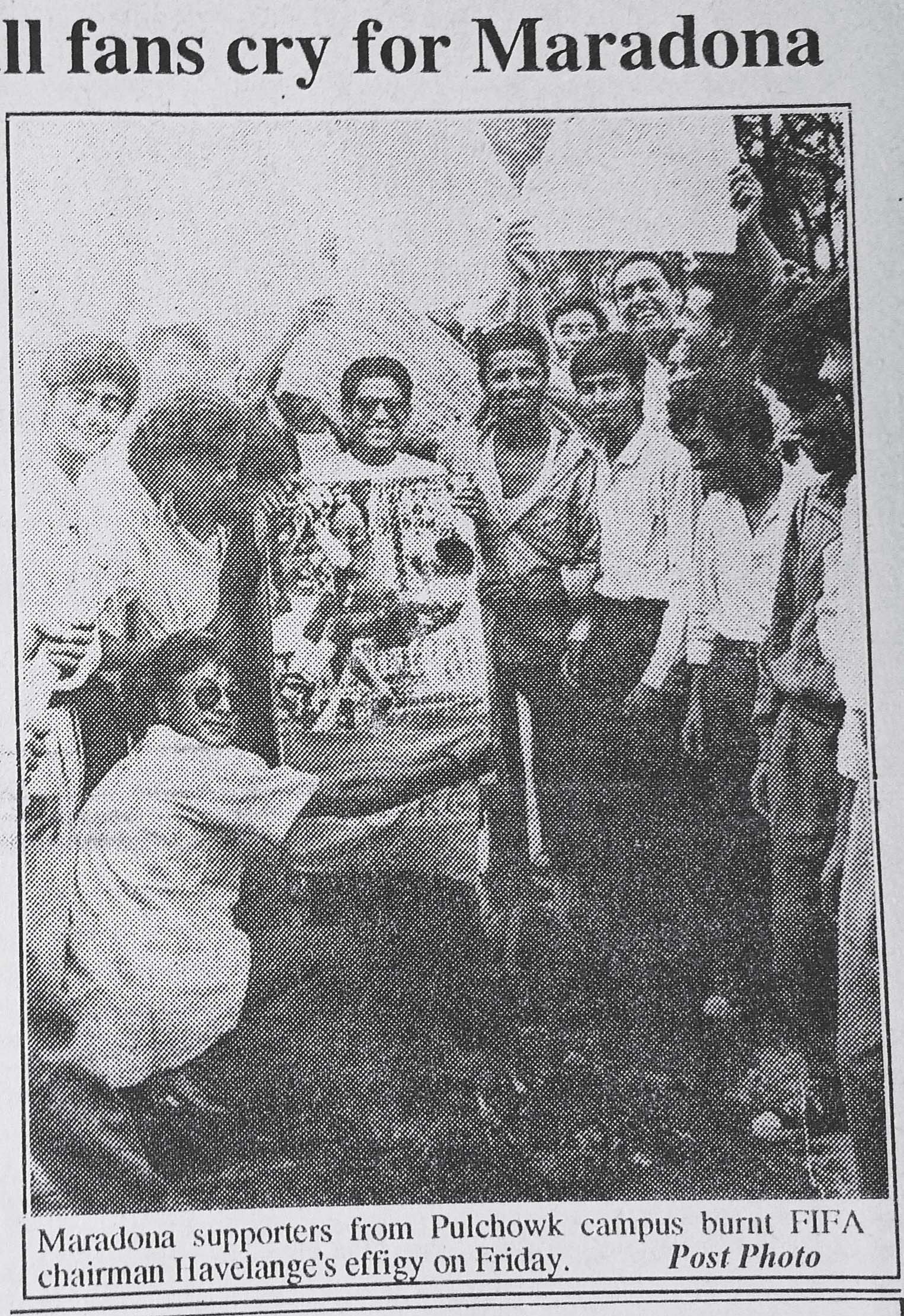
“Pulchowk campus football fans cry for Maradona,” reports TKP (July 9, 1994). According to the report, students wrote and displayed slogans: “Uncle Maradona we miss you, we miss you,;You are the victim of FIFA conspiracy,; You have been cheated,; No Maradona, no World Cup,; Shame on you FIFA,; Dissolve FIFA,; Down with FIFA President.”
They burnt the effigy of FIFA president Joe Havelenge. And, in a strongly worded statement, they accused FIFA of “hatching conspiracy against the super star to end his glorious career.” In protest, they also “decided to boycott classes for 8 days.”
But not everyone felt that Maradona’s suspension was unjustified, and instead felt let down by the football star. A local Maradona fan sent a letter titled “Don’t cry for me Argentina” to TKP (July 2, 1994). “You have let us down,” he writes. “You have proved your performances to be no more than a mirage.”
A photo published by Bikas Rauniyar along with this letter shows Argentine fans of Patan who put up posters with slogans to vent their anger at Maradona. “DRUG ADICTS” reads a poster placed against Maradona’s jersey. “Maradonna [sic] you give deeply sock [sic] for your crazy fans,” reads another.
World cup ‘forbidden pleasure’ for Kathmandu's womenfolk?
Apparently not all of Kathmandu was affected by Maradona’s suspension, or, even the World Cup fever in the least, most notably Kathmandu’s women who were apparently untouched by the pervasive World Cup mood.
“Football for girls has never been a subject of interest”, reads the title of the news report under the byline of reporter Sushil Thapa in TKP (June 21, 1994).
“The ongoing World Cup football tournament may have aroused unprecedented interest in girls in different parts of the world. But it does not speak the same in our girls,” he writes. “In a random survey conducted by this Post reporter to find Nepali girls interest in the World Cup, it was found that a shocking 90 percentage had no any sort of interest. And were not even bothered to watch the matches.”
He quotes Pratima Pradhan, a student, who “flatly said what more bore can it be seeing 90 minutes football on television.”
In his another report “World Cup rouses little interest in girls” (June 29, 1994), Usha, a class 10 student from Adarsha Vidhya Mandir tells him, “‘I just do not like football… When my family members see matches at home, I feel like smashing the screen. It really gets my nerve’.”
Binita Joshi, an undergraduate student, writes in her article “Exams and World Cup” in TRN (June 17, 1994) that she is “puzzled why boys are so thrilled when it comes to football.”
But did it really mean that the World Cup was only for Kathmandu's men?
Shikha Upadhya, a class 8 student from St. Mary’s School, writes a passionate letter to the editor, “Born to be burdened?” in TKP (July 8, 1994).
“Everyday we are told to do what we have been doing for years,” she writes. “‘Study, study, study’. Tons of homework await completion and there are books to pore into.
“I can’t even watch World Cup football matches that comes [sic] once every four years inspite [sic] of the great interest I have. It seems as if it is ‘A forbidden pleasure’. So I have become fed up, I only long for holidays. Studies have become like a curse. What should I do? I guess all have the same problem…….
“I pacify myself by watching the highlights, but I miss all the excitement of the interesting matches. At that time I feel very sorry and I feel as if we were born to be burdened by our teachers and guardians who do not want to give respite.”
Shifting media, shifting World Cup moments
Post-1998, in the decades of 2000s and 2010s, the internet and mobile phones arrived, and defined Kathmandu’s World Cup experience.
“The Twitter World Cup”, an article by Dinesh Wagle in TKP (June 20, 2010), discusses and records the moment of Kathmandu’s shift to the digital world to experience the World Cup.
“I shared my 2002 World Cup excitement by email, downloaded many photos of my favourite players and match schedules from web sites, and posted comments on some online discussion boards. Four years later [in 2006 World Cup], I posted my first World Cup entry (blog) on my interactive web site,” he writes.
Far from the world of newspapers and television, with the turn of the 21st century, broad platforms of digital and social media, in texts, visuals and multimedia have prominently defined and shaped Kathmandu’s World Cup moments.
Mobile phones and internet platforms, all of newspapers, television and radio have been merged into a tiny portable device. Watching the World Cup need not be a group event today as in the television age of the 80s and 90s. Incessant data and online streaming have purged fears of loadshedding disrupting matches and of lost thrills in recorded matches.
Should Kathmandu’s favourite star be suspended this World Cup, his Kathmandu fans need not organise a protest, for they can vent all their rage on Twitter, Tiktok and Reddit.
And with every teenager holding a mobile phone, a school girl will not have her teachers and guardians dictate her schedules for matches.
Prawash Gautam
Prawash Gautam is an independent researcher with an interest in social history.
Most Read from Sports
Editor's Picks

Constitutional Bench caught in seniority, ‘pick and choose’ dispute

A Dom boy’s long road to becoming a doctor

From blankets to handmade dolls, two foreign women bring comfort to flood survivors

News Analysis: When institutional defence exposes institutional fault lines

It’s a bird … it’s a plane … it’s the Indian ambassador’s farewell tweets
E-PAPER | October 17, 2026

×