Nepal’s para table tennis players train on borrowed gear but dream of Asian Games medals
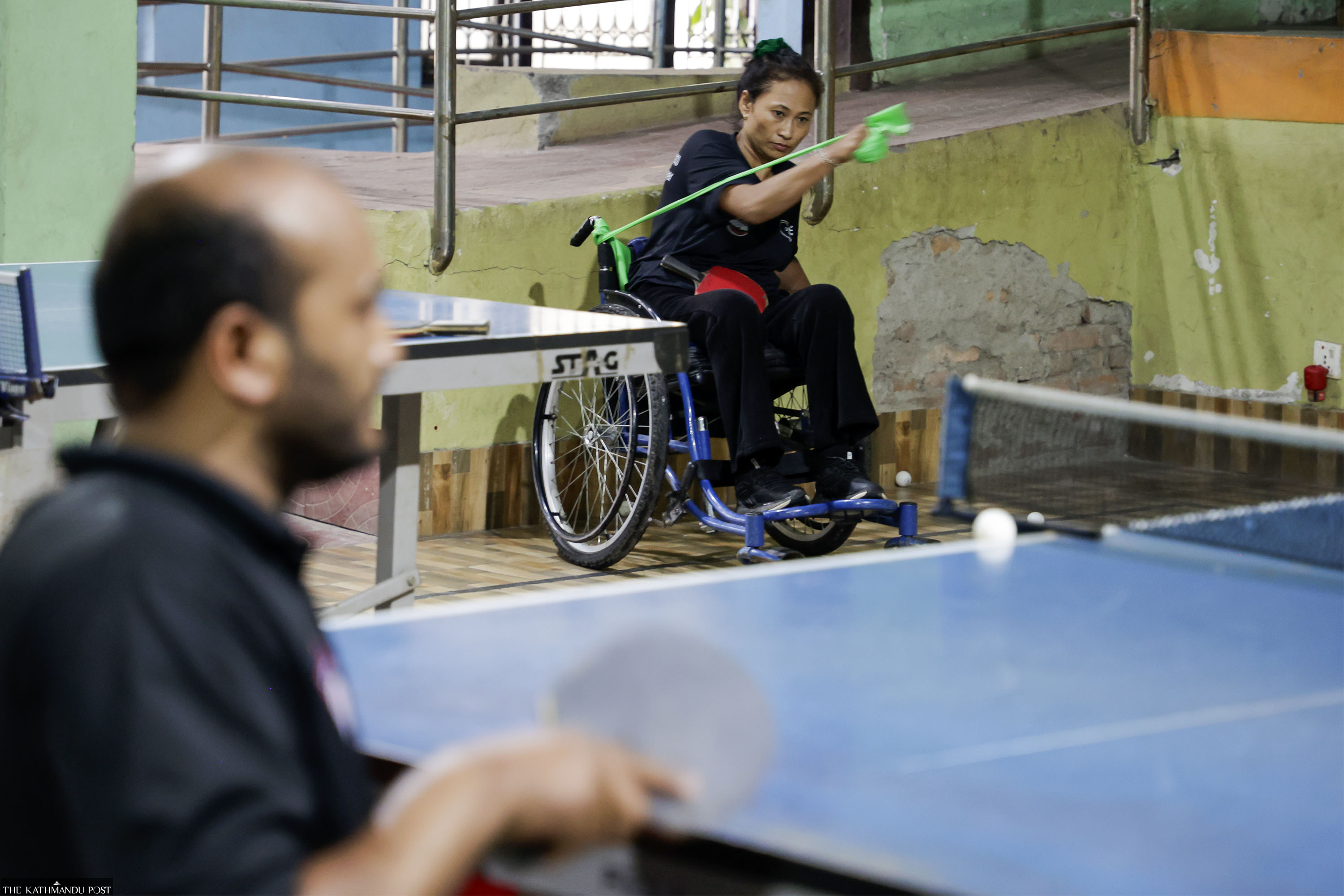
The players have had to finance much of their preparation themselves, navigating costly equipment, limited facilities and a system that offers little recognition for their achievements.Nepal’s para table tennis players train for the 5th Asian Para Games at the hall of Nepal Disabled Association’s Khagendra New Life Home in Jorpati, Kathmandu, on Thursday. Hemanta Shrestha/TKP
Every evening, a hall just inside the main gate of the Nepal Disabled Association’s Khagendra New Life Home in Jorpati, Kathmandu, hums with activity. Except on Saturdays, when the routine shifts to the morning, the space is filled with the rhythmic percussion of training—the sharp click of balls meeting rackets, their quick pop against the tables, and the clatter across the concrete floor whenever a shot is missed.
In the rare moments of silence, the rhythm of play gives way to quiet replenishment: athletes catching their breath or meticulously applying fresh rubber to their rackets with practiced hands.
They are expensive, echoed five para table tennis players training for the 5th Asian Para Games as they glued the rubber on Thursday. These are second-hand rubbers they brought from Japan by requesting the players there. They cannot afford new ones themselves.
In Nepal, a basic set of two rackets and three balls can be purchased for less than Rs500. But neither these budget options nor professional gear costing thousands more are standardised for the specific requirements of international competition.
“I recall being denied a racket that cost me thousands of rupees during a Paralympic qualification event,” said Keshav Thapa, who is currently preparing for his third Asian Para Games. A wheelchair user, Thapa has previously represented Nepal at the 2018 and 2022 Asian Para Games in Indonesia and China. “I ended up competing using a borrowed racket from another participant,” Thapa said.
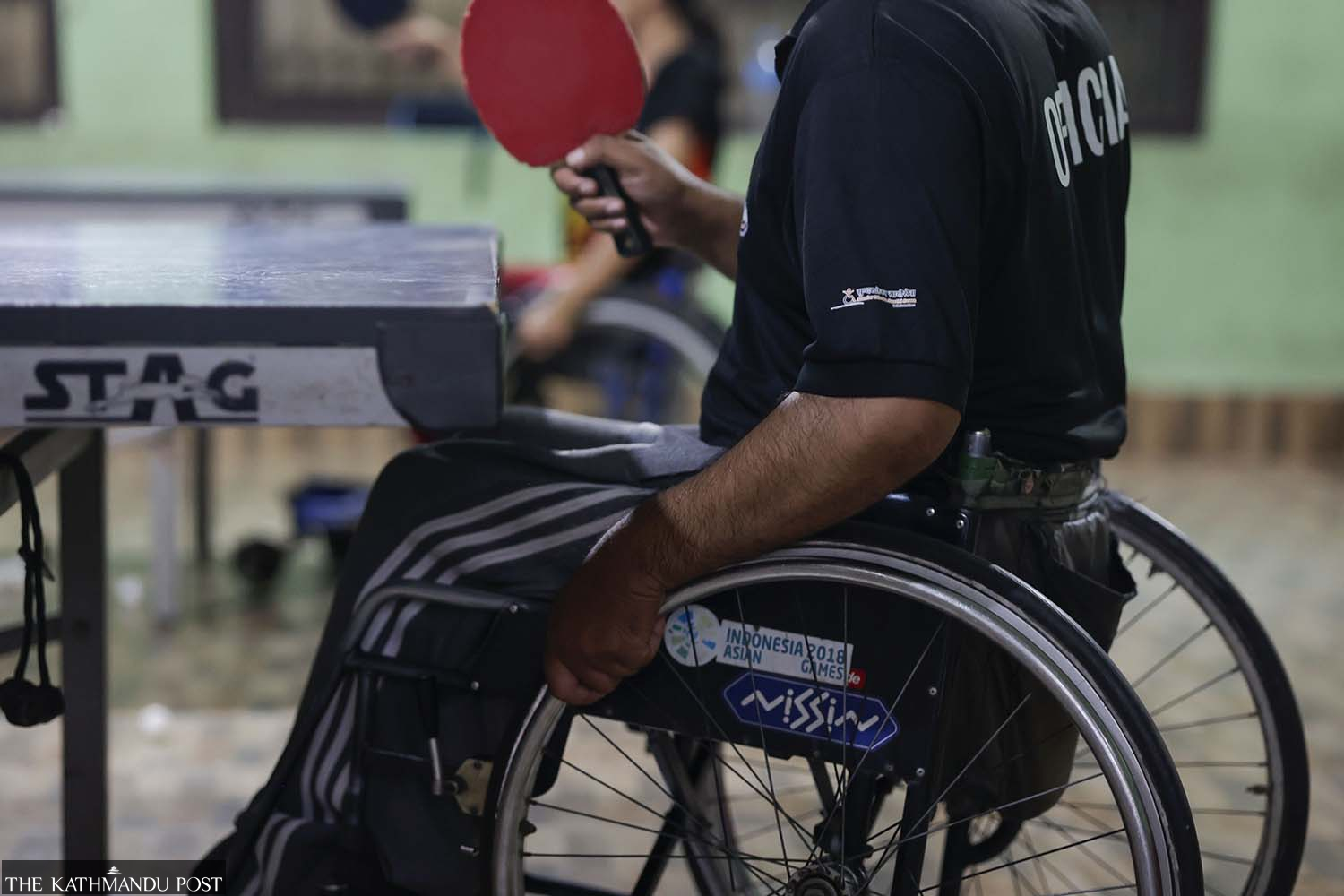
Para table tennis player Keshav Thapa trains for the 5th Asian Para Games on the same wheelchair he used during the 2018 Asian ParaGames in Indonesia. He will be representing Nepal at the Asian main event for the third consecutive edition in September in Japan. Hemanta Shrestha/TKP
Should athletes be paying out of pocket to represent their country at major international events like the Asian Para Games? While global sports standards demand robust state sponsorship, for Nepal’s para table tennis players, self-funding is a grim, routine reality. This systemic government neglect forces athletes to rely on second-hand rubbers sourced from Japan and borrowed rackets just to remain competitive. Despite their proven potential—exemplified by continental medals and unwavering dedication—these players must navigate a precarious landscape where empty pockets and state indifference stand in stark contrast to their resolve to bring home glory.
Nepal has participated in the Asian Para Games since its inaugural edition in Gwangzhou, China, in 2010. But the country sent athletes for table tennis at the Games only from the second edition in South Korea in 2014. Hira Niraula and Ram Prasad Kharel represented Nepal in table tennis then.
At the 2018 Asian Para Games in Jakarta, Indonesia, four table tennis players—Thapa, Sonika Dhakal, Lek Bahadur KC and Raikosha Shahi—represented Nepal.
KC has not played of late, while Shahi is currently the treasurer at the National Physical Disabled Table Tennis Association (NPDTTA). Shahi reaches the hall in Jorpati to manage the boards and other equipment before any players arrive for training. Thapa and Dhakal, meanwhile, are still competing.
On Thursday, Dhakal was the first to arrive at the training hall. She greeted Shahi as soon as she saw her, pushing the rims of her wheelchair. Dhakal had travelled a long way to get here, from Sanga in Bhaktapur, over 20 kilometres away, where she works as a peer counsellor at the Spinal Injury Rehabilitation Centre. “The bus picks me up at 6:55am and drops me off at around 5pm, the time when my training commences,” she said, as she entered the hall and started stretching her arms with the second-hand rubber bands brought from Japan.
Dhakal, who is 42, is training for her fourth participation at the Asian Para Games. She was one of the first Nepali athletes to participate at the Asian Para Games in China in 2010. But Dhakal was then a para swimmer.
“I found swimming expensive,” Dhakal said with a laugh. She was in for a rude shock when she found out table tennis was not a cheap sport either, she said.
After shifting to table tennis, Dhakal has represented Nepal in the sport at the Asian Para Games in South Korea and Indonesia. “I did not participate in the previous edition in China in 2023 as I could not afford it,” Dhakal lamented.
Alongside Thapa and Dhakal, five other para table tennis players are aiming to represent Nepal in Japan. All of them have played for the country at international tournaments in the past—out of their pockets.
“We have made up our minds to spend the required amount ourselves this time as well,” said Digam Sing Chemjong, one among the seven para table tennis players aiming to represent Nepal in Japan.
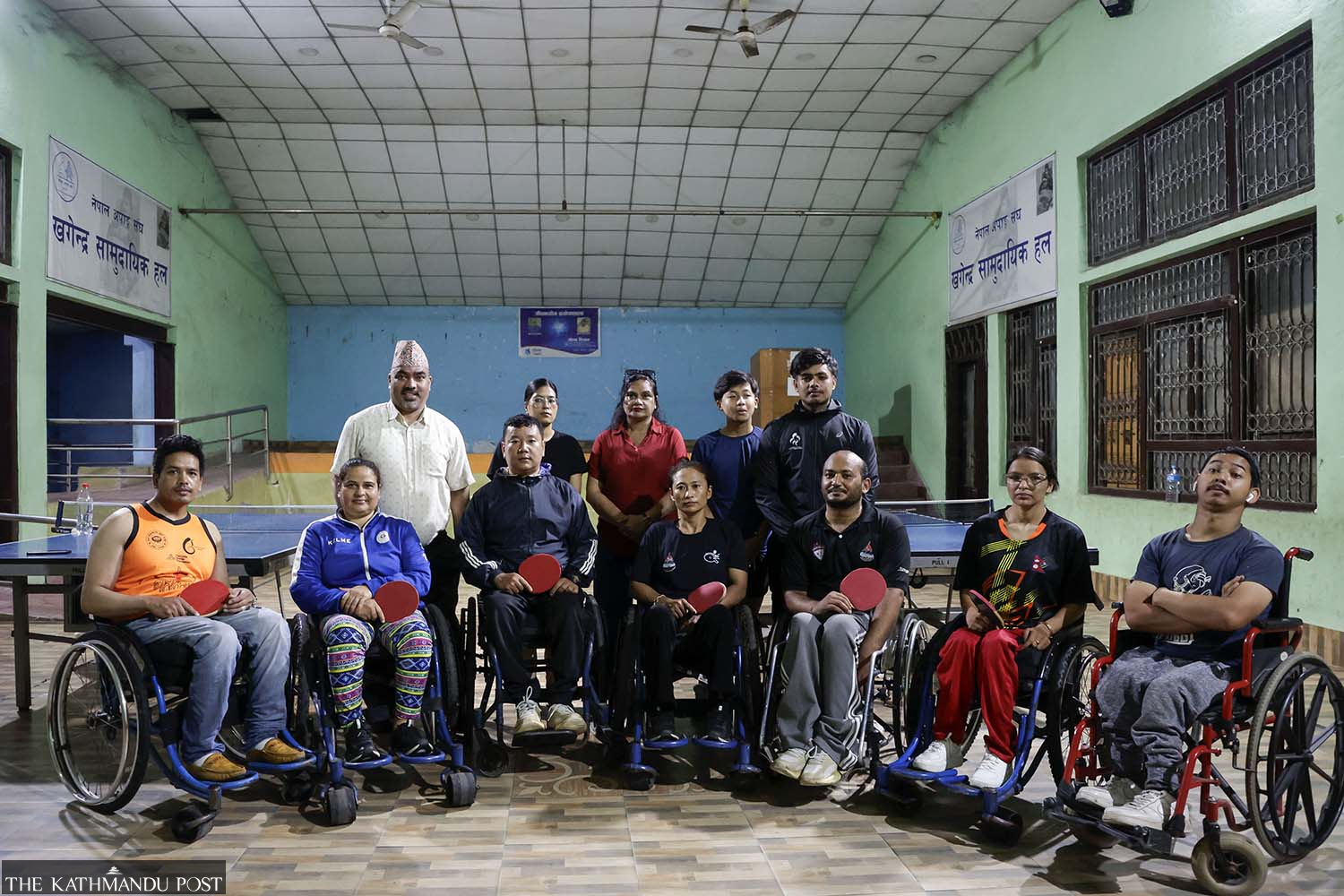
Five of the seven para table tennis players who will be representing Nepal at the 5th Asian Para Games pose with volunteer coach Basanta Bharati and aspiring players alongside officials of the National Physical Disabled Table Tennis Association during a self-funded training camp at the hall of Nepal Disabled Association’s Khagendra New Life Home in Jorpati, Kathmandu, on Thursday. Hemanta Shrestha/TKP
Chemjong was one of the two para swimmers, alongside Dhakal, from Nepal at the 2010 Asian Para Games. He then also led the national wheelchair cricket team as its captain. It was during his captainship that Nepal won their first tri-series in 2017 by defeating India and Bangladesh at the TU Ground.
“In the end, I found solace in table tennis,” Chemjong said. “My biggest reason to take up sports is to win medals and trophies for the country. Though the state has neglected us, we have not stopped loving our country.”
The government has allocated Rs3.5 million for the country’s participation at the Asian Para Games in Japan. There are expected to be at least three dozen athletes across around a dozen sports from Nepal. And the budget allocated does not even cover a one-way fare for these athletes, let alone coaches and officials required to support these athletes with disabilities.
Chemjong, who also visits the National Table Tennis Training Centre in Lainchaur during the mornings, said he had to wait for three days in his wheelchair—with a bat in his hands—to be called to play by able-bodied athletes.
“Can you even play table tennis in a wheelchair? Can you play these strokes? These are the questions I faced at the beginning in Lainchaur around three months ago,” Chemjong said. “But once I got a chance to play, many were shocked. Now, they call me to play with them.”
Chemjong said that there is not much difference between table tennis players on a wheelchair and those who are physically able. “All you need is the hunger to give your best,” he added.
Alongside Thapa, Dhakal and Chemjong, Lali Tamang and Bibek Rai are also aiming for another shot at a table tennis medal at the Asian Para Games.
Rai, who works at Dharan Sub-metropolitan City and trains locally, had participated in Hangzhou, China, in 2023. Tamang, who currently works at the Vocational Opportunity for Inclusion to Community and Employment (VOICE) project run by Spinal Injury Sangh Nepal (SISN), represented Nepal in the previous Asian Para Games as well.
While the 2023 event was Rai’s first participation at the Asian main event, Tamang was a wheelchair runner at the 2018 Asian Para Games in Indonesia.
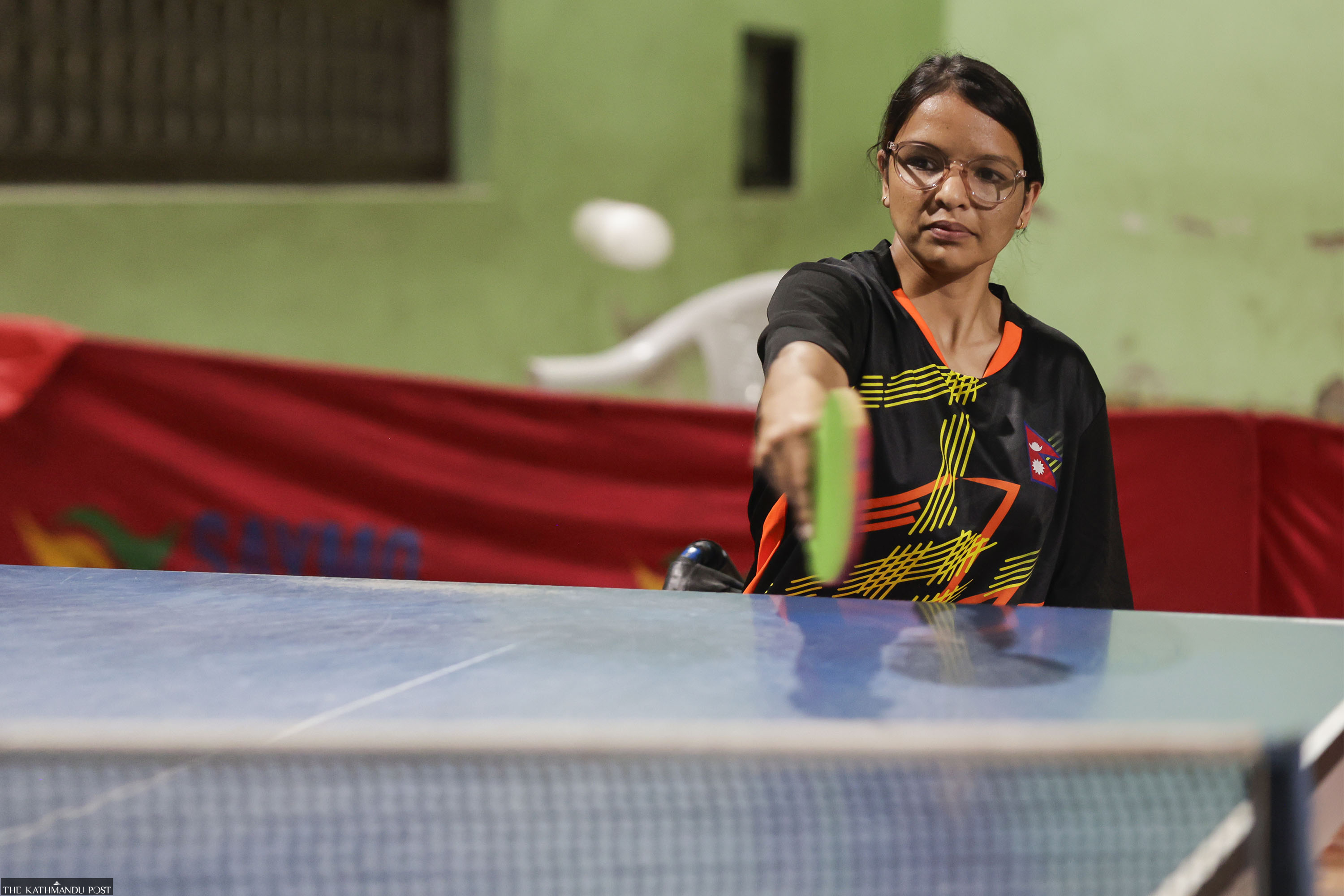
Nirmala Bhandari trains in Jorpati. Hemanta Shrestha/TKP
“I left athletics after I got to see the difference between foreign para athletes and us in Indonesia,” Tamang said. “They had quality wheelchairs. When I asked how much it cost, the answer was over Rs1 million. Then, I decided to shift to table tennis believing it would be cheaper and better.”
But the lack of support from the state has made table tennis an expensive game, too.
“I want to win medals for the country and motivate many others like us to come outside and challenge the world,” Tamang said. “I do not care if I have to invest in it myself.”
And it is the same reason why emerging table tennis players have also decided to continue the sport.
For Nirmala Bhandari, 23, for instance, it has not been long since she started playing table tennis. After just a couple of months of training, she represented Nepal at the 2025 Asian Youth Para Games in Dubai.
After she arrived at the training hall in Jorpati on Thursday evening, riding her scooter for around an hour from Lalitpur, Bhandari said that she was highly motivated after seeing many athletes like her leaving their mark at the Asian Youth Para Games.
“When I asked those foreign athletes about the support they received back home, I felt jealous,” Bhandari said. “From receiving training at the places that were near and accessible to being provided with other necessary equipment, they have all the support. Back in our country, even finding an accessible training area is a herculean task.”
However, Bhandari, who spent handsomely while travelling to Dubai, does not want to quit anytime soon.
“I will continue playing table tennis until I can,” said Bhandari, who is currently pursuing her Master’s degree in Journalism. “I do not care if I have to spend all the hard-earned money on this sport and try winning medals for the country.”
So are these athletes ready to take on the world? The response from their volunteer coach Basanta Bharati is an emphatic yes.
“I am fully confident that these players can challenge the best in the world,” Bharati told the Post. “They might not win, but they are not easy to beat… The fire in them burns very bright. But they need more support from the state.”
Bharati adds he is quite optimistic about his players winning medals in Japan.
“These players are training very hard,” Bharati said as he showed hand-weight bands that weighed from half a kilo to a kilogram that were worn by the players to improve their strokes. “For instance, let’s see Swikrit Neupane. He already won a silver medal at the Asian Youth Para Games in Dubai last year.”
Digam Singh Chemjong plays a shot. Hemanta Shrestha/TKP
Neupane is currently training in his hometown of Biratnagar. “I have my examinations underway and could not be in Kathmandu for training,” Neupane, who is pursuing a Bachelor in Computer Application, told the Post over a phone call.
Rai and Neupane are two players who do not play in a wheelchair. They both fall in Class 7.
Wheelchair table tennis players fall under Classes 1-5 while those with physical impairment and who play while standing fall under Classes 6-10. There is also Class 11 for athletes with an intellectual impairment.
Neupane, who ranks 357th in the world among standing men’s singles, has been playing table tennis for over a decade. He dedicates his table tennis journey to coach Biken Thapa, who operates Stellar Table Tennis Training Centre in Biratnagar. “After my family’s support, it was coach Biken who trusted in me,” he said.
Even Chemjong has praised Thapa’s training centre as one of the best in Eastern Nepal. “I have trained and played there many times,” Chemjong said. “The most beautiful thing is that the centre is wheelchair-friendly. And coach Biken is very experienced.”
Neupane, 22, sees a good future in table tennis. “My family was very happy when I won silver last year, though I had to spend a good amount of money for travel and accommodation, among others,” he said. “I even got honoured by the provincial and local authorities. The whole community praised me. It was a great moment.”
Neupane’s medal-winning journey further exposes the state's systemic neglect of para athletes. While the Sports Development Guidelines, 2079, reserve cash incentives exclusively for Paralympic medalists, the government offers no such recognition for success in the Asian Youth Para Games or Asian Para Games. Yet, despite years of official indifference, the para table tennis squad remains driven by a singular, defiant purpose: to bring home medals for Nepal.
Thapa, the athlete, however, lamented that they do not even have a proper wheelchair. “We use the ones that are available and have come through someone’s support,” he said. “We need a sports wheelchair, which is extremely expensive.”
Citing Palesha Goverdhan’s historic medal in Paris 2024, Thapa said he believes para athletes will soon get the state’s attention again. “It shall start from the Asian Para Games in Japan,” he said. “We will give our best to win medals for the country.”
Nayak Paudel covers sports for The Kathmandu Post. He previously worked at the Post (2018–19) and spent over five years at The Rising Nepal. His reporting spans crime, health, education, and social issues.




 22.92°C Kathmandu