Nepal’s para athletes are chasing medals with little more than hope and donations
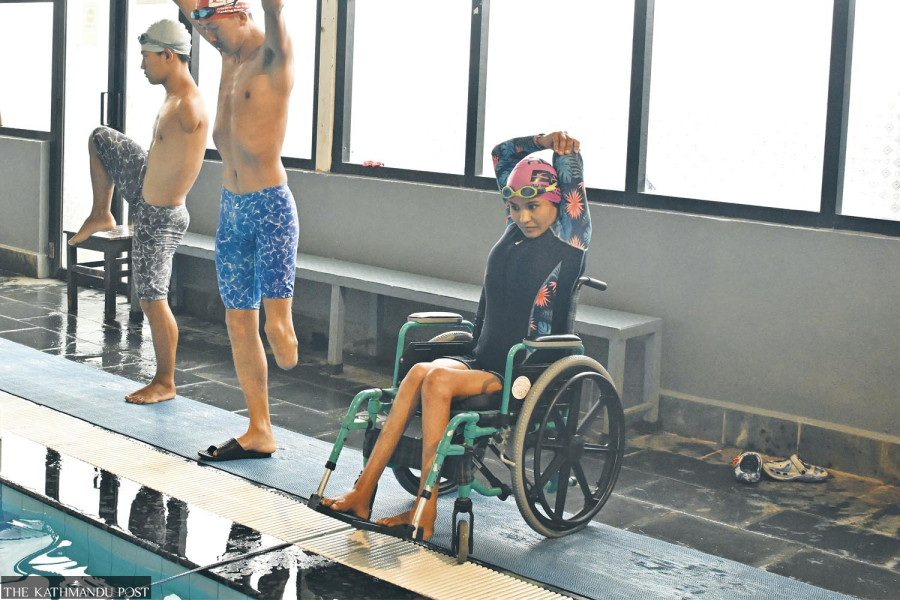
With government support falling far short of actual costs, athletes and associations are relying on personal contributions to prepare for the Asian Para Games. Three of the four Nepali para swimmers participating in the Asian Para Games in Japan warm up before their training session in Bauddha, Kathmandu, on July 24. Post Photo
Should para-athletes and para-sports receive the same level of investment and opportunity as their able-bodied counterparts? While much of the global sporting community increasingly answers with a resounding “yes,” Nepal remains a glaring exception.
“Today, the Paralympic Games are the world’s third biggest sports event in terms of ticket sales; only the Olympic Games and the FIFA World Cup sell more,” writes olympics.com. “Since the Salt Lake City 2002 Games, one organising committee has been responsible for hosting both the Olympic and the Paralympic Games. Athletes from both Games live in the same village and enjoy the same catering services, medical care and facilities.”
Nepal has not won a single medal at the Olympics, despite participating in 15 editions since the country’s first participation at the 1964 Tokyo Olympics. Regarding the Paralympics, which started in Rome in 1960, Nepal first participated in the 2004 edition in Athens, Greece, and bagged its first Paralympics medal in the previous edition in Paris, France, in 2024.
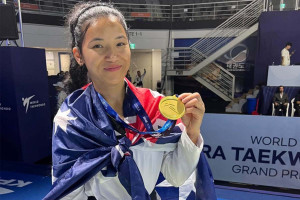
When para taekwondoin Palesha Goverdhan landed at the Tribhuvan International Airport with the bronze medal, she got a hero’s welcome. She boarded a four-wheeler with a trunk and was taken to the National Sports Council with a rally.
Ironically, the ones who accompanied Goverdhan in the front row of the trunk were Teju Lal Chaudhary, the then Minister for Youth and Sports, and Tanka Lal Ghising, the then member secretary at the National Sports Council. Chaudhary and Ghising were then the heads of two of the biggest sports authorities of the country that had given zero rupees for Goverdhan’s training.
Goverdhan’s life changed after the bronze medal. She got cash prizes from the state and several business houses. She felt that she was well recognised for clinching the historic medal for the country. Yet, the state has failed to provide the sustained investment needed for her to turn that bronze into gold at the 5th Asian Para Games this October and the Los Angeles 2028 Paralympics.
Goverdhan had also bagged a bronze medal at the 4th Asian Para Games in China in 2022, becoming the first Nepali to win a medal at the Asian main event.
“Para taekwondoins were given up to Rs600 a day until the end of the fiscal year 2025/26 to train for the upcoming Para Asian Games as part of the government’s Mission 26. But it was not regular,” said Kabiraj Negi Lama, Goverdhan’s coach who has still been working voluntarily despite helping Nepal win over a dozen international medals in para taekwondo in over a decade.
And while even the hero of the country like Goverdhan has not received sufficient support from the state, one can imagine the situation of other para athletes, especially those aiming to win medals for the country at the Asian Para Games in Japan’s Aichi-Nagoya, from October 18 to 24.
The tournament will feature 18 sports and expects participation from 3,600 to 4,000 players and team officials from 45 nations and regions across Asia. From Nepal, 35 para athletes have been confirmed to be participating in 10 sports—para athletics, para badminton, boccia, para judo, para powerlifting, shooting para sports, para swimming, para taekwondo, para table tennis and wheelchair tennis—to date.
And the government has allocated Rs3.5 million for the 35 para athletes to participate in Japan. It means one para athlete received Rs100,000 on average, which is not even the one-way ticket price to Japan.
“The one-way ticket price to Japan has reached up to Rs150,000 per person. And it is only increasing,” Radha Ghale, president of the National Paralympic Committee, told the Post. “We are currently searching for funds from friends, association members and corporate houses as the government’s current budget is nowhere close to covering our expenses.”
Further, the participants need to pay USD50 each per day as the registration fee during their time in the tournament.
“Iit is not only about athletes. We need to take coaches and team officials as para athletes need utmost care and support,” Ghale added. “Some of our athletes do not have limbs. Some are suffering from spinal cord injuries, so their body parts below the waist do not work. They need officials to help change their clothes and assist them in restrooms.”
According to Ghale, they plan to send 29 coaches and officials alongside 35 athletes to the Asian Para Games. “You can calculate the cost that is required and how much the government’s Rs3.5 million will cover,” she added.
If we look at the government’s budget for the Asian Games, which will see participation from 128 able-bodied athletes across 22 sports, it is Rs112 million. The government, through the NSC, had also been given Rs28 million for Mission 26, an ambitious plan to win double-digit medals with at least one gold—which has never happened before in Nepal’s history.
But Mission 26 could never accommodate para athletes. Para taekwondo got some money, while other para sports also did, but it was only to utilise the budget that got unspent after being utilised for abled-bodied athletes.
Mission 26 saw an end with the end of the fiscal year 2025/2026. Now, the NSC has started sending athletes qualified for the Asian Games abroad for training as well.
“Currently, we have intensified training for the Asian Games’ athletes. With the start of the fiscal year 2026/2027, we have started providing Rs1,200 per day to the athletes of 22 sports,” informed Deepak Bista, a two-time Asian Games bronze medallist who is currently the head of National Team Preparation under the NSC and looks after Mission 26.
When the Post inquired with the NSC about the reason behind the minimal budget for para athletes, the governing body of Nepali sports cited a lack of money within the government itself.
“We all know that the government does not have sufficient money and resources to fund the athletes completely,” said Khushraj Dahal, spokesperson at NSC. “It is why para athletes did not get enough budget for training and their participation in the Asian Para Games. It is the budget provisioned in the Red Book.”
So, how have the para sports associations been funding regular training of their athletes?
“We have been collecting funds from board members and have sought help from corporate houses to fund their training to date. We have been doing so since 2004,” said Om Nath Siwakoti, chairperson of Para Athletics Association of Nepal. “We have eight athletes participating in the Asian Para Games. Three have been training in Nepali Army’s premises in Sanobharyang, four train in Dasharath Stadium and one is training in Pokhara.”
Siwakoti stresses that his para athletes could bring home a couple of medals. “And we hope that the NSC and the government will provide some more budget in the upcoming days.”
Likewise, seven para athletes will represent Nepal in para table tennis.
“We have been given a hall at the Jorpati-based Nepal Disabled Association’s building. Five of our seven players are training there,” said Ganesh KC, president of National Physical Disabled Table Tennis Association of Nepal. “Swikrit Neupane and Bibek Rai are training in their hometown of Biratnagar and Dharan, respectively.”
Neupane, whose undergraduate exams are underway now, had clinched a silver medal at the Asian Youth Para Games in the UAE last year, and he has been training with the Biratnagar-based coach Biken Thapa. Rai works at Dharan Sub-metropolitan City and trains by himself.
KC revealed that the NSC has provided absolutely no funding for their Asian Para Games preparations. “We are entirely on our own,” he said. “Through personal contributions and sheer determination, we manage to provide the athletes with even their most basic dietary needs during training.”
So, why are these associations and their members spending money from their own pockets?
“It is because of the athletes like them,” said Saroj Shrestha, president of Nepal Para Swimming Association, when the Post reached their training in Boudha last week. Four para swimmers are participating in the Asian event.
Shrestha said so after Harka Man Gharti, who lost both his arms after getting electrocuted from an unfenced hydropower project in Baglung while he was a child, said, “I have told our association officials that ‘If I am going, that’s for bringing the medal’.”
Nayak Paudel covers sports for The Kathmandu Post. He previously worked at the Post (2018–19) and spent over five years at The Rising Nepal. His reporting spans crime, health, education, and social issues.




 27.12°C Kathmandu