



 14.69°C Kathmandu

Sat, Oct 24, 2026
Sports
How Nepali para-swimmers are turning tragic negligence into a shot at Asian Para Games glory
Robbed of limbs and mobility by public negligence and ignored by state bodies, Nepali para-swimmers find liberation and elite purpose in the water as they set their sights on Japan.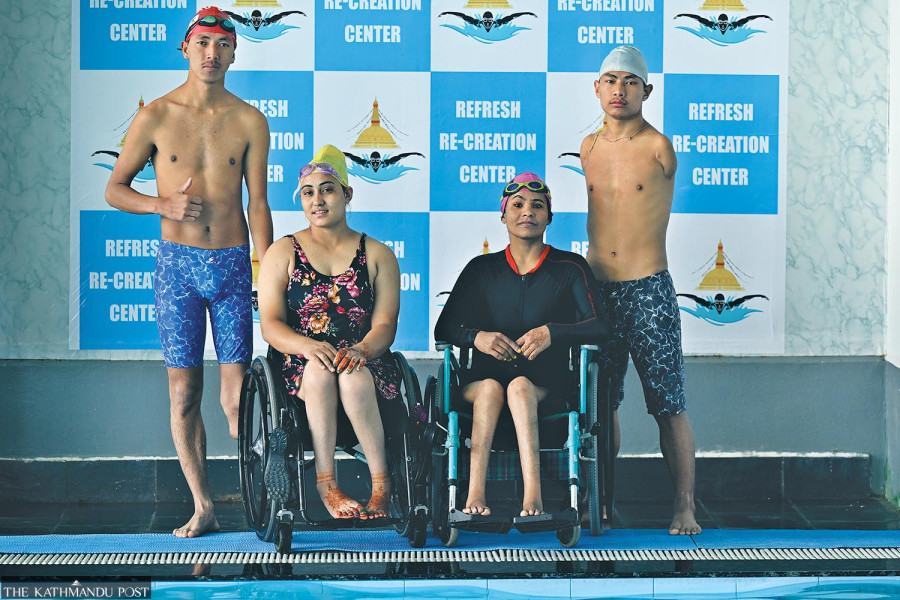
bookmark![]()
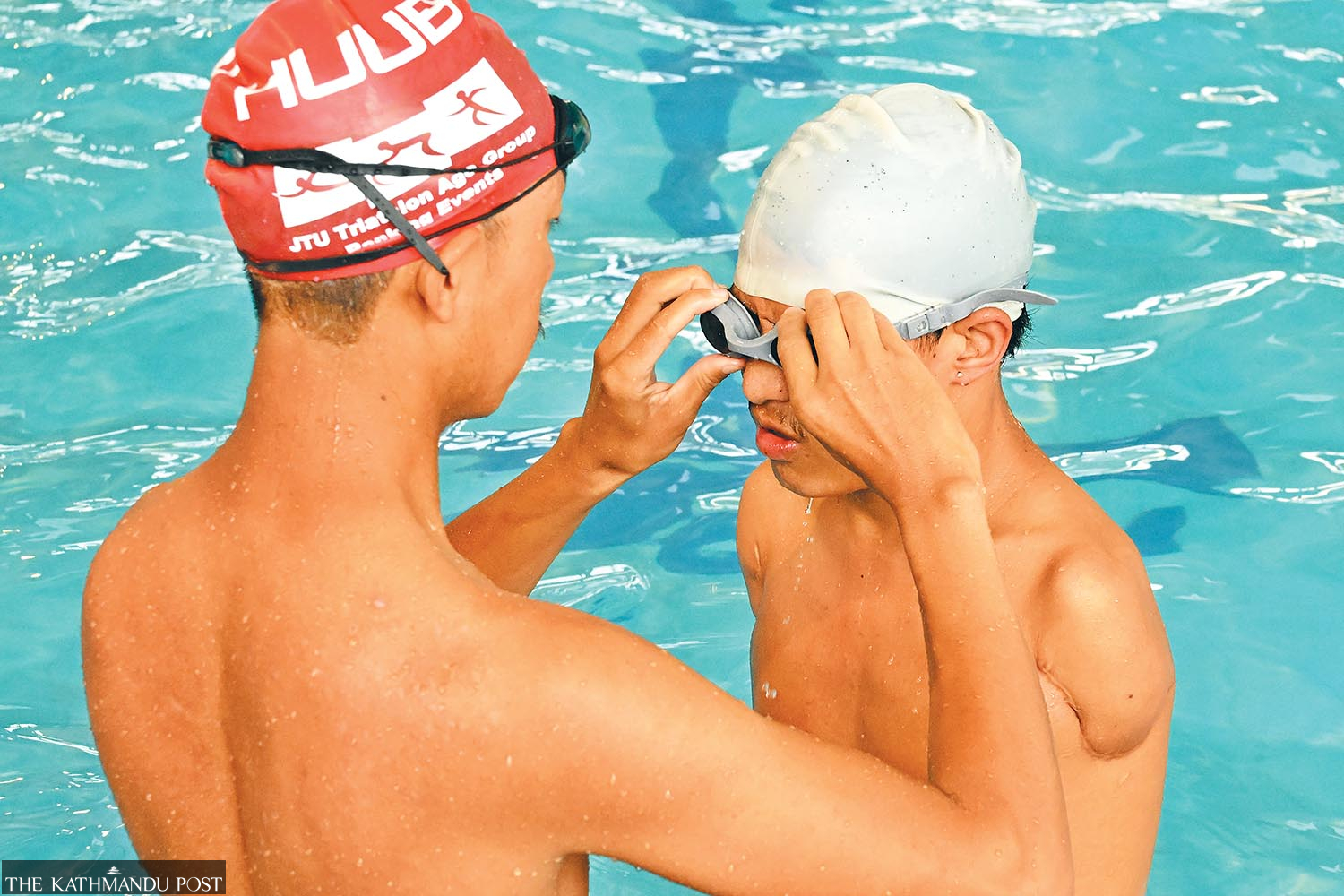
Member Singi Syangba (left) helps Harka Man Gharti adjust his glasses at the Refresh Recreation Centre in Bauddha on Friday.
Nayak Paudel
Published at : July 25, 2026
Updated at : July 25, 2026 08:05
Kathmandu
What are the basics of swimming? Hands and legs maybe.
But when Jenisha Kadayat, Harka Man Gharti and Member Singi Syangba stood at the edge of the pool at the Refresh Recreation Centre in Bauddha on Friday morning, they lacked what most would consider the bare basics.
Kadayat warmed up from her wheelchair, her body immobile below the waist due to a spinal cord injury. Gharti, who has no arms, stretched his legs and torso, while Syangba—his left leg amputated below the knee—hopped on one foot to maintain his balance as he went through his warm-up routine.
As the trio waited for coach Subha Shrestha’s whistle, Kadayat was already afloat in the lane since she could not stand, while able-bodied swimmers nearby and gym-goers on the floor above, who saw the trio for the first time, watched in amazement: How can they swim?
But the moment the whistle blew for a 100-metre swim, their doubts evaporated. Gharti and Syangba sliced into the water with sharp dives, while Kadayat propelled herself forward, her stroke clean and powerful. They weren’t just swimming; they were executing laps like professionals along the 25-metre-long pool.
The trio was training for the fifth edition of the Asian Para Games, scheduled for October in Japan.
“We have four swimmers preparing to represent the country,” said Saroj Shrestha, president of the Nepal Para Swimming Association. “Srijana Sarki is our fourth, though she missed today’s session.”
The squad has been training at the Boudha facility for about five months—a location chosen largely out of necessity.
“Finding an accessible pool for para-athletes is exceptionally hard,” Shrestha explained. “The swimming complex in Satdobato is simply too far for them to commute regularly. We are deeply grateful to this centre for giving us pool access at a heavy discount.”
Except on weekends, their one-hour training session kicks off precisely at 7:30am.
Getting there is quite a for these swimmers. Kadayat, who lives in a hostel in Jorpati, arrives on a scooter retrofitted with auxiliary support wheels to navigate the Kathmandu traffic. Gharti and Syangba, who walks with a prosthetic leg, arrive on foot, as they live within a ten-minute walk from the venue.
But their journey to this pool started much further away—and in ways none could have anticipated.
Injured by someone else’s negligence
Kadayat was riding her bicycle home in Kailali’s Gauriganga Municipality, her mind drifting through ordinary thoughts. Then, in a split second, a tree crashed down on her, altering her life forever.
“It was on November 2, 2013,” recalls Kadayat, now 26. The date is etched in her memory. “Some people were chopping down a tree. There were no warning signs to alert passersby, and no one standing by to tell people to stop. The tree fell on top of me. The next thing I knew was that I had lost all movement in the lower half of my body from a spinal cord injury.”
A couple of years later, around the time of the devastating April 2015 earthquake, Gharti’s life took another tragic turn.
“I was just a kid back then,” recalls the 21-year-old native of Baglung. “We used to play and herd cattle near an under-construction hydropower site. One day I grabbed an insulator—something I had touched many times before—without knowing the power had been switched on. I was severely electrocuted. There was no fencing, no warning signs, nothing to keep us away.”
Syangba, on the other hand, was working in the transport sector at the Kerung border crossing between Nepal and China in Rasuwa district. The year was 2017.
“I was standing beside our truck on the side of the road when another truck hit me,” Syangba shared. “My left leg was crushed so badly that it had to be amputated below the knee. Because the accident happened right in the border zone, no authorities on either side ever filed a case or initiated legal proceedings.”
Without any legal accountability, none of the three received compensation from those responsible for their accidents. Saroj Shrestha, president of the Nepal Para Swimming Association, noted that their journey from injury to elite training was borne entirely out of personal endurance.
“None of the trio received any financial support from the authorities and covered their treatment on their own,” Saroj said. “They lost their abilities, but have dedicated themselves to a bigger goal. We are glad they took up a sport and decided to make their name as they still have a lot of fire in them.”
Swimming changed their lives
“When I first lost mobility, people around me said I would have been better off dead. At my lowest, I even tried to take my life a couple of times,” Kadayat said, with a subtle grin as she recounted a struggle she had overcome. “When I told my family and neighbours that I wanted to become a swimmer, they were simply shocked.”
Their concern wasn’t entirely misplaced. Even before her accident, Kadayat had nearly drowned a few times as a child and never knew how to swim.
“I finally took the plunge about nine years ago,” she recalled. “And ever since, the pool has been my solace. I feel completely normal the moment I enter one.”
Kadayat also argued that swimming has improved her physical and mental health. “I feel strong mentally. While swimming, my legs mobilise in the water; it improves blood circulation,” she adds.
Syangba had travelled to Kathmandu for a prosthetic leg when a doctor suggested he try swimming.
“In water, I found a renewed purpose,” he said. “It gave me a reason to push for more in life.”
Gharti, meanwhile, has lived in Kathmandu ever since losing his arms—moving to the Capital to access both specialised medical care and accessible education.
“I went to a pool with a group of friends from my hostel, and they urged me to give it a shot,” Gharti recalled. “That was about seven years ago. Today, swimming is an integral part of my life.”
Beyond athletic performance, all three emphasise that swimming restored their self-respect and mental drive. That confidence extends past the pool deck: all three are actively pursuing higher education.
Kadayat is currently in the third semester of the Master in Public Administration at Jana Prasashan Campus in Balkhu. Syangba recently earned his Bachelor’s in Education from Kalika Himalaya Campus in Rasuwa. Gharti, having just completed high school, plans to study computer science.
“I can operate a computer or laptop using my toes,” Gharti said, effortlessly lifting his foot to demonstrate how his toes manoeuvre across a keyboard.
No state support for para swimmers
Syangba moved to Kathmandu five months ago specifically to prepare for the Asian Para Games. Back home in Rasuwa, consistent training is impossible.
“There is an outdoor pool near my home, but without heating, I can’t use it,” Syangba explained. “Because of my amputation, my body doesn’t tolerate cold water.”
Even the Capital has a dearth of temperature-controlled facilities.
“Not every swimming facility is welcoming or accessible for athletes with disabilities,” said coach Subha. “Cold water is a major health issue for them. Here in Boudha, the indoor pool stays around 26-27 degrees Celcius. Even so, they cannot manage to train throughout the week.”
Despite these persistent obstacles, the trio has consistently found ways to adapt and excel.
They are also no strangers to the international stage. It was their standout performance at the Para Swimming World Series in Japan last year that punched their tickets to the Asian Para Games.
“All three completed their races under the required minimum qualifying times,” said Saroj, who rarely misses a morning training session. “They are aiming for major results on the continent’s biggest stage, all while operating with no state resources.”
Even now, the Para Swimming Association relies almost entirely on private goodwill to keep the lights on and the pool access paid for.
“There is zero support from the government. We survive on contributions from well-wishers,” Shrestha added. “If we could secure stable financial backing to properly resource their training, I firmly believe our swimmers could compete with the very best in the world.”
But the swimmers insist that state neglect will not hold them back when they step onto the block in Japan.
“It isn’t just para-athletes who are neglected in Nepali sports. Almost every athlete faces this,” the trio conferred. “In a situation like this, proving what we can do with actual results on the international stage will make our success feel sweeter.”
Gharti stressed that he was not going to Japan merely to attend the Asian event. “I told our association officials … ‘If I am going, that’s for bringing the medal’,” Gharti told the Post with a wink of determination.
At the Asian Para Games, Kadayat, Gharti, Syangba and Sarki will be competing in the 50-metre and 100-metre freestyle categories. Besides, Gharti is competing in the 50-metre butterfly event as well.
Kadayat falls in the S6 category while Gharti is in S5 and Syangba in S10. “Srijana’s classification is yet to arrive. But she is also suffering from spinal cord injury and is most likely to compete in the S6 category,” said Saroj Shrestha.
And with determination to do better the next day, the trio left the pool for home. Syangba and Gharti said they would have rest for a while, while Kadayat rushed to the hostel, where she’d have her lunch and then ride to Banasthali—to the Rastriya Swatantra Party office. She has been working as a receptionist for around three years.
Nayak Paudel
Nayak Paudel covers sports for The Kathmandu Post. He previously worked at the Post (2018–19) and spent over five years at The Rising Nepal. His reporting spans crime, health, education, and social issues.



Most Read from Sports
Editor's Picks





E-PAPER | October 24, 2026

×