Questions unanswered as Sudan Gurung returns to home ministry
Human rights officials expect no impartial investigation into their recommendations when the individual under scrutiny helms the ministry responsible for carrying it out.Ministers Sudan Gurung and Mahabir Pun take their oaths of office on Tuesday. Dipesh Darshandhari/TKP
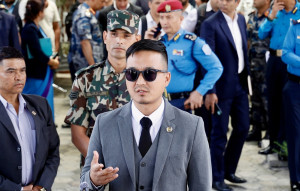
When Rastriya Swatantra Party lawmaker Sudan Gurung walked out of the home ministry on April 22, he framed his resignation as a test of the political culture he had promised to build and as a step towards ensuring an impartial investigation into allegations surrounding his controversial dealings.
Less than two months later, he returned to the position on Tuesday without the government even making the investigation report public. Instead, the National Human Rights Commission has recommended an investigation against him saying last September’s Gen Z protest turned violent after Gurung took leadership of the protest, raising further questions about accountability.
Prime Minister Balendra Shah placed him in the position for the second time, three days after a panel led by former high court judge Achyut Prasad Bhandari submitted the probe report with the finding: “there was no basis to conclude that the source of the assets was suspicious”. Joining the Shah Cabinet alongside Gurung is independent lawmaker Mahabir Pun, who will helm the newly created Ministry of Science, Technology and Innovation.
Before selecting Gurung, the Cabinet decided on Tuesday itself to accept the report by the Bhandari committee. However, it neither made the report public nor announced the date to publish it.
“I know the report was submitted on Friday and he [Gurung] has become minister today [Tuesday],” Dipa Dahal, press and investigation expert to the prime minister, told Kantipur. “I have no additional information.”
Officials at the constitutional human rights watchdog expect no impartial investigation into their recommendations when the individual facing scrutiny heads the ministry responsible for carrying it out.
“How can we expect a fair investigation when the person recommended for investigation is leading the ministry responsible for it?” Lily Thapa, an NHRC member who led the investigation, told Kantipur.
She said a similar pattern was observed in cases related to the Maoist conflict. When individuals facing allegations were appointed to government positions, it prevented investigation from reaching their logical conclusion.
“This trend could be repeated,” she said.
Soon after assuming office, Gurung announced a series of decisions aimed at strengthening criminal investigations. He said the Nepal Police’s Central Investigation Bureau would be further strengthened and made more effective, adding that “every file will be opened”.
He directed investigators to expedite pending cases and announced plans to establish specialised units within the bureau to handle serious crimes, organised crime and financial offences. He also instructed officials to move ahead with an investigation into the 2001 royal massacre.
The June 1, 2001 palace massacre claimed the lives of King Birendra Bir Bikram Shah Dev, Queen Aishwarya, Crown Prince Dipendra and several other members of the royal family. The tragedy put Gyanendra Shah on the throne.
Gurung also announced plans to form a special task force to study whether criminal cases filed in connection with incidents linked to the Gen Z movement could be withdrawn.
In addition, he directed the formation of a Sensitive Information Vigilance Team (SIVT) within the security apparatus to monitor and prevent leaks of confidential information from the home ministry and security agencies.
A prominent figure to emerge from the Gen Z movement, Gurung first assumed office as home minister on March 27.
On his first day in office, he directed police to arrest former prime minister KP Sharma Oli and former home minister Ramesh Lekhak in connection with recommendations made by a commission investigating the September incidents.
The directive was issued shortly after Gurung met Nepal Police Inspector General Dan Bahadur Karki and then-Armed Police Force Inspector General Raju Aryal.
The arrests were based on recommendations by a commission led by former judge Gauri Bahadur Karki. Ironically, Aryal himself had been recommended for criminal investigation by the same commission. The Cabinet later decided to form a separate inquiry panel to investigate security personnel implicated in the incidents.
Gurung stayed at the Police Headquarters until Oli and Lekhak were arrested in the early hours of the following morning.
Although his first tenure lasted only 26 days, Gurung quickly became one of the most visible ministers in the Shah administration.
He carried out frequent inspections of police units, visited victims of political violence and attracted public attention through an active social media presence. He also made headlines after posting photographs of himself sleeping overnight at the ministry.
Gurung regularly publicised details of ongoing investigations on social media. When former minister Deepak Khadka was arrested on money laundering charges, Gurung shared a copy of the arrest warrant from his personal Facebook account, prompting questions about the appropriateness of such disclosures by a sitting home minister.
Security analyst Indra Adhikari believes Gurung’s return reflects the prime minister’s confidence in him.
The home ministry remained under the prime minister for months before Gurung’s return, she told Kantipur. “That suggests Shah considered him the preferred candidate for the post. Statements made by Gurung and his associates during the investigation also indicated that he was expected to return.”
Even after Gurung resigned, his personal secretary, James Karki, continued working from the ministry.
Yet some observers caution that his second tenure may prove more challenging.
“In several instances, there seemed to be a lack of institutional maturity,” said Hemanta Malla Thakuri, a retired deputy inspector general of Nepal Police. “There may have been a desire to achieve results, but decisions were often made in haste rather than through established procedures. That created difficulties for the police organisation. It remains to be seen how he handles the ministry this time.”
Gurung also returns to a ministry facing major policy challenges.
Nepal Police continues to function under the Police Act of 1955, while a long-awaited federal police law remains pending. Several provinces have already enacted their own police law. Work is also underway on a new Armed Police Force law, placing responsibility on the home ministry to move both bills forward.
He also faces the challenge of implementing several initiatives announced during his first tenure, including plans to improve police uniforms and establish a domestic factory to produce them, at a time when the ministry’s budget has been reduced.
Before entering politics, Gurung was known primarily for his social work.
Following the 2015 earthquake, he organised rescue and relief efforts and later established ‘Hami Nepal’, a volunteer organisation focused on disaster response. The organisation later sent relief assistance to earthquake victims in Turkey.
While Gurung returns to a familiar office, Pun begins his ministerial tenure in a portfolio that reflects his long-standing advocacy.
Pun has long argued that science, technology and innovation receive insufficient attention in government policy.
Speaking in Parliament previously, he criticised the exclusion of science and innovation from government policies and budgets.
“You can build a beautiful vehicle and comfortable seats, but without an engine it will not move,” he said. “Science, technology and innovation are the engine of the economy.”
After returning to Nepal after graduation from the University of Nebraska in 1989, he taught mathematics and science for nearly 13 years before returning to his home village.
In 1997, using four donated computers, he established a computer laboratory at Himanchal Secondary School in Myagdi. With no electricity available, he installed a small hydro-generator to power the equipment.
His efforts to bring internet access to remote villages later attracted international attention. In 2001, after seeking assistance through the BBC, he received support from around the world. The broadcaster subsequently featured his work in a report titled “The Wooden Computer”.
Pun went on to pioneer wireless internet connectivity in remote parts of Myagdi district, using modified routers and repeater stations to link isolated communities to the outside world.
His work earned him the Ramon Magsaysay Award in 2007. He later received honours including induction into the Internet Hall of Fame, the Social Innovation Award and the Jonathan B Postal Service Award. The University of Nebraska also awarded him an honorary doctorate.
In recent years, Pun has been promoting innovation and technology through the National Innovation Centre. He had established the centre in 2012.




 15.26°C Kathmandu