Self-styled journalists test the limits of press freedom
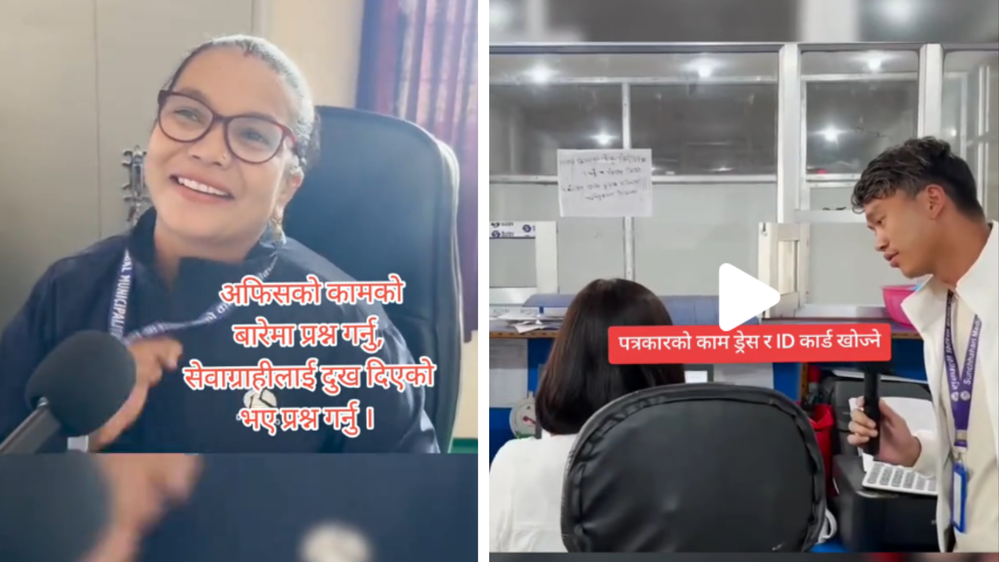
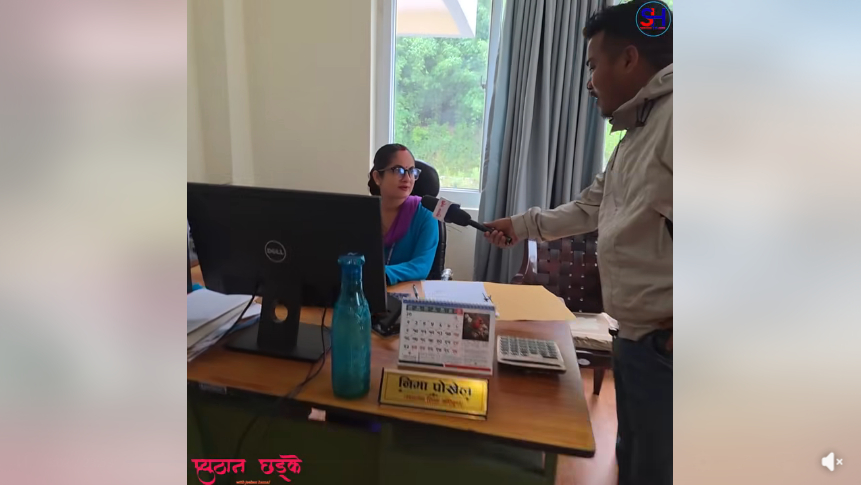
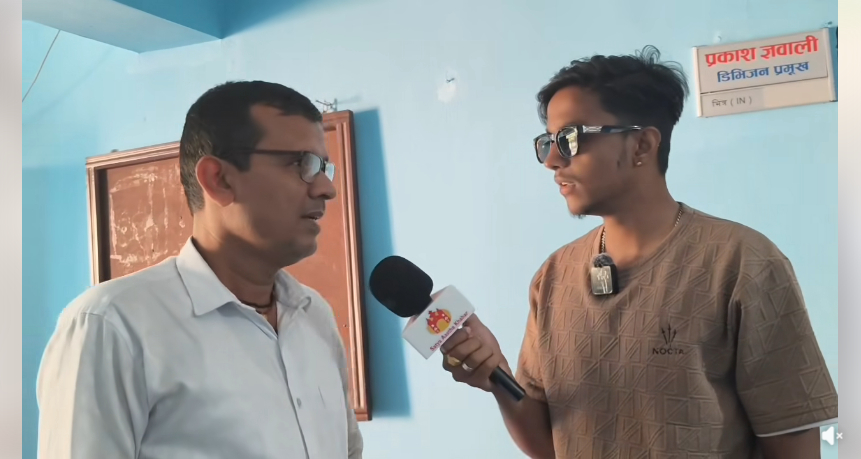
A growing trend of filming and confronting civil servants on camera for social media clicks is blurring the line between journalism and intimidation.Screengrabs from YouTube videos show self-styled journalists questioning government employees at their workplaces. The videos typically feature surprise inspections in which government employees are questioned about attendance, identity cards and dress codes.
On June 21, a nine-minute video went viral on Nepal’s online community. It showed a heated altercation between a ward chair and a woman, who identified herself as a journalist. The confrontation escalated when the woman hit the ward chair.
The incident involved Rabindra Devkota, ward 18 chair of Bhimdatta Municipality in Kanchanpur district, and Aishwarya Kunwar, who posted the video on her own social media account. The footage shows the two arguing before Kunwar lunges and shoves Devkota twice, reaching towards his neck.
Following the incident, police detained Kunwar, and the Kanchanpur chapter of the Federation of Nepali Journalists swiftly suspended her membership.
But the episode was far from an isolated case.
Across Nepal, a growing number of self-styled journalists carrying microphones and cameras have been walking into government offices, confronting public officials, filming tense exchanges with employees and posting the footage online in the name of ‘investigative journalism’ or ‘surprise inspections’.
Media experts, journalists and government officials say the trend bears little resemblance to journalism and instead amounts to intimidation disguised as public accountability.
Journalism, often described as the fourth pillar of democracy, is meant to inform the public, expose wrongdoing and strengthen good governance. Press freedom exists to pursue the truth and defend citizens’ rights. But the explosion of social media and online content has blurred the boundaries of professional journalism. Observers say it has also raised serious concerns about ethics, standards and accountability.
Many of the videos follow a strikingly similar pattern.
Individuals carrying microphones walk unannounced into government offices, schools and public institutions. Without properly introducing themselves or seeking permission, they begin questioning staff about dress codes, identity cards, attendance records and working hours. The exchanges are filmed and later uploaded to Facebook and YouTube, often with sensational headlines designed to attract clicks.
In one video, a man holding a microphone approaches a female employee at Dangisharan Rural Municipality in Dang district.
“Are you feeling cold?” he asks.
“No,” she replies as she hurriedly unzips her jacket.
“So why are you wearing that?”
“This is my uniform.”
“Stand up. Is that really your uniform?”
Visibly nervous, the employee tries to explain that she is wearing the required white shirt and blue trousers. The interviewer keeps pressing her.
“So that’s a T-shirt? Looks like something you’d wear to the market. Planning to go shopping straight after work?”
The employee repeatedly denies the suggestion and appears increasingly uncomfortable as the questioning continues.
The interviewer seems less interested in reporting than in putting the employee on the spot.
In another video from the same page, the man walks into Ghorahi Sub-metropolitan City Office while an employee is on the phone. He demands to inspect the employee’s identity card, forcing him to remove it from his bag and display it on camera. The employee appears reluctant to speak, but the questioning continues uninterrupted.
The same person confronts a female government employee over her attire, insisting that the clothes she is wearing do not qualify as the official government uniform because they were tailor-made rather than issued as standard dress. He repeatedly pressures her to stand up and display her outfit to the camera so viewers can judge whether it complies with the dress code. The visibly uncomfortable employee eventually stands and complies as the questioning continues.
A review of dozens of similar videos reveals the same approach. Employees are filmed without meaningful consent. Privacy is ignored. Staff are questioned aggressively in their own workplaces, often appearing intimidated as they are pressured to answer.
The same style appears on videos published by the Facebook page Satya Aastha khabar.
A man wearing dark sunglasses enters the Groundwater Resources and Irrigation Development Division Office in Birgunj carrying a microphone. Instead of asking about public services or policy issues, he focuses on employees’ clothing and identity cards before obtaining the attendance register and questioning exactly when each employee arrived and left work.
Watching the footage, one could easily mistake him for a government inspector rather than someone claiming to be a journalist.
Similar ‘raid-style’ videos are regularly published by online outlets such as Sanchar Hub Online TV HD, Falano News (Gandaki Chhadke) and Pyuthan Chhadke (chhadke means surprise inspection). Armed with microphones bearing their own logos, they enter local government offices early in the morning and interrogate employees as though conducting criminal investigations.
Government officials say the practice is taking a psychological toll.
Ekraj Adhikari, spokesperson for the Ministry of Land Management, Co-operatives, Federal Affairs and General Administration, said employees have increasingly complained of harassment despite performing their duties properly.
“In many cases, staff members have faced abuse and abnormal pressure driven by personal interests,” Adhikari said. “Such activities disrupt office work and discourage employees. We have even received reports of some female staff experiencing severe mental stress and depression.”
Is this journalism?
Media watchdogs say no.
Jhabindra Bhusal, chief officer at the Press Council Nepal, the regulatory body responsible for enforcing the journalist code of conduct, said that barging into government offices with microphones and intimidating employees is a clear violation of journalistic ethics.
“Entering offices without permission, filming without consent and questioning employees about what they are wearing or where they are going is simply not journalism,” Bhusal said.
Nitu Pandit, vice president of the Federation of Nepali Journalists, agrees.
“Journalism requires adherence to professional values and ethical standards,” she said. “What we are seeing does not meet those standards. These practices violate the fundamental principles of journalism.”
Former FNJ president Shiva Gaunle was equally blunt.
“The current trend of carrying a microphone and confronting people has nothing to do with journalism,” he told Kantipur. “Walking into any government office or school with a mobile phone or camera and asking random questions cannot be called journalism.”
According to Gaunle, legitimate reporting follows an established process.
“Information must first be of genuine public interest,” he said. “Journalists should conduct basic research, prepare questions in advance and request interviews through the office’s information officer or the relevant authority at an agreed time.”
Kundan Aryal, head of the Department of Journalism and Mass Communication at Tribhuvan University, warned that such practices are creating a damaging public image of journalism itself.
“What does a child think when they hear the word journalist today?” Aryal asked. “They think a journalist is someone who barges in and scolds people. That is the standard many Nepali media outlets are helping create. The practitioners themselves are rough and show little respect for professional values.”
Those producing the videos reject the criticism.
Gaurav Barma, managing director of Satya Aastha Khabar, said his team only visits offices after receiving complaints from the public.
“Our reporting is based on complaints from service seekers,” he said. “We don’t know what’s happening inside every office. We visit government offices when members of the public tell us employees are absent or services are delayed.”
Jeevan Hamal of Sanchar Hub Online TV HD defended the practice on similar grounds.
“Our role is to bridge the gap between citizens and the government,” he said. “People come to us because they are not receiving services when employees fail to show up on time.”
Birendra Gharti of Sunchhahari Khabar YouTube channel argued that journalists have a responsibility to check whether civil servants are doing their jobs.
“Our main objective is to see whether government employees paid with taxpayers’ money are fulfilling their responsibilities,” he said. “Office discipline is the first step toward good governance.”
Yet Gharti also admitted that his team does not always follow the journalistic code of conduct.
“There may be occasions when the code of conduct isn’t fully followed,” he said. “You cannot always follow every rule during sting operations.”
Asked whether employees also have the right to privacy, Gharti replied, “It depends what you mean by privacy. We haven’t filmed anything secret.”
Hamal of Pyuthan Chhadke YouTube channel insisted he seeks permission before entering offices.
“You can see it in my videos,” he said. “I ask before going inside. These days I focus more on issues than on surprise inspections.”
Government officials say enforcement must strike a careful balance.
Adhikari said monitoring the conduct of civil servants is ultimately the government’s responsibility, not that of self-appointed inspectors carrying cameras.
“If there are concerns about an employee’s conduct, journalists should raise them with the office chief or the relevant regulatory authority,” he said.
The ministry is now discussing ways to address the issue without undermining press freedom.
“If we respond through heavy-handed restrictions, we risk harming the broader agenda of transparency and good governance,” Adhikari said. “We need a balanced framework that holds both public officials and media practitioners accountable without restricting openness.”
The Press Council says it has already begun monitoring such content.
“We are observing these activities closely,” Bhusal said. “Some individuals have received warning letters, phone calls and formal notices. In serious cases, disciplinary action has already begun.”
Pandit of the Federation of Nepali Journalists warned, however, that regulation should never become an excuse to suppress freedom of expression.
“The state has a responsibility to regulate,” she said. “But regulation must not become intimidation or criminalisation simply because someone has expressed an opinion.”
Aryal believes the wider journalism profession must also take responsibility.
“Every profession has an obligation to society,” he said. “We need an honest discussion about the practices we are promoting. Just as parents are responsible for raising their children, experienced journalists have a duty to mentor the next generation.”
Gaunle says the immediate priority is simple.
“Many of these people need to learn the basic principles of journalism,” he said. “Professional organisations and institutions such as the Press Council should run media literacy and ethics training. Journalism should never become a tool for intimidating public employees or causing psychological harm.”




 17.63°C Kathmandu