How Nepal could lose a generation of footballers due to FIFA’s suspension
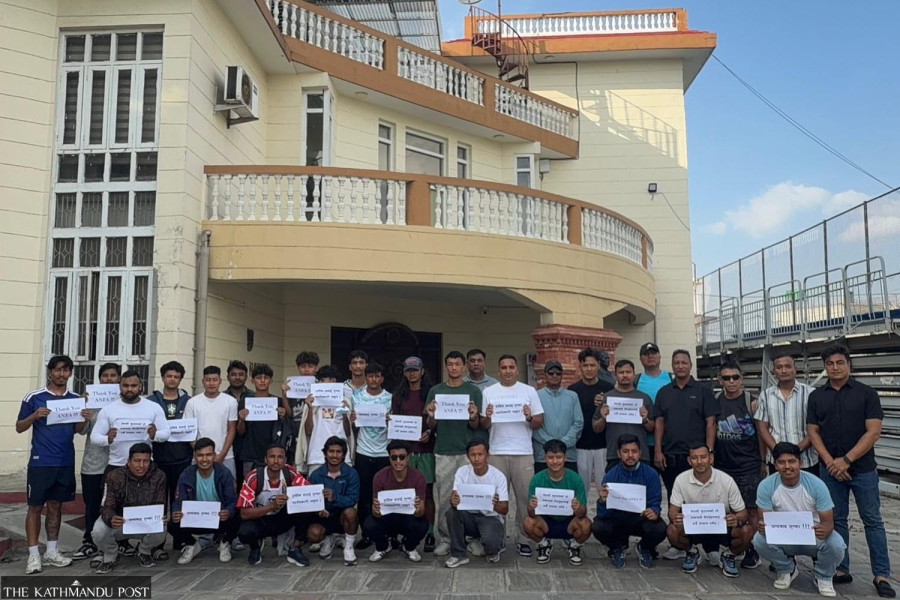
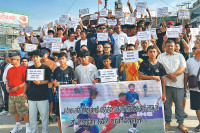
Players are missing international tournaments, domestic football has stalled, thousands of livelihoods are at risk, and years of political interference have left the country's football future hanging in the balance. Nepali footballers and supporters gather for a protest at ANFA Building in Satdobato, Lalitpur, following the suspension from FIFA. Post file photo
As football enthusiasts across Nepal immerse themselves in the excitement of the FIFA World Cup, the country’s own football community finds little to celebrate. Nepal has been plunged into an unprecedented crisis after FIFA imposed an indefinite suspension on the All Nepal Football Association, leaving the future of the nation's most popular sport hanging in the balance.
FIFA cited ‘third-party interference’ after a dispute triggered by intervention from the National Sports Council, a move that the world governing body considers a violation of the independence required of its member associations. The suspension has brought Nepal’s international football activities to a halt and deepened uncertainty surrounding a sport already troubled by years of internal disputes.
The ban has disappointed supporters and shaken players, coaches and administrators whose careers depend on regular domestic and international competition.
Despite the gravity of the situation, the Ministry of Education and Sports has struggled to convince stakeholders that it has a clear plan to end the impasse. Minister Sasmit Pokharel has acknowledged that successive governments repeatedly interfered in ANFA’s affairs but has stopped short of outlining a concrete roadmap for lifting the suspension.
“Nepali football cannot go any lower than it already has,” said Pokharel, adding that the government has written to FIFA and the Asian Football Confederation (AFC) and proposed dialogue to resolve the dispute.
The minister also remarked that Nepal does not necessarily have to play in the World Cup but should at least show promise, while lamenting the absence of regular league football. His comments, however, have drawn criticism from football observers.
Under FIFA statutes, ANFA’s leadership is elected through affiliated clubs and district associations rather than government appointments. The minister’s suggestion that former players and football contributors should simply be brought into ANFA overlooks that established electoral structure. Likewise, participation in FIFA World Cup qualifiers is not optional for countries wishing to remain active in international football. Every member association enters a lengthy qualification process that also influences FIFA rankings and forms part of the pathway to the AFC Asian Cup.
For many within Nepali football, the government’s statements have reinforced concerns that policymakers underestimate the significance of the suspension.
National team players, meanwhile, remain reluctant to speak publicly. One player, requesting anonymity because of the sensitivity of the issue, urged all sides to abandon personal interests.
“Whatever has happened has already happened,” said the player. “Now everyone should put aside their own interests and work together to resolve the dispute for the sake of Nepali football.”
The suspension marks the first FIFA ban in Nepal’s football history. Besides barring participation in international competitions, it has frozen FIFA funding that supports football development, technical programmes, infrastructure and grassroots projects. FIFA grants have financed youth football, coaching education and long-term development initiatives, making the suspension particularly damaging.
According to ANFA, at least 324 people directly involved in Nepali football have immediately lost their livelihoods or seen their work disrupted. They include 158 employees and coaches, 60 men's and women's national team players, 92 licensed coaches and 14 FIFA-listed referees.
The wider impact is even greater. More than 39,000 age-group players participate through around 1,700 schools, while another 22,000 footballers are registered across 49 district associations. Hundreds more compete in A, B, C and D Division leagues, and Nepal has around 600 licensed coaches. Football officials estimate that more than 80,000 people could ultimately be affected if the suspension continues.
The consequences are already visible. Nepal has missed three international tournaments, including the AFC Women's Champions League, the AFC Women's Under-17 Asian Cup qualifiers and the AFC Men's Under-20 Asian Cup qualifiers.
No progress as crisis drags on
At a time when Nepali football remains suspended by FIFA, both the NSC and the ANFA insist they are working to resolve the crisis. Yet, beyond those assurances, there is little evidence of tangible progress.
NSC Vice-Chairman and former national footballer Bishal Shrestha said the council was treating the situation seriously. “We are deeply concerned about the current situation,” he said. “The council is committed to resolving the problem, and we have already initiated the necessary process.”
Shrestha is also leading an investigation into ANFA’s recent financial transactions following allegations of widespread corruption within the football governing body. However, he declined to elaborate on the progress of the inquiry.
ANFA spokesperson Suresh Shah likewise maintained that the association was actively pursuing every possible avenue to end the suspension. “We are open to all possible options,” he said. “Efforts are continuing from our side as well.”
Despite such claims, stakeholders say little has changed on the ground. A national team player, speaking on condition of anonymity, said no meaningful initiative was underway to resolve the impasse. “Nothing concrete is happening at the moment,” the player said. “The biggest victims are the players, while those engaged in football politics remain largely unaffected. Before making any decisions, everyone should think about the future of the players.”
Fear of a lost generation
If Nepal’s FIFA suspension drags on, football officials fear the country could lose an entire generation of players. Even more worrying, there may not be enough young talent ready to replace them.
The warning comes at a time when domestic football has already suffered from a lack of regular competition. The A Division Martyrs’ Memorial League has been held only once in the past four years. Of the players who featured in that tournament, roughly a quarter have since migrated abroad, while around half have quit football altogether. Most of those still in Nepal have had few opportunities to play competitively.
The men’s national team continues to rely heavily on experienced figures such as captain Kiran Chemjong and Rohit Chand, both of whom have earned more than 100 international caps. Many of their contemporaries have already left the country, while those who remain are nearing the end of their careers. Among the newer generation of national team players, many have either moved overseas or faded away from the domestic football scene.
The outlook is even more concerning for the women’s national team. Led by captain Anjila Subba Tumbapo, with veteran Renuka Nagarkote among its most experienced players, much of the current squad has represented Nepal for nearly a decade. Many have already surpassed 50 international appearances and are approaching retirement, yet a new generation is not ready to succeed them.
Former Nepal captain Upendra Man Singh recently faced a question he found difficult to answer. A parent approached him and asked whether encouraging his talented son to pursue football was risking the boy’s future amid endless disputes in Nepali football.
“I had no answer,” Singh admitted. Running a football academy in Madhyapur Thimi, he has also noticed a steady decline in enrolment. Fewer children are choosing football, raising concerns that Nepal may soon struggle to field competitive national teams at every level.
Lessons from Olympic committee dispute
Nepal’s football crisis bears striking similarities to the dispute that engulfed the Nepal Olympic Committee just a year ago, offering lessons that many believe should not be ignored.
Following the NOC election that returned Jeevan Ram Shrestha as president, the then government refused to recognise the election result, declaring it illegitimate. Authorities froze the committee’s bank accounts, locked its headquarters for months and barred its office bearers from travelling abroad. The government even formed an ad hoc committee headed by Dhruba Bahadur Pradhan.
The rival committee went on to occupy the NOC headquarters in Satdobato and claimed to be the country's legitimate Olympic body. It also pledged to oversee Nepal’s participation in the upcoming Asian Games. However, those claims failed to gain international recognition. The International Olympic Committee and the Olympic Council of Asia continued to recognise the Shrestha-led committee, while disciplinary action was taken against several officials associated with the government-backed body.
Following political changes in Kathmandu, the Shrestha-led committee was eventually restored and continues to represent Nepal in international Olympic affairs. Despite strong government backing, the parallel committee failed to establish legitimacy abroad.
The episode is particularly relevant because ANFA is a member of the NOC. During the height of the Olympic dispute, ANFA voted to withdraw its NOC membership, a move widely seen as aligning with political pressure at the time.
Critics now argue that ANFA failed to recognise that the same kind of government interference could eventually be directed at football itself. The current FIFA suspension, they say, underscores why respecting the autonomy of sports bodies is essential under international statutes.
A history of conflict
The turmoil engulfing Nepali football today is far from new. In many ways, the sport’s history has been accompanied by an equally long history of political interference, institutional rivalry and internal power struggles.
The ANFA was established in 1975, replacing the Nepal Football Association, which had become a FIFA member in the early 1970s. According to long-time football observers, the game’s growing international profile soon attracted the attention of the then royal establishment, ushering in years of political influence over football administration.
Disputes surfaced almost immediately, reportedly forcing FIFA and the AFC to send representatives to Nepal in an attempt to mediate. During the Panchayat era, football administration was frequently shaped by political interests rather than sporting priorities.
The conflict persisted after the restoration of democracy in 1990. When Ganesh Thapa emerged as ANFA president in 1995, FIFA and the AFC were initially reluctant to recognise his leadership while Rukma Shumsher Rana remained in office. Thapa went on to lead Nepali football for more than two decades, a period marked by recurring factionalism and controversy.
The divisions peaked in 2000, when two rival ANFA committees operated simultaneously. FIFA recognised Thapa’s leadership, while a government-backed parallel association was headed by Geeta Rana. Although rumours of a FIFA suspension circulated at the time, the world governing body continued to support the internationally recognised administration, and the rival body eventually faded away.
More recently, ANFA became embroiled in allegations of match-fixing and corruption. Thapa was subsequently banned by FIFA, while leadership passed through Lalit Krishna Shrestha, Narendra Shrestha, Karma Tsering Sherpa and eventually, incumbent president Pankaj Bikram Nembang.
The current suspension is widely viewed as the latest chapter in a decades-long cycle of division, weak governance and political interference, for which no single faction can claim innocence.
How early election triggered the latest conflict
While Nepal’s football crisis has deep-rooted causes, the immediate trigger was ANFA's decision under the leadership of Nembang to hold an early election. At the time, the association was divided into three rival factions, and the leadership argued that an early vote—despite having three months of its term remaining—was the best way to break the deadlock.
Although few opposed the idea of an early election itself, the decision to proceed without first conducting district and provincial elections drew widespread criticism. ANFA maintained that its statutes did not require those lower-level polls beforehand, but critics argued that bypassing them undermined a fundamental democratic principle. Leadership elections, they insisted, should begin at the grassroots.
Many observers regard that decision as the Nembang administration’s biggest political miscalculation, one whose consequences continue to reverberate.
Despite the criticism, ANFA’s four-year tenure was not without achievements. The association maintained most of its routine programmes and made notable progress in youth and women’s football. However, the country’s premier domestic competition, the Martyrs’ Memorial A Division League, was held only once during the entire term, leaving the leadership vulnerable to persistent criticism over its overall performance.
The ball is in ANFA’s court
Resolving Nepal’s football crisis will not be easy, but it is far from impossible. The responsibility now rests primarily with the ANFA, despite the suspension imposed by FIFA. The biggest victims of the ban are not football administrators but players, coaches, referees and other technical personnel whose careers have been brought to a standstill.
That is why ANFA president Nembang must take the lead in finding a solution. He has an opportunity to prevent Nepali football from slipping into a deeper crisis by building consensus among all stakeholders and engaging constructively with FIFA and the AFC.
Those familiar with Nepali football believe the dispute can still be resolved quickly. But that will require the ANFA leadership to set aside pride, rigidity and factional interests. If compromise can restore Nepal’s place in international football, they argue, the association should not hesitate. The solution must come from within Nepali football—not be imposed from outside.




 25.64°C Kathmandu