Why is Deuba embracing the Hindu agenda he once blocked?
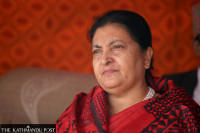
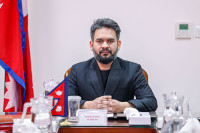
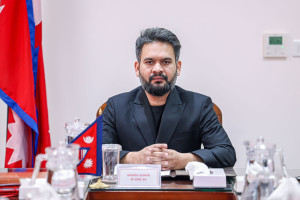
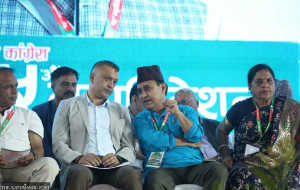
Analysts argue the move reflects the former Congress president’s desperate bid to reclaim relevance, not a genuine shift in values.Former president of Nepali Congress Sher Bahadur Deuba is flanked by leaders Shashank Koirala (left) and Shekhar Koirala during thedissident camp’s national gathering at Sukedhara in Kathmandu last week. Dipesh Darshandhari/TKP
The demand to restore Nepal as a Hindu state has resurfaced at the centre of political debate within the Nepali Congress’s Sher Bahadur Deuba camp, with the vocal backing of the former party president himself.
The development is striking because Deuba, when he was at the helm of the party, kept the issue out of formal party forums even when many Mahasamiti members signed petitions supporting it. The same demand has now been endorsed by a national gathering of Congress leaders close to Deuba.
The shift has raised questions about whether Deuba is embracing the Hindu state agenda to regain political relevance after he was forced out of the party’s leadership through the special general convention earlier this year.
Lok Raj Baral, a professor of political science, says the move reflects political insecurity more than a change in ideology.
“Deuba has taken this line because he has no ground left to stand on,” Baral said. “By adopting a regressive line that can push society towards another conflict, he is damaging whatever political space and sympathy he had regained.”
Baral added that senior politicians in Nepal have often used issues such as relations with China and India, or religion, to remain politically relevant. “They don’t have any progressive agenda for developing the country,” Baral said, “so they use such cards to keep the political business going.”
The Hindu state campaign in the Congress is not new. The late Khum Bahadur Khadka was among the first senior Congress leaders to organise it as a political campaign after Nepal was declared secular. Following Khadka’s death in March 2018, other leaders, including Shashank Koirala and Shankar Bhandari, championed the Hindu state agenda.
Bhandari led a signature campaign at the Congress Mahasamiti meeting in December 2018. More than 700 members initially signed a proposal demanding that Nepal be restored as a Hindu state. Still, the proposal failed to become part of the formal agenda. At that time, the then party president Deuba and senior leader Ramchandra Paudel opposed the idea.
The issue returned before the Mahasamiti meeting in Godavari in 2024. Bhandari and other leaders formed a campaign for the Hindu state agenda. More than 1,000 Mahasamiti members eventually signed a petition supporting the restoration of a Hindu state, according to campaigners. Shashank Koirala was among those who supported the demand.
Deuba yet again rejected the proposal. According to a leader involved in the campaign, Deuba told the delegation that the political situation did not allow the party to adopt the agenda. He had dismissed the proposal even before the Mahasamiti meeting convened.
That position renders Deuba’s recent move particularly ironic. After Deuba was unceremoniously pushed out of the party’s leadership, he remained abroad for months while facing a money-laundering investigation. He and his wife, former foreign minister Arzu Rana Deuba, had left Nepal for medical treatment and later stayed in Singapore and Hong Kong.
In April, the Kathmandu District Court issued arrest warrants against the couple, which were quashed by the Supreme Court a month later. Interpol also declined to issue a Red Notice, saying the legal threshold had not been met.
In June, the Deubas wrote to the Department of Money Laundering Investigation saying they intended to return and would cooperate with investigators. Deuba returned to Nepal on August 13. His return coincided with preparations for a national gathering of his faction, held from August 14 to 16.
His renewed political activity has therefore drawn widespread attention. His faction has continued to challenge the legitimacy of the Thapa-led Congress. In July, the Deuba faction moved the Supreme Court seeking a review of a verdict that upheld the Election Commission’s recognition of the Thapa-led leadership.
Against this backdrop, the Hindu state proposal has become more than a question of religious identity. It is also part of a struggle over political space inside the grand old party.
Prakash Sharan Mahat, a leader close to Deuba, rejects the view that the agenda is merely a tactical move. He argues that the issue has roots in the Congress’s position during the constitution-drafting process.
“At that time, the Congress position was to provide religious freedom,” Mahat said. “The communist parties, particularly the Maoists, were not ready to accept it. So a compromise was reached so that the constitution could be issued on time.”
Mahat said the issue failed to receive proper attention in previous party forums because internal disputes over electoral alliances and leadership dominated discussions. “When the question of whether to form an electoral alliance became the major issue, other serious agendas were pushed aside,” he said. “All the energy was poured into who would lead, who would become president and who would become stronger.”
He said the Hindu state proposal passed by the Deuba faction’s gathering has now triggered a wider debate within the Congress. “Even within the Sanepa-based Congress, serious discussion has begun,” he said.
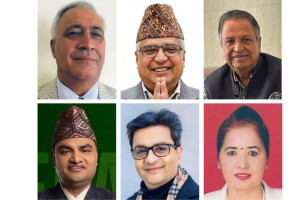
Although the Deuba faction’s gathering endorsed the Hindu state agenda, it has not become the Nepali Congress’s official position. The move has also sparked disagreement within the Deuba camp, with leaders including Prakash Man Singh, Bimalendra Nidhi, Krishna Prasad Sitaula and Min Bishwakarma opposing the policy. The proposal was reportedly endorsed at the gathering on Deuba’s direct instruction.
The Thapa-led party leadership, however, has rejected the idea that the gathering’s decision represents Congress’s policy. At a Central Working Committee meeting, Thapa said the party’s official position could only come from its recognised constitutional forums.
The issue also has a foreign-policy dimension. Some Congress leaders and political analysts have linked the renewed Hindu state debate to the influence of Hindu nationalist politics in India, particularly the Bharatiya Janata Party.
Political analyst Krishna Khanal said Deuba’s search for political space after losing party leadership, concerns about his own political security and the influence of Hindu nationalist forces in India could all have contributed to the decision to promote the agenda.
Baral said while there was no proof that Deuba was acting at India’s direction, he believed the possibility could not simply be dismissed. “Even if there is pressure, political leaders must stand by their principles,” he said. “They must be able to say that certain things do not suit Nepal’s context.”
The India question has a history dating back to the constitution-making process. Former prime minister Baburam Bhattarai has said Indian officials had suggested that Nepal replace the word ‘secular’ with ‘religious freedom’ in the new constitution. In 2015, India’s then foreign secretary S Jaishankar visited Kathmandu shortly before the constitution was promulgated and met several Nepali leaders amid India’s concerns over the constitution process and demands from Madhesh-based parties.
After the constitution was promulgated in September, 2015, India imposed a border blockade that severely disrupted supplies to Nepal.
According to a political leader involved in the constitution-drafting process, Article 4, Sub-article (1) of the constitution was initially drafted simply as: “Nepal is an independent, indivisible, sovereign, secular, inclusive, democratic state.”
The leader added, “After the Indian establishment expressed serious concerns regarding secularism, an explanatory clause was appended, specifying that ‘secularism’ denotes the protection of religion and culture practised from ancient times (sanatan dharma), along with religious and cultural freedom.”




 20.58°C Kathmandu