Supreme Court annuls arrest warrant against Deuba couple, bars detention
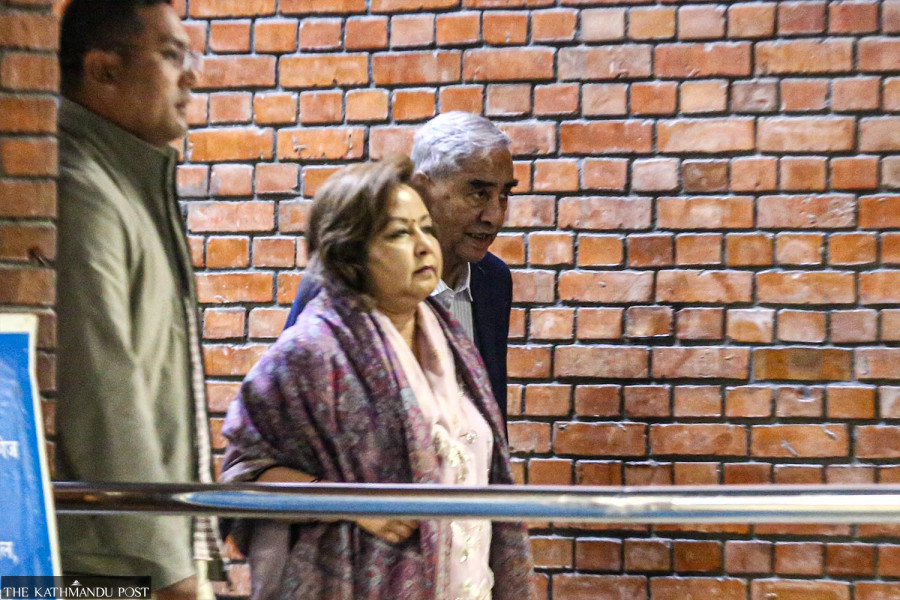
The court found that the authorities failed to establish valid legal grounds for arrest under the anti-money laundering law, which requires a reasonable belief that an accused may flee, destroy evidence, or obstruct the investigation. Post File Photo
The Supreme Court on Monday invalidated the arrest warrant issued against former prime minister Sher Bahadur Deuba and his wife Arzu Rana Deuba, ruling that they cannot be arrested based on the warrant issued by the Kathmandu District Court on April 6.
A division bench of Justices Mahesh Sharma Poudel and Nityananda Pandey issued the interim order in response to a petition filed by Deuba on May 1.
In its order, the Supreme Court said the arrest warrant had automatically become inactive, noting that the legal procedure and format required under criminal procedure rules had not been properly followed while seeking and issuing the warrant.
The court also said the Department of Money Laundering Investigation and the Kathmandu District Court had failed to clearly establish the legal grounds necessary for issuing an arrest warrant. Under Nepal’s anti-money laundering law, an arrest can be made only if there are reasonable grounds to believe that an accused person may flee, destroy evidence, obstruct the investigation, or influence the case. The order said such grounds had not been adequately demonstrated.
The Deuba couple is currently outside Nepal. Deuba had left for Singapore on February 25, just ahead of the March 5 elections. The couple were later believed to be in Hong Kong, although their whereabouts could not be independently verified.
The bench further observed that, following amendments to the Anti-Money Laundering Act, jurisdiction over cases investigated by the Department of Money Laundering Investigation lies with the Special Court. However, there was no indication that the department had sought permission from the Special Court or that the Special Court had authorised the arrest warrant.
The court said that while investigators are legally empowered to arrest suspects during an investigation, such action must strictly comply with due process and cannot be arbitrary.
Earlier, on May 19, a single bench of Justice Meghraj Pokharel had issued a show-cause order directing the respondents to submit written explanations.
Although the petitioners, who filed the case on behalf of the Deubas, had sought an interim order to stay any arrest on the grounds that a money laundering investigation was underway, the Supreme Court had initially declined to grant immediate relief, observing that it would be appropriate to decide the matter only after hearing arguments from both sides.
The arrest warrant against the Deubas was issued days after the formation of the government led by Balendra Shah following the Rastriya Swatantra Party’s resounding victory in the March 5 elections.
Meanwhile, Interpol has refused to issue a Red Notice against the Deuba couple for a second time.
According to police and investigation officials, Interpol last week informed Nepali authorities that the request had again been denied, citing insufficient documentation and lack of clarity regarding the case.
Nepal’s first request for a Red Notice had earlier been rejected after Interpol said there were insufficient grounds to issue the notice and requested additional documents. Authorities later sent additional information in late April, but Interpol again responded that the paperwork remained incomplete, according to a police official familiar with the matter who spoke on condition of anonymity because he was not authorised to speak to the media.
The official said Interpol had sought further clarification on the alleged predicate offence, the legal basis of the investigation, and the amount of money allegedly laundered.
Under Nepali law, a money laundering investigation requires proof of a predicate offence—an underlying crime through which illegal income was generated. Interpol had questioned what that predicate offence was in the Deuba couple’s case.
Nepali authorities had sought the Red Notice in an effort to bring the Deubas back to Nepal for investigation. However, with Interpol rejecting the request and the Supreme Court annulling the arrest warrant, any further move to seek an international notice now appears unlikely.
After the arrest warrant was issued, Deuba, a five-time prime minister and former president of the Nepali Congress, denied any wrongdoing. In a Facebook post, he said false and misleading claims were being spread about his family’s property and finances and maintained that he had properly declared his assets in accordance with Nepali law. He had also said he would return to Nepal soon, without specifying any timeline.




 23.96°C Kathmandu