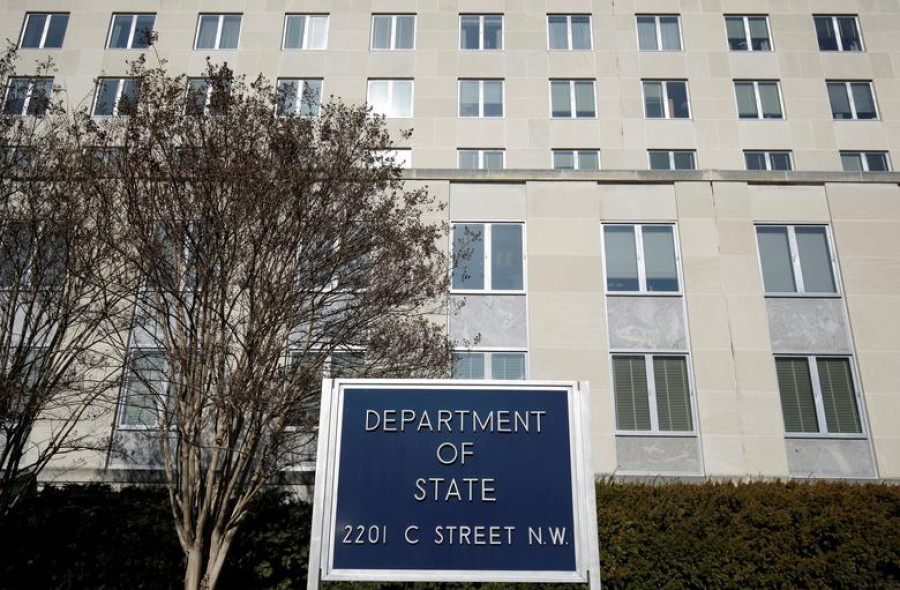
The US Department of State has announced that it will make its visa bond programme permanent for citizens of 50 countries, including Nepal, effective from Monday. Soon after the State Department introduced the scheme as a pilot programme last year, the Nepali government took up the issue with senior US officials, urging them to review the policy.
The move makes permanent a 12-month Visa Bond Pilot Program that took effect on August 20, 2025. The scheme applies to certain applicants for temporary business and tourist (B1/B2) visas.
This rule finalises the temporary final rule that went into effect on August 20, 2025, which launched a 12-month long Visa Bond Pilot Program (Pilot Program), and establishes a permanent visa bond program, reads a State Department statement issued on Friday.
“An alien applying for a visa as a temporary visitor for business or pleasure (B1/B2) may be required to submit a bond (‘visa bond’) to ensure that the alien maintains his or her nonimmigrant status and departs as required,” the State Department said in the 34-page rule.
The bond is refundable if the visa holder leaves the United States within the authorised period of stay, does not travel before the visa expires, or is denied admission at a US port of entry.
The rule also raises the maximum bond amount from $15,000 under the pilot programme to $20,000. Applicants may be asked to post a bond of $10,000, $15,000 or $20,000 depending on their purpose of travel, employment, income and other factors. Under the pilot programme, bond amounts ranged from $5,000 to $15,000.
Consular officers are generally expected to require a $15,000 bond, although they may impose a lower or higher amount based on individual circumstances.
The programme affects nationals of several African countries as well as Nepal, Bangladesh and Bhutan in South Asia.
In January this year, the US Embassy in Kathmandu announced that Nepalis who were otherwise eligible for B1/B2 visas could be required to post a bond of up to $15,000. The embassy said applicants would be informed during their visa interview if they were required to pay the bond.
Applicants were also advised not to pay through third-party websites and not to make any payment until instructed by a consular officer. B1/B2 visas would not be issued until the required bond had been paid, the embassy said.
According to the State Department, visa bonds may be required for applicants from countries with high visa overstay rates, inadequate information sharing, weak identity verification systems, incomplete criminal records, or deficiencies in travel document security and screening procedures.
Senior officials at Nepal’s Ministry of Foreign Affairs told the Post that Foreign Minister Shisir Khanal had repeatedly raised the issue with visiting US officials over the past four months.
According to the officials, Khanal discussed the matter with Assistant Secretary of State for South and Central Asian Affairs Paul Kapur, Trump’s special envoy and US ambassador to India Sergio Gor, and Under Secretary of State for Political Affairs Allison Hooker during separate meetings and conversations.
US officials told their Nepali counterparts that the visa bond requirement was linked primarily to visa overstays, document fraud and other immigration violations by Nepali nationals.
“They said the system is automatically reviewed and countries with improved compliance receive better scores. If Nepal’s performance improves, it could eventually be removed from the list,” a senior Foreign Ministry official said. “We will continue raising the issue.”
Officials at the Foreign Ministry and Nepal’s Embassy in Washington said document fraud, visa overstays and the misuse of public benefits reserved for US citizens were among the reasons Nepal was included in the programme.
According to one official, the latest US assessment found that Nepali applicants continued to submit fraudulent documents and that 3.34 percent of Nepali nationals had accessed certain US government-funded public benefits reserved for citizens.
Based on 2024 arrival data, Nepali nationals were among the higher users of some subsidised public services, prompting increased scrutiny of visa compliance, officials at the Nepali Embassy in Washington said.
The United States has also temporarily suspended the issuance of immigrant visas to Nepali nationals, citing concerns over compliance with immigration rules and public-benefit regulations.
The State Department said the programme is intended to encourage foreign governments to reduce visa overstays, strengthen identity verification, improve information sharing and enhance the security of travel and civil documents.
“By its design and intention, the programme is a tool of diplomacy,” the department said.
Anil Giri is a Chief Sub Editor covering diplomacy, international relations and national politics for The Kathmandu Post. Giri has been working as a journalist for more than two decades, contributing to numerous national and international media outlets.




 18.53°C Kathmandu