Subsidised rice reaches Humla through Chinese route after 7-year gap
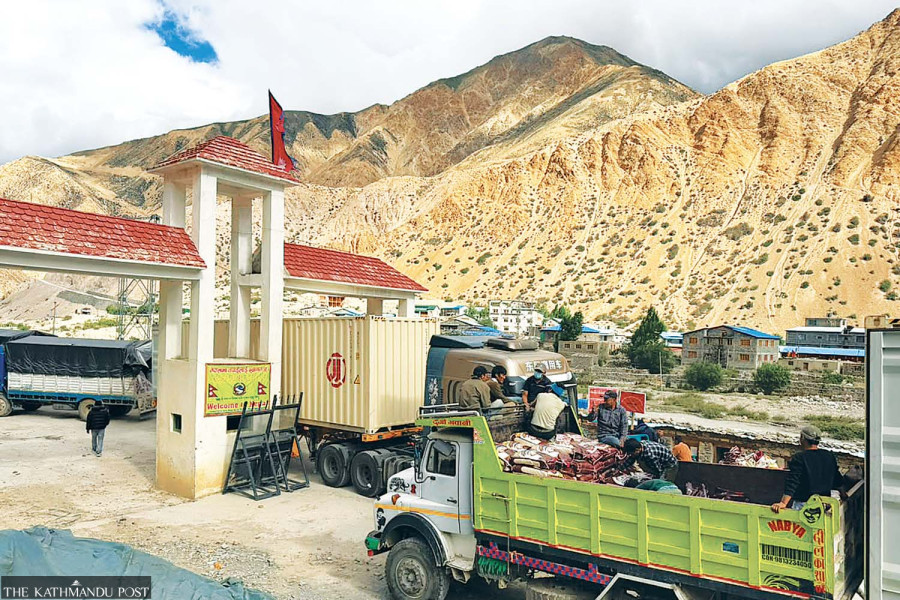
Twenty-eight trucks carried the rice from Kathmandu to Kerung, where it was transferred into eight Chinese containers, each carrying 400 quintals, to Hilsa. A truck that carried rice sent from Kathmandu, pictured in Humla recently. Post Photo
After a seven-year halt, the Food Management and Trading Company has started transporting subsidised rice to Humla through the Chinese route again, as poor road conditions along the Karnali Corridor continue to make supplies difficult during the monsoon.
The consignment travelled from Kathmandu through Rasuwa, Kerung, Jongba, Purang (Taklakot) and Hilsa before reaching Simkot, the district headquarters of Humla. According to the company, the consignment reached the destination covering nearly 600 kilometres in China in 17 days.
Twenty-eight trucks carried the rice from Kathmandu to Kerung, where it was transferred into eight Chinese containers, each carrying 400 quintals, to Hilsa. The company said the transport charge from Kerung was Rs39 per kilogram.
“Even at the current freight rate, transporting rice through China was around Rs8 to Rs11 cheaper per kilogram,” said Krishna Thapa Magar, chief of the company’s Humla branch. “The Chinese route is considered safer because the Karnali Corridor requires loading and unloading at several points.”
The company brought 1,500 quintals for its Simkot branch, 700 quintals for the Limi sales centre and 1,000 quintals for the Yalbang sales centre through China.
Transport from Surkhet to Humla costs Rs20 to Rs30 per kilogram, while the branch chief said the rate from Kathmandu through the Karnali Corridor can reach Rs50.
China stopped allowing food transport through its roads in 2019 amid the Covid-19 pandemic. Before Humla was connected to Nepal’s national road network in July last year, the district depended on air transport for basic food supplies.
“The road has only recently been connected, and its narrow, unpaved sections make it difficult for large cargo vehicles to operate,” said Thapa Magar. “The Karnali Corridor is risky during monsoon, which is why we chose the Chinese route for rice transportation.”
The construction of a Bailey bridge over the Chuwakhola finally connected Simkot to the national road network after nearly three decades of efforts. The corridor remains challenging, however, with unfinished bridges and several poor road sections continuing to disrupt travel during the monsoon.
Humla, a remote mountain district in Karnali Province, has been allocated 23,000 quintals of rice this year. The company says 6,300 quintals are in stock at the Simkot branch, enough to maintain supplies during the rainy season. Rice is distributed through Simkot, Sarkegad and Srinagar depots and 10 other sales centres.




 13.59°C Kathmandu