Nepal’s crackdown on businessmen can’t have it both ways
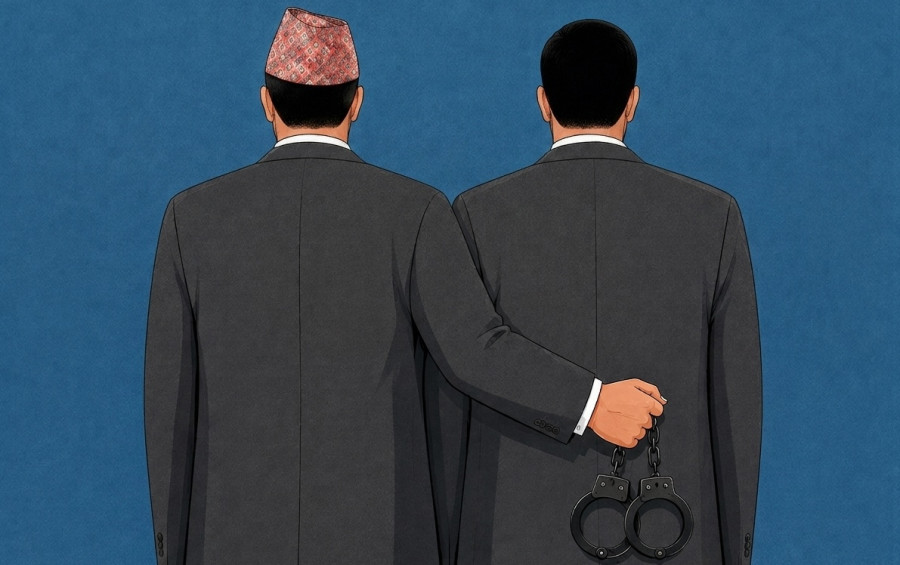
Balendra Shah’s administration has every right to dismantle corruption and business-politician collusion. But it should ask whether the cost of its methods will be borne by an economy already desperate for investment. Illustration generated by OpenAI’s ChatGPT
In early May, days after Shekhar Golchha was arrested, the Supreme Court found his detention illegal, explicitly citing the bypassing of due process. But within hours of his release, a team from the Central Investigation Bureau rearrested him on a separate insurance-fraud allegation. A CIB official told reporters the new case was entirely unrelated to the one the court had just thrown out. Last month, Golchha was released on bail for Rs10 million.
It’s a small scene, but it captures something the Balendra Shah administration hasn’t resolved yet. A government can pursue accountability and still overreach. The question is whether this one can tell the difference — and whether it can keep doing both at once.
Nepal’s arrests and legal charges against high-profile businessmen — from Shankar Agrawal to Shekhar Golchha to Prithvi Bahadur Pande — are starting to resemble a crackdown that took the business world by storm almost ten years ago. In February 2017, days after youth-led protests had helped force South Korean President Park Geun-hye’s impeachment, Samsung heir Lee Jae-yong was arrested on charges of bribing Park and her confidante in exchange for government support for a merger. Lee was convicted, imprisoned and later pardoned. A separate set of charges tied to the merger itself dragged on for years, ending only in 2025 when South Korea’s Supreme Court upheld his acquittal.
The point is not that Nepal is South Korea, or that Golchha is Lee. The comparison is about something more basic: what prolonged legal uncertainty can do to business decision-making, even in a country with far stronger institutions. The cost of those years of jeopardy surrounding one of South Korea’s flagship companies made headlines across major business publications. Bloomberg’s own editorial board made a version of this argument in January 2017, before Lee’s conviction — that punishing one executive wouldn’t fix what actually needed reforming. Samsung subsequently shelved the internal “Future Strategy Office” that had coordinated group-wide decisions, while major investment and M&A decisions remained constrained. When Lee was finally cleared of the merger-related charges in 2025, the end of that legal uncertainty was seen as a positive for the company.
Nepal’s version may not appear as acute right now. But the quieter concern spreading through the business community is more consequential than a few angry statements from businessmen: people are beginning to ask what kinds of ordinary commercial decisions can expose them to criminal investigation. FNCCI, CNI and the Nepal Chamber of Commerce issued a joint statement after Golchha’s arrest, conceding plainly that the private sector has no disagreement that anyone found guilty should be held accountable, while asking the government to listen first and not treat detention as the default response to an allegation; guilt after all is a matter for the courts to establish. A new Asset Investigation Commission, established primarily to target politicians and bureaucrats, has pulled in private board members over their roles in institutions such as SEBON and Nepal Telecom.
Underneath the personnel churn, however, something more durable appears to be happening: the anti-graft body’s new national strategic plan extends anti-corruption law, for the first time, to private companies, cooperatives and banks directly. Finance Minister Swarnim Wagle has framed the whole push in his own words, telling a Kathmandu audience the government is working to dismantle institutional capture and the collusion between business interests and corrupt politicians, and has urged the private sector not to protect wrongdoing.
Wagle’s argument is not hard to understand. Nepal has a long history of business-politician entanglements, and businesses should not be above the law. But there is a crucial distinction between investigating corruption and making legitimate commercial risk look like criminal conduct after the fact. A commercial decision that turns out badly, or even one that raises regulatory questions, does not by itself establish a criminal offence. There should be a credible basis for treating conduct as potentially criminal before a criminal investigation is launched, and the fact that an investigation is warranted does not, by itself, mean that the person under investigation must be arrested or detained. The latter can change how an entire economy behaves.
The newest frontier of this is the loan itself. At a meeting with Wagle this month, the chief executives of 20 commercial banks told him their staff was growing afraid to lend. Nepal Bankers’ Association President Santosh Koirala put it to the finance minister directly: bankers fear they could be arrested simply for extending loans or making investments. Whether those fears are ultimately borne out in any particular case is for the courts and investigators to establish. But the perception itself matters: if bankers begin to believe that commercially defensible decisions can later expose them to criminal liability, they will have the incentive to avoid decisions that lending requires.
The case of Nepal Investment Mega Bank is the most recent example of what many people see as government overreach. In 2025, NIMB auctioned defaulted telecom operator Smart Telecom’s collateral to Ncell, following a routine recovery procedure under banking rules when a borrower defaults. The CIB opened a case anyway, alleging collusion, and has since recommended prosecution of 22 people — executives and board members of NIMB and Ncell — over a claimed Rs95 billion loss.
Three former central bank governors, not otherwise aligned with each other, have all said that this is the central bank’s jurisdiction, not the CIB’s. But the issue need not be framed as a choice between the Nepal Rastra Bank and the CIB. The central bank has regulatory and supervisory responsibilities over banks, while the police can investigate suspected criminal conduct. The more important question is whether a disputed banking decision involves a regulatory breach, poor commercial judgment, or evidence of an actual criminal offence — and whether the institution investigating has a proper legal basis for doing that. One of the former governors, Chiranjibi Nepal, has summarised the cost of getting that wrong quite frankly: bankers should not be treated like criminals or murderers and subjected to arbitrary arrest.
The legal merits of the NIMB case will ultimately be decided by the courts. But the question for the government is broader than any one case: what message does an arrest send to the next banker asked to approve a difficult loan, or the next board member asked to make a commercially necessary decision?
As NEPSE continued to fall, Prime Minister Balendra Shah convened capital-market stakeholders directly, trying to talk it back up. We don’t know yet whether that intervention will work. But the fact that the prime minister felt the need to reassure investors is itself revealing.
Nepal wants more capital, more investment and more lending. It also wants to dismantle the networks of corruption that have distorted all three for the last three decades. Those goals are not inherently contradictory. What is contradictory is asking the same people to take economic risks while making them wonder whether those decisions could later become grounds for criminal prosecution. A government cannot extend an invitation for the same class of people for capital and prison time in the same news cycle and expect them to ignore the latter.
Anup Kaphle is the Group Editorial Director of Kantipur Media Group. He previously served as the editor-in-chief of Rest of World in New York, where he led award-winning coverage of technology's impact in the emerging markets. He has spent nearly two decades in U.S. newsrooms covering international affairs and national security, including roles at The Washington Post, BuzzFeed News and The Atlantic.




 23.85°C Kathmandu