Public Service Commission raises objections to civil service bill provisions, prompting revisions
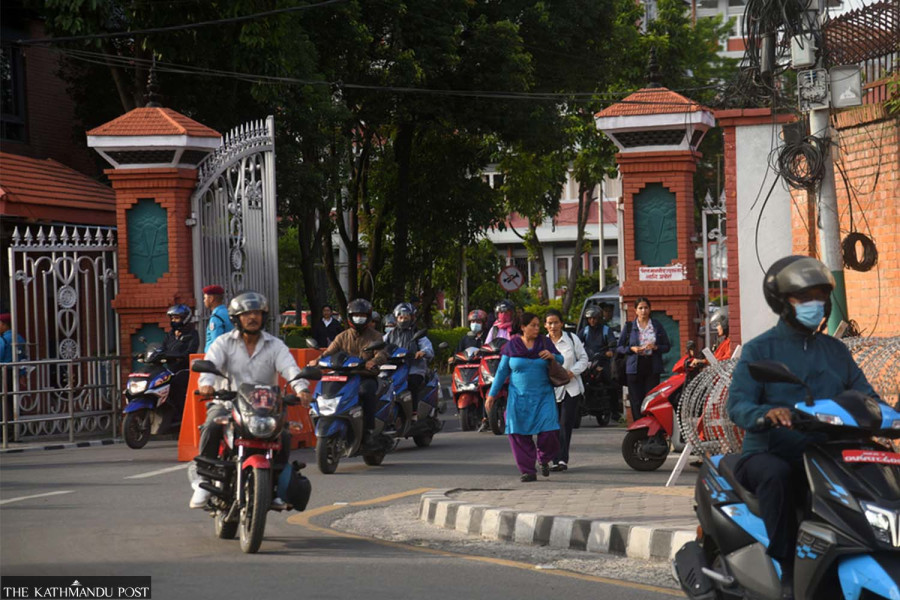
Commission objects to proposed 55-year or 30-year service retirement rule and pension changes, saying they could conflict with legal protections for civil servants. Civil servants leave Singha Durbar in Kathmandu. Post file photo
The government is preparing to revise the draft Civil Service Bill after the Public Service Commission raised objections to several proposed provisions.
The Ministry of Land Management, Co-operatives, Federal Affairs and General Administration plans to make the necessary changes and submit the revised draft to the Cabinet at its next meeting.
Madan Bhujel, secretary at the ministry, said the draft would be revised based on the commission’s recommendations and submitted to the Cabinet soon. He did not disclose which provisions would be changed.
According to ministry officials, the commission has objected to new provisions on retirement and pensions. It has said the proposals are inconsistent with existing legal provisions governing civil servants’ terms and conditions of service.
Following the commission’s feedback that the proposed retirement provisions could run counter to existing law, the ministry has held internal discussions on possible changes to the bill. The minister and senior ministry officials have also discussed which provisions could be revised before the draft is sent to the Cabinet, according to ministry sources.
The commission has rejected proposals for a one-time provision to compulsorily retire civil servants once they reach 55 or complete 30 years in service, to reduce the five-year term of secretaries to three years, and to count only 30 years of service for pension purposes regardless of how long an employee actually served.
“Those provisions, in the commission’s view, would run against existing legal protections governing civil servants’ terms of service. That is effectively a refusal to endorse them,” a ministry source said. “The commission has only provided its advice, and whether the government accepts it is ultimately a matter for the government. But we are discussing revisions in light of potential legal challenges that could arise in court later.”
The ministry is considering removing some provisions or adding new ones before sending the bill to the Cabinet, while ensuring that existing legal protections for civil servants are not adversely affected.
It is also working on an alternative that would retain the proposed retirement rule requiring employees who are 55 or have completed 30 years of service to retire, while protecting benefits guaranteed under existing law.
Under one option being considered, employees who retire at 55 or after completing 30 years of service would be granted a pension based on a service period calculated up to the age of 58.
The ministry wrote to the commission on September 9, following a Cabinet decision on September 3, seeking its comments and recommendations on the draft bill. The commission sent its response to the ministry on September 24.
Joint secretary Purushottam Sharma, spokesperson for the Public Service Commission, said the commission submitted its recommendations after an extensive review and discussion. He said it had assessed the entire draft in light of the Constitution, existing laws, established legal principles and practices, as well as recommendations it had made in the past.
Commission sources said the protection of terms and conditions of service guaranteed to employees when they enter the civil service was a key concern in its recommendations. “It is up to the government whether to listen to or accept the commission’s recommendations,” a commission source said. “But the commission has strongly emphasised that the service, benefits and conditions of employees it recommends for appointment should not subsequently be changed in a way that adversely affects them.”
The Civil Service Act 1993 bars changes to an employee’s terms of service at the time of appointment if those changes adversely affect the employee without their consent. The law currently sets the mandatory retirement age for civil servants at 58 and does not prescribe retirement based on length of service. For pension purposes, an employee’s actual years of service are counted.
Section 58 of the Act states that the salary, gratuity, pension and other service conditions in force at the time of a civil servant’s appointment cannot be changed without their consent in a way that adversely affects them. It also states that where the law is amended in a way that adversely affects those conditions, the amended provisions will not apply to an employee who has not given written consent accepting the changes.
The commission has drawn the government’s attention to these provisions, according to sources. It has advised that employees should not be retired in a manner that adversely affects the terms of service in force at the time of their appointment.
The proposed bill contains a one-time provision to retire employees who have reached 55 or completed 30 years of service. Thereafter, employees would retire only upon reaching 60. The commission has also questioned the fairness of having two different retirement arrangements.
More than five months after the ministry prepared the draft, the bill has yet to be tabled in Parliament.
The ministry made the draft public in early April and sent it to the Ministry of Law on May 26 for its concurrence. The law ministry returned it only after three months. “Nothing is final yet. We are looking for options that will ensure the legal foundation of the future law remains sound,” a ministry official said. “We want to avoid adversely affecting civil servants or giving them the impression that their service benefits have been cut. The ministry is preparing to submit the draft to the Cabinet on Tuesday or the following day, if possible.”




 17.81°C Kathmandu