Ex-Gorkhas seek recruitment revival as Indian Army chief visits Nepal
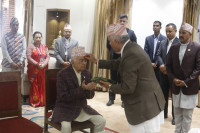
Veterans raised the recruitment freeze directly with Gen Dheeraj Seth in Pokhara, but the Agnipath scheme was left off the formal agenda of his meetings with Nepal’s top officials. Indian Army chief General Dhiraj Seth at a function in Rambazar, Pokhara on Wednesday. Nepal Photo Library
Former Gorkha soldiers who served in the Indian Army have urged visiting Indian Army Chief General Dhiraj Seth to resume recruitment of Nepali youths, which has remained suspended since 2020.
Gaj Bahadur Thapa, central vice-president and Gandaki Province coordinator of the Nepal Bharatiya Gorkha Sainik Board, raised the issue with General Seth after an event at the Pension Paying Office in Ram Bazaar, Pokhara. The Indian Army chief had been in Pokhara before he wrapped up his four-day visit to Nepal on Wednesday.
“We have been raising our voice for Gorkha recruitment, and you must also address it,” Thapa told Seth, drawing applause from fellow veterans gathered at the facility.
Seth did not make a concrete commitment to resuming recruitment under India’s Agnipath scheme. The issue was also left out of the high-level formal discussions held in Kathmandu before he returned to India on Wednesday.
The Agnipath scheme did not feature in Seth’s meeting with Prime Minister Balendra Shah, who also holds the defence portfolio, or in delegation-level talks with Chief of Army Staff General Ashok Raj Sigdel.
Nepali Army spokesman Brigadier General Rajaram Basnet said the formal discussions focused mainly on bilateral military relations, joint training and strategic cooperation. The primary purpose of Seth’s visit was the conferral of the honorary rank of General of the Nepali Army, a senior army official said.
Nepalis’ recruitment into the Indian Army was suspended in 2020 following the outbreak of the Covid-19 pandemic and remained frozen through 2021. India introduced the Agnipath scheme on June 14, 2022, replacing traditional recruitment with a short-service model under which personnel aged 17 to 23, known as Agniveers, serve four-year terms.
Under the scheme, recruits receive a lump-sum payment of around 1.2 million Indian rupees at the end of their service, but do not receive lifelong pensions or medical coverage.
The scheme triggered widespread protests in India and strong reservations in Nepal. Concerns in Kathmandu centred on the potential social and national security implications of returning short-service military personnel without pension security.
The government led by then-prime minister Sher Bahadur Deuba subsequently halted Gorkha recruitment pending a formal bilateral understanding, maintaining that unilateral changes to the recruitment system should not be applied to Nepali recruits without prior consultation.
According to sources at the Ministry of Foreign Affairs, the agenda for Seth’s visit was prepared by the Bilateral Group on Security Issues, comprising officials from the defence and foreign ministries of both countries and senior military officers.
The Agnipath scheme was not included in the group’s framework, officials said. Nepali foreign ministry officials had prepared responses in case their Indian counterparts raised the issue, but no such discussion took place during the visit.
Seth’s visit came amid growing pressure from former Gorkha soldiers, their families and prospective recruits. A week before his arrival, ex-Gorkha associations submitted memorandums to the Nepali government through local administration offices in six major cities.
In Pokhara, the Indian Ex-Gorkha Brigade organised a rally involving veterans, their families and prospective recruits. Participants marched from Pokhara Stadium to the District Administration Office at Sahid Chowk, calling on the government to intervene diplomatically to resume recruitment.
Recruitment and pension concerns
Nepalis’ service in the Indian military dates back more than two centuries, to 1815, following the Anglo-Nepal War and the subsequent peace treaty with the British East India Company.
Over the decades, Gorkha troops have become an important part of Nepal-India military ties, while their pensions and post-retirement benefits have also contributed to the economies of communities across Nepal.
An estimated 36,000 Nepali citizens currently serve in the Indian Army, while around 125,000 Indian Army veterans live in Nepal. The Pension Paying Office in Pokhara alone serves about 60,000 ex-servicemen and their dependants.
Before recruitment was suspended in 2020, around 1,400 Nepali youths were recruited into the Indian Army each year from more than 5,000 applicants who competed in physical and academic examinations held in major urban centres.
Veterans also used Seth’s visit to raise concerns about delays in family pension payments.
Thapa said Nepali youths recruited before 1990 were often enlisted primarily based on physical fitness, without stringent documentation requirements such as citizenship certificates, birth certificates and marriage registrations. Family pensions for widows were introduced only after 1984, during the tenure of Indian prime minister Indira Gandhi, he said.
The lack of documentation from that period has since created discrepancies between Nepali citizenship records and Indian military records over names, spellings and dates of birth.
Thapa estimated that 8,000 to 10,000 widows of former Gorkha soldiers in Nepal are currently unable to claim their pensions because of such discrepancies.
“A name or age on a local citizenship card often differs slightly from military service books,” Thapa said. “Neither the government of Nepal nor the government of India has taken proactive steps to simplify verification.”
He urged Seth to allow pension claims to be verified through photographs and biometric thumbprints instead of requiring exact documentary matches. He also called on the Nepali government to simplify its administrative verification procedures.
Seth assured the veterans that the Indian Army would make every effort to address the welfare concerns of former Gorkha soldiers.
He left Nepal on Wednesday after completing his four-day visit and was seen off at the Tribhuvan International Airport by Lieutenant General Pradeep Jung KC and his wife.




 20.07°C Kathmandu
.jpg)