Nepalis around the world step in to cover footballer Aashish Rai’s medical bills
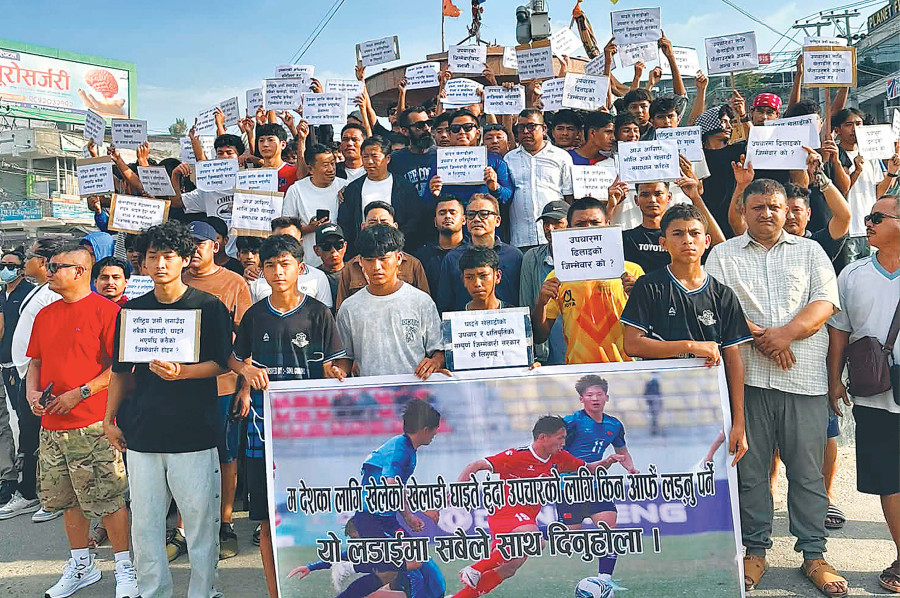
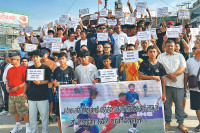
Injured midfielder Aashish Rai has received around Rs2 million from well-wishers worldwide, exposing the sharp contrast between public solidarity and official indifference. Supporters stage a rally in Italahari, Rai’s hometown, on Saturday demanding that the government bear all medical and rehabilitation expenses for the national player. Photo: Aashish Rai’s Facebook
It took footballer Aashish Rai over a year of silent suffering to finally speak out. His injury was mishandled from the outset; he was mistreated during rehabilitation; and the All Nepal Football Association, the country’s football governing body, had provided only erratic support.
Even that meagre backing came to a complete halt following FIFA’s suspension of ANFA on June 24. Rai then found himself stranded in Bangkok, Thailand, where the governing body had sent him for treatment. Left with no choice, Rai was forced to go public with his ordeal. He hoped the new Balendra Shah administration would step in to take responsibility for his recovery as he was injured while playing for the country.
But more than a month after the Post reported his ordeal on July 14, state assistance has proven negligible. To date, the government has provided just Rs150,000, through the National Sports Council.
That, however, is nowhere near enough, Rai told the Post over a phone call on Monday. It costs him between Rs450,000 and Rs500,000 per month to cover his treatment, rehabilitation, medication, and stay in Bangkok. “What should I make of Rs150,000?” he said.
Rai had initially held high hopes for the new government, recalling how happy he felt listening to Balendra Shah’s speech on supporting football from the grassroots during his election campaign. Today, however, that optimism has given way to deep disillusionment.
“The issue has also been raised in the parliament,” Rai said. “But the state is yet to respond properly.”
Harka Sampang, chairman of the Shram Sanskriti Party who got elected to the House of Representatives from Sunsari-1, the neighbouring constituency to Rai’s home in Itahari, had raised Rai’s situation in the parliament a week ago.
It is not that the government has not reached out to Rai yet. Apart from the Rs150,000 support through the NSC, Rai got a phone call from a government representative.
“I do not know which ministry or department the person represented,” Rai said. “He said that the government did not have any law to send money abroad.”
For a lack of adequate government support, Nepalis from around the world have stepped in to help Rai, raising funds for him. And this is how Rai is affording his treatment and stay in Bangkok. This constrast between overwhelming public generosity and state indifference highlights a grim reality for Nepali athletes—celebrated when representing the nation, but forced to depend on public charity when injured in its service.
Contributions have poured in for Rai from across the world—from Nepal to Japan to Australia. Nepal United FC in Australia, for instance, has donated him Rs81,000. The Malaysia-based N Penang FC, in coordination with Himalayan FC and Nepbourne FC, collected Rs1.2 million. Shantinagar FC, a club from Rai’s hometown, is also aiming to collect more funds through the 5th Monsoon Football Tournament, which is taking place soon at Budha Subba Football Ground in Itahari. In Japan, Spice Purbeli FC announced that a portion of the proceeds from its upcoming SMILES GOLD CUP 2026 futsal tournament—scheduled for August 30 in Chiba—will be donated to support Rai’s ongoing treatment.
Support has also come in from individual well-wishers, including Prasamsha Bhandari, a ninth-grader at Tender Feet Boarding School in Sundarharaincha, Morang, who donated her Rs1,000 competition prize money to Rai’s cause.
Funds are also being raised through GoFundMe, a crowdfunding platform.
“The way Nepalis around the world supported me with as much money as they could is how I was able to resume my rehabilitation in Bangkok,” Rai said. “I cannot thank them enough.”
Rai was also heartened by a youth rally organised by his friends and supporters in Itahari on Saturday to press the government for immediate intervention. Demonstrators marched holding placards reading, “Applause when playing for the nation, neglect when injured—how long will this injustice continue?” and “The government must take full responsibility for the treatment and compensation of injured players.”
Public solidarity is there but Rai stresses that meaningful state intervention remains absent.
“The most crucial support—from the state—is still missing,” Rai said. “If given the opportunity, I would like to speak directly with Education and Sports Minister Sasmit Pokharel to explain my reality.”
When contacted, the NSC stated that it plans to release an additional Rs100,000 for Rai through the Athlete Welfare Fund, bringing its total assistance to Rs250,000.
“We initially dispatched Rs150,000 from an emergency fund designated for accidents involving players or staff—a fund that had a total budget of only Rs700,000,” explained Khush Raj Dahal, spokesperson for the NSC. “We are now arranging to reimburse another Rs100,000 through the Athlete Welfare Fund.”
Asked if Rs250,000 was the maximum state support available to a national athlete injured in service of the country, Dahal cited rigid budgetary constraints.
“We cannot spend funds outside designated budget line items,” Dahal said. “This Rs250,000 is the absolute maximum we can extend under current rules.”
To date, Rai has received just over Rs2 million—including the NSC’s initial Rs150,000—through donations from well-wishers and crowdfunding efforts worldwide.
Doctors have advised the midfielder that he will require at least six more months of intensive rehabilitation before he can return home for surgery to remove the hardware in his leg.
“When I last consulted the doctors, they told me I need about six more months of rehab. Only after that can I return to Nepal to remove the steel in my leg,” Rai told the Post. “I have only one fear left: will my treatment come to a halt once again in the coming months for lack of money?”
ANFA has said it would bear all expenses related to Rai’s treatment until he fully recovers and will resume the pending payments and treatment process as soon as the legal and administrative issues surrounding its suspension are resolved. However, given the government’s present handling of the crisis, an immediate resolution—and the lifting of the ban—remains a distant prospect.
Even the ruling Rastriya Swatantra Party’s chief whip Prakash Chandra Pariyar raised Rai’s issue at the parliament on Monday. Whether the government will hear the plea of its own party’s member remains to be seen.
Nayak Paudel covers sports for The Kathmandu Post. He previously worked at the Post (2018–19) and spent over five years at The Rising Nepal. His reporting spans crime, health, education, and social issues.




 23.79°C Kathmandu