He dreamed of playing for Nepal. Now he’s fighting a battle off the pitch
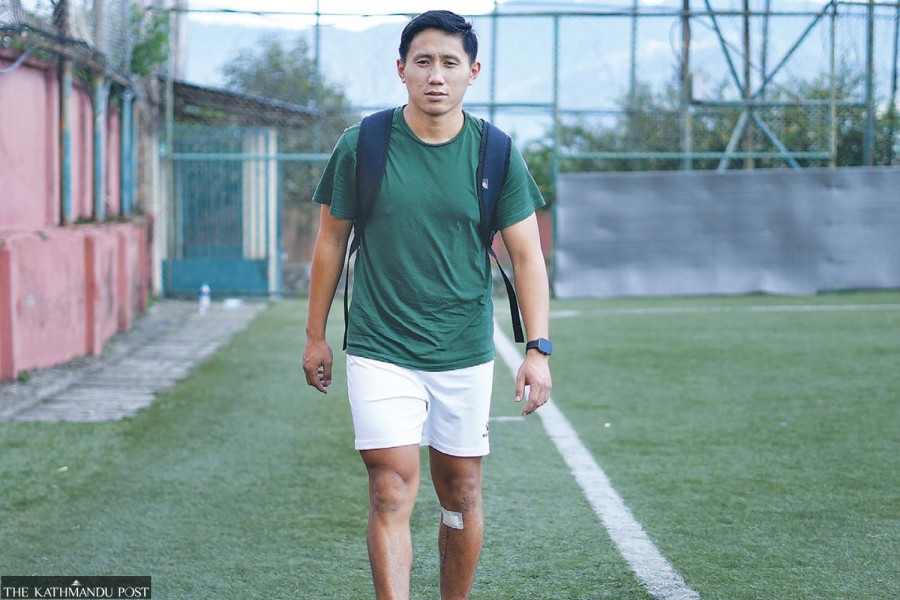
Aashish Rai was once a promising midfielder. Then came a devastating injury and a funding crisis, compounded by ANFA’s indifference.Aashish Rai returns to ANFA’s hostel after exercising at the gym of the ANFA Complex in Satdobato, Lalitpur, on July 31 last year. Hemanta Shrestha/TKP
Aashish Rai had spent his childhood chasing one dream—to don the Nepal national team jersey. Not even his father’s repeated attempts to hide his football boots could keep him away from the game. Then, in the 36th minute of a friendly between Nepal U23 and a representative team of China on February 15 last year, that dream suddenly appeared in jeopardy.
Nepal were trailing 0-1 in front of a loud crowd at Dasharath Stadium. Rai, a midfielder, collected the ball near the halfway line, flicked it past one defender and burst into open space. As another defender closed in, the two collided. Rai tumbled to the ground, his left knee twisting unnaturally. Within seconds, it was clear something was terribly wrong.
Footballers suffer injuries and, with proper treatment and rehabilitation, usually find their way back onto the ground. Rai’s case, however, was different. The way his injury was handled from the very beginning left him fearing that his playing career could be over.
“National youth team member Aashish Rai suffered multiple fractures to his left leg,” the All Nepal Football Association wrote on a ‘get well soon’ Facebook post on March 6, 2025. “He was immediately rushed to the hospital, where he underwent surgery. Rai is currently recovering from the injury and is expected to be off the field for at least a year.”
The reality, however, was very different from what ANFA’s statement portrayed.
Rai was first rushed to Star Hospital in Lalitpur, where he remained on a stretcher for nearly three hours before being transferred to B&B Hospital. Doctors at B&B Hospital were surprised that his injured leg had not even been bandaged before the transfer.
“It was extremely painful. I do not even want to remember it,” Rai told the Post on July 31 last year when he was rehabilitating at ANFA’s gym in Lalitpur. “The way my treatment started and the way I have been treated in different aspects—I am devastated.”
Nearly a year later, Rai’s struggle continues.
He travelled to Bangkok around a couple of months ago to continue his treatment, but says his rehabilitation has come to a standstill after ANFA stopped sending financial assistance more than a month ago. Unable to afford the treatment on his own, Rai says he has been relying on financial support from friends to cover his living expenses while continuing only the rehabilitation exercises he can manage from his hotel.
“My friends have sent me some money, which has helped me cover my lodging and food expenses,” Rai told the Post over a video call on Monday. “But my treatment and rehabilitation at Bangkok Hospital have been on hold for almost a month now.”
Rai informed that he has spent around Rs200,000 in the last one month to survive in Bangkok through friends’ support.
Rai hails from a modest family in Sunsari. He first kicked a football while studying at Him Shikhar English School in Tarahara.
“I was 14 years old when I played in the Coca-Cola Cup,” Rai recalls. “I then also played at U18 level for Sankata FC and Tribhuvan Army FC.”
He was also a part of the Tushal Youth Club squad that finished third in the Martyr’s Memorial ‘B’ Division League in 2019. He also played in the ‘A’ Division for Chyasal Youth Club and New Road Team in the 2021/22 and 2023 seasons, respectively.
In the Nepal Super League, Rai also played for Kathmandu Rayzrs in 2021. He was bought at Rs130,000 for the 2023 season of the NSL by Sporting Ilam FC De Mechi.
Rai’s rapid rise through domestic football marked him out as one of Nepal’s brightest young midfielders. He was also in the national squad when Nepal, under Kuwaiti head coach Abdullah Almutairi, hosted Mauritius in 2022. He did not come off the bench in that game. But it was certain that Rai would soon be playing for the senior national team.
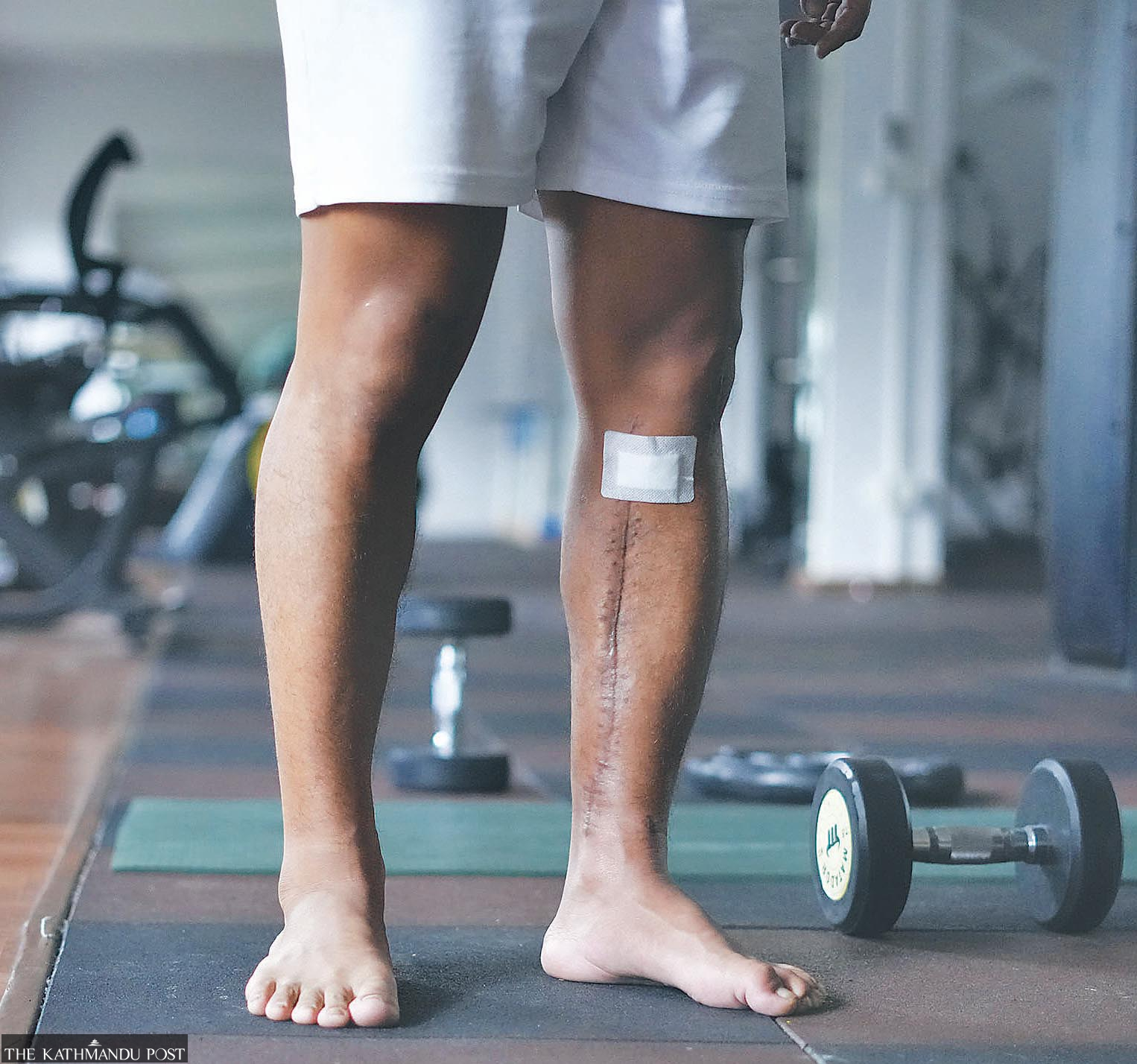
His injured leg after the first surgery. Hemanta Shrestha/TKP
Today, however, football is no longer his immediate concern.
“I don’t even think about returning to the field anymore,” he said, his expression turning somber. “Right now, I just want to be able to walk properly. It pains me when I am following my rehabilitation activities—running, jumping and other forms of exercise.”
But with his treatment in Bangkok on hold due to a lack of funds, even Rai's modest goal of walking properly now seems increasingly out of reach. He says he does not want to return to Nepal to continue his rehabilitation, alleging that his experience with ANFA has left him disillusioned.
“To be honest, treatment in Nepal is good. There are good doctors,” Rai said. “However, treatment alone does not help. Rehabilitation is important, and for that I need proper care. ANFA only added to my misery during the months I stayed at its hostel.”
When the Post met Rai at ANFA’s gym in July last year, the physical toll of the injury was evident.
He was staying at ANFA’s hostel on the side of the artificial turf at the ANFA Complex in Lalitpur. Determined not to rely on crutches all the time, he slowly made his way to the gym by holding onto the railing along the turf. The short walk took several minutes as he moved one cautious step at a time.
Life at the ANFA hostel was no easier. Rai was accommodated on the third floor and had to make his way down to the ground-floor kitchen before carrying his meals back upstairs on his own. He says there were also times when he was told there was not enough food for him.
After he began speaking publicly about his ordeal on Facebook, Rai says ANFA even stationed a security guard outside his room to stop others from meeting him.
The Post had to quietly meet Rai at the gym while most ANFA officials were at Dasharath Stadium for FIFA’s Football for Schools launch on July 31.
Shortly afterwards, Rai said ANFA assured him that his treatment and rehabilitation would receive proper attention. Hoping the promises would be fulfilled, he requested that the Post not publish his story at the time.
For months, Rai chose to endure his frustrations in silence. He occasionally took to Facebook to voice his concerns, but repeatedly held back from seeking media attention, believing the situation would improve.
For a while, it seemed to him that ANFA’s approach had changed. With coordination between ANFA and the Chinese Embassy in Kathmandu, Rai travelled to Yunnan, China, for treatment in September last year. Before heading to Bangkok for further rehabilitation, he was also accommodated in a good hotel, giving him hope that his recovery was finally receiving the attention it needed.
Now, he says, he can no longer wait.
“I cannot wait any longer,” Rai said, struggling to hold back his emotions. “I am frustrated. There is no reason for me to stay quiet anymore. I have decided to fight for justice. All I want now is proper treatment so that I can walk properly again.”
Rai still has a metal plate in his left leg. He says the toes on his left foot do not move properly because the bone has yet to heal fully.
“The doctors in Bangkok say it will take around a year before the plate can be removed,” Rai said. “But with my treatment and rehabilitation on hold, I do not think I will be ready by then.”
Rai says even his family back home does not know the full extent of his ordeal. He also shared that ANFA has not reimbursed all the money that he has spent on his treatment and care, even after he submitted the bills.
“They [my family] will know after this story is published,” he said. “I never wanted to tell them about the problems I have been facing because they already worry so much.”
Asked why financial support for Rai had stopped, ANFA officials attributed it to FIFA’s suspension of the association.
“We have been supporting Aashish from the very beginning,” a senior ANFA official told the Post on condition of anonymity because of the sensitivity of the matter. “But we cannot continue that support now that ANFA is under suspension. The office is closed, and the FIFA funds through which we were supporting him have also stopped.”
However, those aware of the situation since Rai’s injury say that ANFA is lying.
“ANFA is lying,” Bikram Lama, president of the Nepal Football Players Association (NFPA), told the Post. “We had asked ANFA to provide support to Aashish since at least a month before the FIFA suspension, as the suspension from the National Sports Council had also led ANFA to stop sending support to Aashish.”
Lama is currently the point of contact for Rai because his calls and messages to ANFA officials, particularly the president and general secretary, have gone unanswered.
Lama, who suffered a similar injury during his playing career, said Rai’s prolonged recovery could have been avoided with proper treatment and rehabilitation.
“I had an injury similar to Aashish’s during my playing days,” Lama told the Post. “But I returned to football after proper treatment and rehabilitation. Aashish, however, has not received the same support, and that is why he is still struggling.”
Lama said the NFPA has repeatedly urged ANFA to ensure Rai receives proper care, but those efforts have yielded little results. The association has now approached the National Sports Council seeking support for the midfielder.
“The NSC has shown interest in helping Aashish,” Lama said. “But it seems we will have to wait until the new fiscal year begins.”
Bishal Shrestha, the former national footballer who was appointed vice-chair of the National Sports Council last month, said the council would do whatever it could to help Rai continue his recovery.
“I was also part of the NFPA delegation that repeatedly urged ANFA to support Aashish,” Shrestha told the Post. “It was through that delegation that Aashish was eventually sent to Bangkok. But to hear that he still has not received the support he needs is disappointing. We have also received a formal request at the NSC, and we will do whatever is possible to help him recover.”
But for Rai, time is running out.
“My visa is expiring in less than a week, and I do not know how to move forward amid the lack of support from ANFA,” he said. “If I extend my visa and stay, I do not have the money to survive, let alone continue my treatment and rehabilitation. I am looking for a long-term solution.”
Nayak Paudel covers sports for The Kathmandu Post. He previously worked at the Post (2018–19) and spent over five years at The Rising Nepal. His reporting spans crime, health, education, and social issues.




 16.82°C Kathmandu