Shah to resume stalled one-on-one meetings with selected ambassadors next week
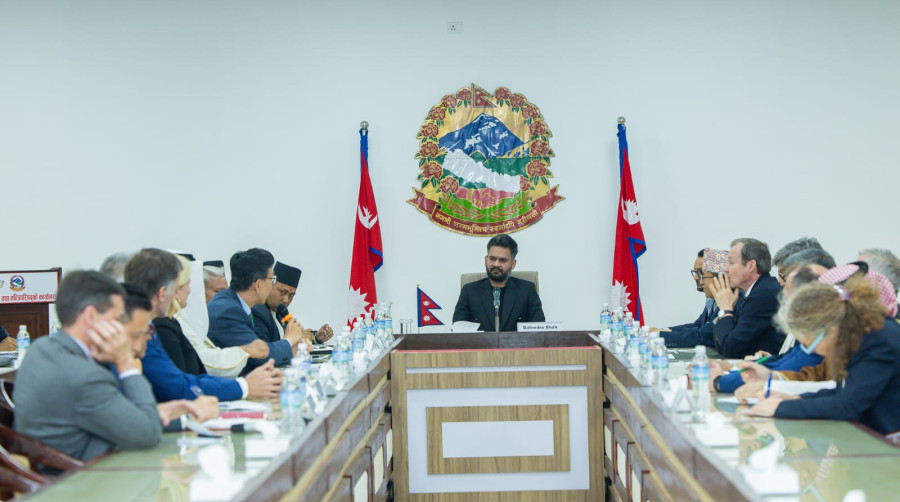
The plan to meet envoys was deferred after tension in Tarai-Madhesh, said PM’s aides. Prime Minister Balendra Shah’s move to hold joint meetings with Kathmandu-based ambassadors on April 9 and May 26 was widely praised by Nepali diplomats, foreign policy experts and observers as a more transparent and equitable approach to diplomatic engagement. Photo: Courtesy of prime minister’s secretariat
Breaking his self-imposed rule, Prime Minister Balendra Shah last week planned one-on-one meetings with ambassadors from selected countries.
Accordingly, informal communication was sent to Indian Ambassador to Nepal Naveen Srivastava, Chinese Ambassador Zhang Maoming, and the US Embassy’s Chargé d’Affaires Scott Urbom.
After receiving communication that they would be contacted for meetings with the prime minister, the ambassadors expressed their happiness about the prospect, according to officials at the Ministry of Foreign Affairs and staff members of the respective embassies.
“We could easily sense a kind of excitement among the ambassadors after they were informed about meeting the prime minister. Personally, they had sent private messages to the divisional heads at the foreign ministry and others about the preparation,” said an official at the ministry.
However, the prime minister’s plan has yet to materialise. His aides attributed the delay to the communal tensions in the Tarai-Madhesh region.
“The initial plan to meet the Indian and Chinese ambassadors separately has not changed,” said one of Shah’s aides. “While the exact dates have yet to be announced, the meetings, being coordinated by the Ministry of Foreign Affairs, are expected to take place next week.”
Shah had been maintaining a self-imposed rule of not holding one-on-one meetings with Kathmandu-based ambassadors, which led him to hold a meeting in a group. His move to hold joint meetings with Kathmandu-based ambassadors on April 9 and May 26 was widely praised by Nepali diplomats, foreign policy experts and observers as a more transparent and equitable approach to diplomatic engagement.
However, after the government completed 100 days in office, political adviser Asim Shah and others advised the prime minister to begin meeting with various domestic stakeholders, including members of the business community, media representatives, contractors, and Kathmandu-based ambassadors, according to priority.
His consultations with business communities and his decision to move away from his earlier stance of not holding individual meetings with ambassadors were the result of recommendations from his advisers, according to the aide.
“It is only natural to begin with the ambassadors of our two neighbours, India and China, given Nepal’s foreign policy priorities,” said the aide.
To underscore that New Delhi and Beijing are equally important to Nepal, Shah is scheduled to meet Indian Ambassador Naveen Srivastava and Chinese Ambassador Zhang Maoming on the same day, followed by a meeting with the US Embassy’s Chargé d’Affaires.
Shah, who assumed office as prime minister on March 27, had initially refused to meet even senior US diplomats visiting Nepal. He turned down requests from the US Embassy in Kathmandu for meetings with US Assistant Secretary of State for South and Central Asian Affairs Samir Paul Kapur and President Donald Trump’s special envoy for South and Central Asia, Sergio Gor.
US Under Secretary of State for Public Diplomacy Sarah B. Rogers also did not receive an audience with the prime minister during her visit.
In the past, newly elected prime ministers would meet foreign ambassadors individually at the Prime Minister’s Office or their official residence within days of assuming office.
Anil Giri is a Chief Sub Editor covering diplomacy, international relations and national politics for The Kathmandu Post. Giri has been working as a journalist for more than two decades, contributing to numerous national and international media outlets.




 14.81°C Kathmandu