Communal unrest exposes failures in Nepal’s intelligence system
The National Investigation Department has long failed to provide timely intelligence on major security threats after years of neglect by successive governments. Nepali Army soldiers out on a patrol in Dewanganj, Sunsari last week after a curfew order was enforced after communal violence erupted on July 26. Parbat Portel/TKP
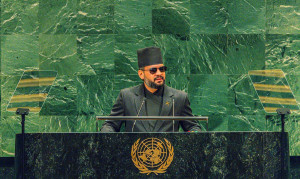
When communal tensions flared up in Dewanganj of Sunsari and swiftly spread across neighbouring districts in Madhesh province, Prime Minister Balendra Shah summoned Inspector General of Nepal Police Dan Bahadur Karki and Armed Police Force chief Narayan Datta Paudel to his office for an emergency briefing.
During the separate high-level consultations held at the Office of the Prime Minister and Council of Ministers on July 29, Shah notably excluded Tekendra Karki, head of the National Investigation Department (NID)—the country’s sole civilian intelligence agency operating directly under his office.
During the meeting with the two security chiefs, Prime Minister Shah sought answers regarding the breakdown of order in Madhesh. “How did the situation in Sunsari go out of control? Under what exact circumstances were live rounds fired, and how did warning shots result in a civilian fatality?” Shah asked. A second victim succumbed to injuries the following day, July 30.
According to the briefings submitted by the two security chiefs, the initial confrontation erupted between two local groups in Sunsari at approximately 10:13 pm on July 26. A small police unit led by Assistant Sub-Inspector Prakash Kumar Shrestha from the Kaptanganj Police Post was dispatched to the scene.
As the crowd grew increasingly hostile, Shrestha requested urgent reinforcements. Inspector Rakesh Rai arrived shortly after from the Area Police Office in Dewanganj with an eight-man team. However, both security details were ambushed by violent mobs armed with wooden logs, stones, and bamboo sticks, forcing an immediate retreat.
Under heavy assault, Inspector Rai fired three warning rounds from his pistol. The security heads stated that a subsequent Armed Police Force unit deployed to regain control of the perimeter fired at least 20 warning shots at around 10:45 pm.
A former chief investigation director of the NID said Prime Minister Shah missed a critical independent perspective by omitting the intelligence chief from these briefings.
“In Siraha, it remains completely unverified who actually fired the lethal bullet, as neither security agency has admitted that their personnel fired the fatal round,” he said. “Had the prime minister consulted the NID chief, he could have received objective, unvarnished information distinct from the operational accounts offered by the frontline police forces.”
However, Prime Minister Shah saw little utility in meeting NID chief Karki. By statutory mandate, the department is charged with gathering preemptive intelligence on matters threatening national security and alerting the executive before crises erupt. While law enforcement agencies act after the fact, the NID is expected to operate beforehand.
According to its official mandate, the department’s core responsibilities encompass collecting intelligence on economic crimes, terrorism, and organised crime, as well as detecting threats to religious, cultural, and communal harmony.
Yet, the NID has repeatedly stumbled in its core mission and led political leaders to systematically discount its strategic assessments. This systemic disuse peaked during the Gen Z protests on September 8 last year, when then-prime minister KP Sharma Oli reportedly left an entire week of intelligence dossiers unread on his desk.
In the latest Sunsari tension, the intelligence structure failed to deliver any advance warning of widespread communal unrest. Home Minister Sudan Gurung recently confirmed that no state agency provided actionable intelligence ahead of the clash in Sunsari.
Operationally, the NID had deployed a team in Sunsari led by Deputy Investigation Director Bimal Ghimire, supported by a provincial intelligence structure headed by Investigation Director Indra Lama. Yet, this entire network failed to detect the rising communal tension.
“This is hardly the first instance where our premier intelligence agency failed to provide advance warning on critical national security developments,” a senior official at the Prime Minister’s Office revealed. “In several previous instances, when the prime minister requested specific briefings, the department leadership was entirely oblivious to the situation on the ground.”
A deputy investigation director within the department expressed dismay that while the chief district officer and law enforcement leadership in Sunsari were summarily replaced following the clashes, the NID setup remained entirely untouched.
“The situation has reached a point where political authorities seem to have forgotten that an intelligence agency even exists,” the official lamented. “In Sunsari, the failure was not limited to the police and armed forces; the civilian intelligence apparatus failed completely.”
Ironically, Prime Minister Shah had reshuffled the Business Allocation Rules on May 15 specifically to strengthen the NID by pulling it directly under the purview of the Prime Minister’s Office.
According to an official at the department, former secretary Govinda Bahadur Karki, currently serving as the chief secretary, had received routine reports from the NID and advocated bringing the agency directly under the prime minister to build a robust information-gathering body.
Former prime minister Oli had similarly centralised the agency under his office prior to the Gen Z movement and drew sharp political criticism for consolidating state power.
The election government led by Sushila Karki subsequently returned the NID to the Ministry of Home Affairs. However, the Good Governance Roadmap 2025 explicitly recommended ending the practice of shifting the agency between ministries, advocating for its permanent placement under the Prime Minister’s Office to ensure institutional stability.
Although the agency returned under Prime Minister Shah’s office, it failed to earn the executive’s operational confidence.
In the past, the agency was brought under the Prime Minister’s Office with the intent of developing counter-intelligence capabilities. Intelligence officers anticipated enhanced political backing to modernise the organisation. Instead, despite operating under a strong government, the department faced unprecedented neglect.
“The NID’s budget has been drastically slashed this fiscal year, with operational funds for information gathering cut by 50 percent,” said a senior official at the department. “Field intelligence requires sustained financial investment. When field officers lack basic resources, intelligence gathering collapses.”
While overall budgetary allocations for home administration were scaled down by Finance Minister Swarnim Wagle in the latest budget, defense allocations saw a notable increase.
Commenting on the intelligence lapse, Nepal Police former additional inspector general Tek Prasad Rai, who served extensively in the Police Special Bureau, emphasised that Sunsari’s history of Hindu-Muslim friction required perpetual high-level surveillance.
“Several active local organisations in the area require continuous monitoring, yet our intelligence apparatus appeared completely oblivious,” said Rai. “This was a collective failure of both the NID and the specialised intelligence units of the Nepal Police.”
Rai highlighted that the Madhesh region had witnessed recurring friction over the hoisting of religious flags at Ramananda Chowk [Janakpur] and provocative public statements. “Even when the decision was taken to remove the disputed flag that triggered the violence, no proactive mediation was initiated. This represents a severe operational lapse,” he added.
Established in 1951 as the central intelligence department, the agency underwent multiple structural transformations. During the 1970s, the NID played a decisive role in gathering actionable intelligence on Khampa insurgents operating in Mustang, earning widespread praise for enabling security forces to disarm the rebellion.
“NID officers provided precise intelligence to security forces showing that arms were being smuggled from Pokhara under the guise of Red Cross humanitarian aid,” said Rajendra Kunwar, author of books detailing the Khampa insurgency.
On August 12, 1975, NID intelligence led to the arrest of a foreign embassy official in possession of confidential cabinet minutes, a case that implicated Bijay Chapagai, private secretary to then Assistant Minister for Water Resources Dhyan Bahadur Rai. During the height of the Maoist conflict after 1996, the department conducted 'Operation Mustang' in coordination with Britain's MI6.
However, following the political change of 1990, the agency’s external intelligence functions were stripped, restricting its scope strictly to domestic intelligence. Department veterans lament that after 1993, successive political administrations reduced the agency to a patronage hub for political appointments.
Former home ministers, including Govinda Raj Joshi, Khum Bahadur Khadka, and Bamdev Gautam, faced persistent criticism for filling department positions with political loyalists. Consequently, the NID’s core function degraded into compiling press clippings and preparing routine political dossiers.
Addressing these structural flaws, former NID additional chief investigation director Shreepurush Dhakal remarked that while discussions frequently reference global agencies like the CIA (USA), RAW (India), or Mossad (Israel), commentators overlook the strategic priority that foreign leaders accord to intelligence.
“The NID often submits intelligence reports, but when decision-makers fail to review or act upon them, organisational capacity naturally erodes,” Dhakal told Kantipur. “Strengthening the NID requires firm political will, followed by targeted financial investment and capacity building. When the state leadership takes intelligence seriously, these operational failures will disappear.”




 15.26°C Kathmandu