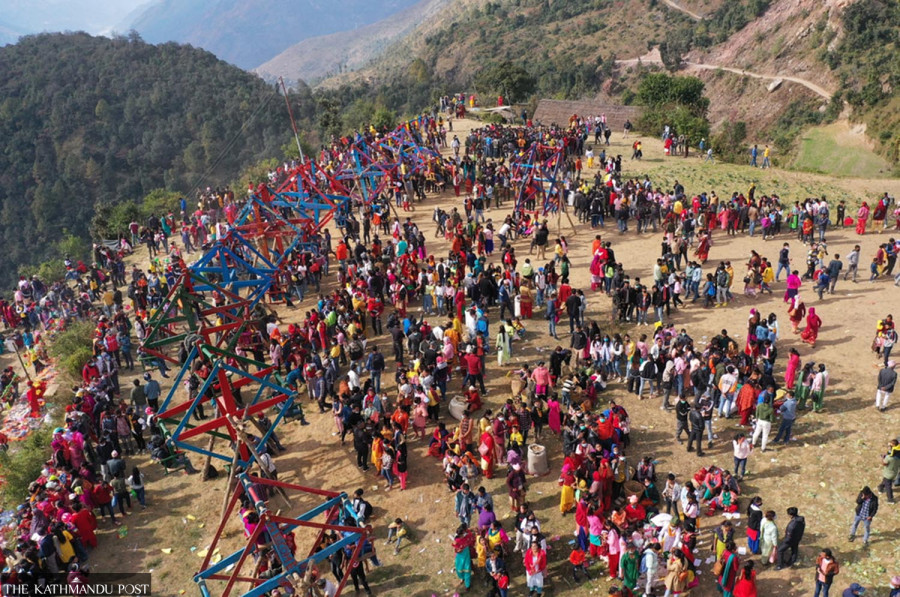
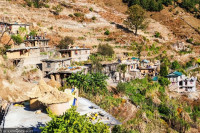
Hundreds of years-old fairs across the hill districts offer a meeting place for worship, folk performances and community celebrations. The Digre Mela underway in ward 5 of Musikot Municipality, Rukum West. Post Photo
As the Dashain and Tihar celebrations wind down, the hills of Karnali come alive with traditional fairs, drawing devotees and visitors from across the region. Among the most prominent is the five-day Digre Mela in Musikot Municipality-5, Rukum West, which began on Friday.
Held annually from Haribodhini Ekadashi to the full moon, the fair is so deeply rooted in local life that Musikot Municipality has declared Monday and Tuesday public holidays to mark the occasion.
The temple management committee estimates that around 100,000 devotees will visit this year, similar to last year’s turnout.
Many come to pray for prosperity, wealth and children, while others are drawn by the traditional dances and cultural performances that make the fair more than a religious gathering.
“People throng the temple to pray for blessings of food, wealth and children,” said Lal Bahadur KC, chair of the temple management committee. “Rare traditional dances such as ‘Sagal’, ‘Garuwa’, ‘Paiseru’ and ‘Singaru’, along with cultural processions, give the fair its distinct cultural and historical significance.”
A bell dating back to 1584-85 is preserved at the temple. Its presence has led to the belief that worship and the annual fair have been held there since at least that time, KC said.
The fair also has a strong social significance. Many people who return to their home districts in Rukum West and neighbouring areas for Dashain and Tihar make a point of attending before heading back.
Devotees travel to Digre from Rukum East, Rolpa, Salyan, Jajarkot, Dang and Surkhet, as well as other parts of Rukum West. Alongside prayers and other rituals, animal sacrifice remains an important part of the celebration. Nearly 1,000 goats are sacrificed during the fair, according to KC.
Digre is one of several traditional fairs that bring Karnali’s hill communities together after Dashain and Tihar. Jajarkot hosts the Ramidanda and Ramailo fairs, Dharapani Mela, Jhadeu Mela and Karkijyula Mela. Other well-known gatherings include the Shankhapipal, Beltapu and Rimna fairs in Rukum West.
The fair season continues through the winter and into spring, with gatherings marking Mangsir Purnima, Poush 15 celebrations, Maghe Sankranti and Chaite Dashain.
“For nearly three to four months, fairs are held in villages across the region,” said cultural scholar Purushottam Upadhyay. “The traditional dances, songs and cultural performances showcased at these gatherings help preserve local traditions and pass them down through generations.”
The Kumakh and Chhayachhetra fairs in Salyan are also popular, as are the Dandimadi and Bestada fairs in Dailekh.
Unlike commercial festivals organised primarily as trade and entertainment events, these gatherings have been part of local life for hundreds of years. They provide a space for people from neighbouring villages to meet, celebrate and showcase their cultural heritage through folk performances.
Local traditions vary across districts. Hudke and Deuda are among the best-known folk dance and music forms in Dailekh, while Jajarkot is known for Deuda, Khyali, Khando, Garra and Tappa dances.
The gatherings gain much of their character from these performances, said Amar Sunar, a community leader from Dailekh. As villagers come together to present the music and dances distinctive to their communities, the fairs become an important expression of the region’s cultural identity.




 21.12°C Kathmandu