Nepali Congress factions hold separate events to commemorate party founder BP
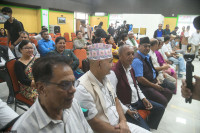
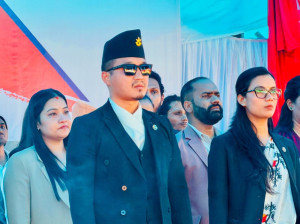
Dissident leaders announce an August 14 national gathering and warn of forming a new party if efforts to restore unity fail. Leaders of the Nepali Congress dissident faction pictured at a function organised to mark the 44th death anniversary of BP Koirala, the party’s founding leader and ideologue, at Nepal Academy in Kamaladi, Kathmandu, on Wednesday. Dipesh Darshandhari/TKP
Six months after a special general convention triggered an internal power struggle in the Nepali Congress, the party’s deepening rift remains unresolved, with leaders loyal to former president Sher Bahadur Deuba moving ahead with their plan to form a separate party.
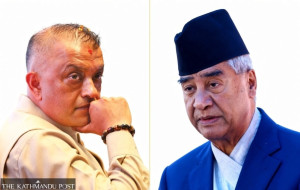
On Wednesday, the two rival factions marked the 44th BP Memorial Day by holding separate programmes. Addressing a gathering organised by the dissenting faction, leaders warned that they would form a new party if efforts to reconcile with the Congress establishment led by Gagan Thapa failed.
The faction also announced a national gathering in Kathmandu on August 14 to chart its future political course.
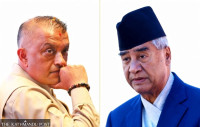
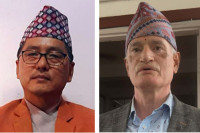
Purna Bahadur Khadka, who leads the Deuba camp, said that discussions on accommodation of the dissenters were not aimed at securing positions for themselves but were intended to achieve a “dignified unity” with the party headquarters.
“We are not going to remain inactive. We are ready to move forward by bringing young leaders to the forefront and standing as their shield,” Khadka said, hinting at the possibility of forming another party. “We do not want anything for ourselves. We fought even during the Panchayat era for dignity. We would rather die than compromise on our dignity.”
Meanwhile, the establishment faction led by party president Thapa observed the memorial for the late party founder BP Koirala with a two-day event. After organising a “Green Run” on Wednesday to raise awareness about climate change, it held a discussion on Thursday on Koirala’s political philosophy, democratic socialism and contemporary challenges facing the country.
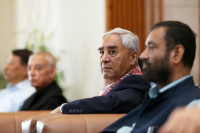
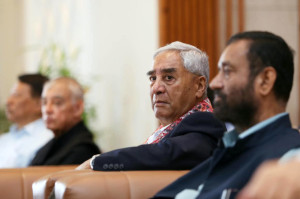
But the commemorations also laid bare the party’s deepening divisions. Senior leader Shekhar Koirala attended Wednesday’s programme organised by the Deuba faction, a move that drew attention as he had previously stayed away from events hosted by the dissident camp.
Others attending the function included senior leaders Prakash Man Singh, Krishna Prasad Sitaula, Bimalendra Nidhi, Shashank Koirala, Bijaya Kumar Gachhadar and Prakash Sharan Mahat.
Badri Pandey, a leader close to Shekhar, said the senior leader had informed his supporters that he would attend the function.
“We knew in advance that Shekhar dai would attend. Once he made up his mind, we did not try to stop him, but we decided not to go,” Pandey said.
At the event, Koirala took aim at Thapa’s leadership, accusing the party of drifting towards authoritarianism.
“The Nepali Congress was founded to fight authoritarianism,” he said. “Now authoritarian tendencies are emerging within the party itself, and they must be stopped.”
At the centre of the dispute is the fate of the 111 office bearers and central members elected at the party’s last convention. The dissident faction wants them inducted into the new Central Working Committee as a whole.
The establishment faction rejects the demand, arguing that accommodating all 111 leaders would create a parallel power centre, institutionalise factional politics and increase pressure for a formal split.
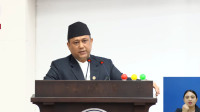
Joint general secretary Prakash Snehi said the party would not accept collective integration under any circumstances.
“A separate party has not been formed, nor are there differences over policy, principles or programmes. The party president, vice-presidents and other office bearers made serious efforts to achieve unity within the party statute. But consensus broke down over the demand to induct all leaders elected at the 14th general convention,” Snehi said.
“Collective integration is not possible. It would be a regressive step, and the party statute does not allow regressive decisions.”
Leaders close to president Gagan Thapa argue that the arrangement adopted after the 2007 merger between the Nepali Congress and Nepali Congress (Democratic), under which positions were shared on a 60:40 basis, entrenched factional quotas that continue to shape the party. Repeating that model, they say, would undermine the reform agenda endorsed by the special general convention.
January’s special general convention declared the party’s transition to “Congress 2.0”, pledging to move away from the old political culture and adopt a new organisational model. But senior leader Shekhar Koirala rejected the concept and argued there has been no change in the political ideology of the Congress.
“What exactly is Congress 2.0? No one really understands what it means,” he said. “There is also talk of social democracy, but the Congress’s social democratic ideology has always been rooted in BP Koirala’s socialist philosophy.”
The establishment also argues that carrying over the old power structure into the new executive would undermine its promise of renewal. Newly elected office bearers are also concerned that accommodating all former CWC members could weaken their own prospects ahead of the 15th general convention, although Snehi denied that such concerns were influencing the leadership.
The Deuba-Khadka faction, however, sees collective integration as essential to preserving its political relevance. Its leaders argue that individual appointments would weaken their bargaining power and reduce their influence in the next general convention.
“The establishment must accept one of two options: either collectively integrate the leaders elected at the 14th general convention into the new structure or create a powerful mechanism to ensure a free and fair 15th general convention,” Prakash Sharan Mahat said at the Wednesday event. “Otherwise, the national gathering will decide our future [course].”
Many leaders in the old establishment believe an organised faction remains essential to maintaining political influence. With the Congress long shaped by factional bargaining and quota-sharing, they argue that only collective strength can preserve their standing within the party.
Although few of them are seen as contenders for the party presidency, many still hope to influence the next leadership through a balance of power. Khadka is 70 now, while Krishna Prasad Sitaula is 79, Shekhar Koirala and Prakash Man Singh are both 75, Bimalendra Nidhi is 70 and Shashank Koirala is 67.
Former president Sher Bahadur Deuba, who is currently abroad, sent a message saying he would return to Nepal soon. Leaders close to Deuba said preparations for the August 14 national gathering are being made in consultation with him, and efforts are under way to bring him back before the event.
If no agreement is reached by then, the question of who would lead a new political force remains unresolved.
Many leaders in the Deuba camp believe Shekhar Koirala would be the most credible figure to lead such a party. However, both Koirala and Khadka have privately told close associates that they are reluctant to split the Congress.
Party leaders view Koirala’s appearance at Wednesday’s programme in that context. Badri Pandey, a leader close to him, said his group had no knowledge of any plan for Koirala to lead a breakaway party.
“We stayed away from the special general convention because we did not want the party to split,” Pandey said. “For the same reason, we did not attend Wednesday’s programme, even though Shekhar Dai did. We feared our presence could be interpreted as supporting a division.”
He said leaders like him were left in a difficult position on BP Memorial Day, as they felt unwelcome at both camps’ events.
If Shekhar Koirala declines to lead a new party, some leaders in the dissident camp have floated former general secretary Shashank Koirala as an alternative, arguing that BP Koirala’s son could appeal to the party’s traditional support base. Nidhi, Singh and Sitaula are also seen as possible contenders, although the faction has yet to decide.
The dissident camp has accused party president Thapa of failing to make a genuine effort to restore unity.
“Unity is not possible unless President Thapa truly wants it,” Khadka said.
Thapa also faces the challenge of competing with the Rastriya Swatantra Party, which draws support from a similar democratic constituency. He is now caught between accommodating the party’s old guard and advancing the reform agenda endorsed by the special general convention.
The Congress has a history of both splits and reunifications. The Nepal National Congress was established in 1947, while the Nepal Democratic Congress was formed in 1948. The two merged in 1950 to create the Nepali Congress and lead the armed struggle against the Rana regime.
The party split again in 2002 when Sher Bahadur Deuba formed the Nepali Congress (Democratic), before reunifying in 2007.
The current dispute reflects a broader contest between the Congress’s traditional leadership and a younger generation seeking change. The dissident camp includes leaders linked to the party’s historic legacy, including Shashank Koirala, Prakash Man Singh, Bimalendra Nidhi and Shekhar Koirala, while Thapa represents a newer leadership that emerged from the special general convention.
Political analyst Puranjan Acharya said the responsibility for restoring unity rests primarily with the establishment faction. Holding separate functions on BP Memorial Day instead of presenting a united front, Acharya said, sent a troubling message to the party and the country.
Analyst Geja Sharma Wagle shared a similar view, saying that the Congress’s inability to commemorate BP Koirala together undermined the values of unity and democratic politics that he championed throughout his life.
“The greater the responsibility a leader carries, the greater the duty to initiate unity,” Acharya said. “The party must preserve its existing members while building a new Congress. Abandoning them in the name of renewal could prove disastrous.”
He said the leadership missed an opportunity to resolve the six-month-long dispute on BP Memorial Day.
“At a time when democracy is under strain and constitutional institutions are weakening, the Congress, which should defend democratic values, is itself divided,” Acharya said. “What is the point of winning control of the party if the country loses its way? The sooner the Congress reunites, the sooner it can help put the country back on track.”
Analyst Wagle urged party leaders to move beyond blame and self-praise, calling for introspection and organisational reform.
“This is a time for self-assessment and self-criticism, but one side appears unwilling to acknowledge that,” Wagle said. “Such behaviour sends a negative message to the public and disappoints party workers.”
He said the Congress needed transformation rather than another round of factional feud.
“This is the time to rebuild public trust, not manage factions and distribute positions,” Wagle said. “The party president must take bold decisions that reflect public aspirations. The current leadership still has an opportunity to revive the Nepali Congress.”




 19.12°C Kathmandu