Standing before the large-scale artworks of Sanod Maharjan brings a peculiar, almost incomprehensible emotion that, with all its abstraction and sublimity, surprises the artist himself.
“In multiple instances, I have found new meanings in my art,” says Maharjan. “Be it while revisiting them long after I pass a particular momentary conscience, or through conversations with people explaining their perspectives.”
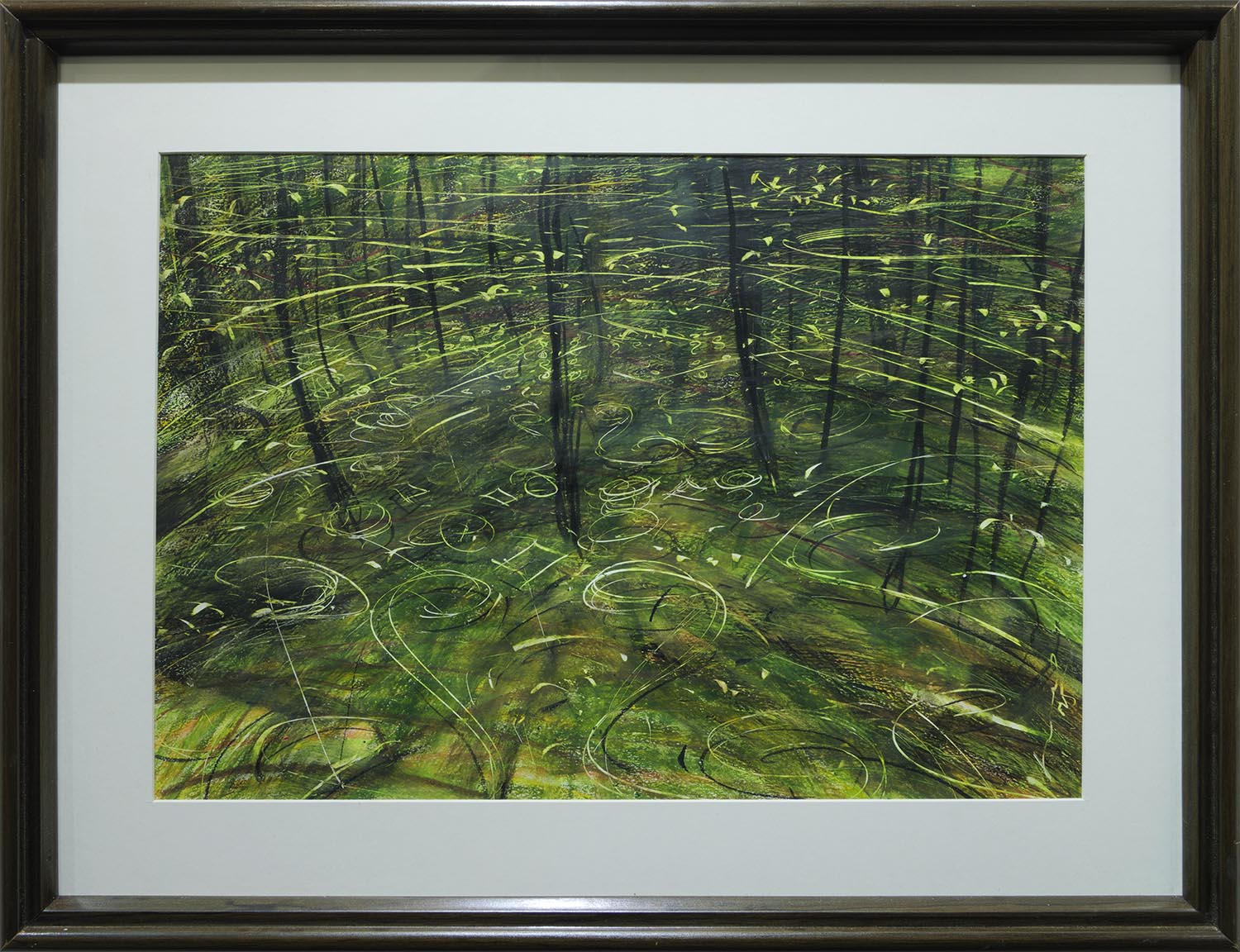
Fragments of yellow, green, purple, red, and black are enveloped in different forms of life in ‘Ek Hul Batas’, avoiding anything larger than itself. With that, the exhibit’s poignancy takes different shapes with each passing viewer.
Perhaps it is this artistic freedom that Maharjan gives both to his audience and to himself that makes his artworks particularly provocative with every viewing. They are placed between intention and spontaneity. Every stroke reflects the artist’s impulse, yet strangely enough, it suggests a conscious choice.
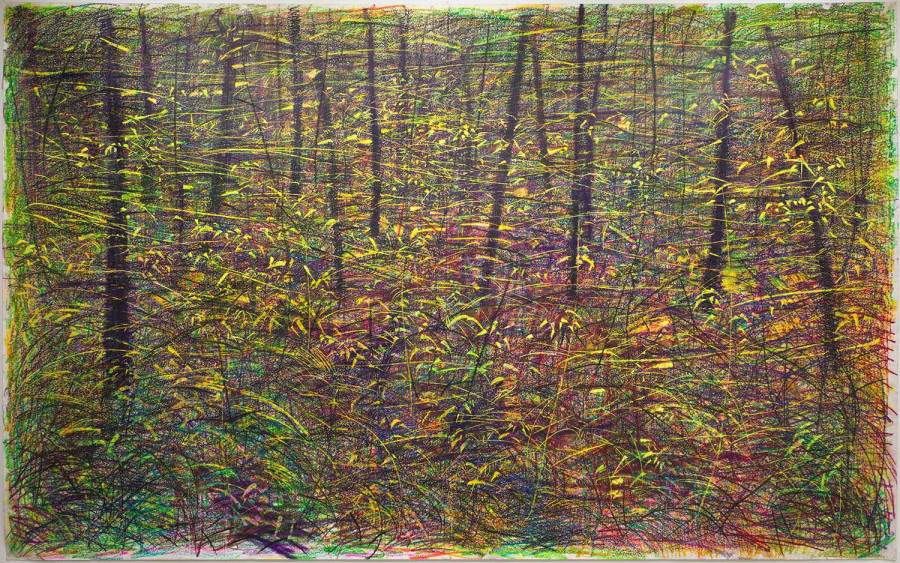
While observing ‘Ek Hul Batas VI', a 121*200 cm artwork featuring layers of oil pastel colours; bright and dimmed and strokes; horizontal, vertical, thick, thin, continuous and fragmented, we gather a point of view from the midst of a forest, witnessing the leaves drift with the wind.
When asked why he used a particular colour, length, breadth and height for a stroke, Maharjan avoids concrete answers as he avoids forms in his abstraction. “This was a calling, a give-and-take relationship, and I allowed myself to wonder and play,” he says.
With his abstractions, a message emerges. To be creative is to avoid being careful.
“Particularly in this one, initially I tried giving it a form and composition – an irresistible urge for an art student. And that is where I lost its meaning,” he says.
The recurring motifs of rivers, wind, land, forest, and leaves imply a lingering presence of Maharjan’s birthplace, Tistung. “I paint as a way of listening to my homeland,” he says. “I left Tistung when I was two, and all I have are the memories, which I try to present in my art.”
“‘Ek Hul Batas’ is about the stories, places and people I wish to remember,” he adds.
And every articulation of his reminisce depicts the tangibility of wind [batas], which becomes the most memorable motif of this exhibit. In this play of memories and colours, Maharjan traces the presence and absence of his grandmother. “It feels as though my grandmother is sending me a message through these winds,” he says.
In different canvases, the colours hold similar meanings. Emotions that yellow carries in ‘Ek Hul Batas VI’ persist in his other artworks. What changes is the reason to create.
Standing in front of ‘Ek Hul Batas IV’, a 152*304 cm artwork, which depicts a rather tumultuous state with more muddled and navy strokes than any other, I ask, “Working on this large paper, do you feel a sense of transformation from beginning to end?”
To which he says, “A lot.”
“Along the way, I find myself,” he adds.
In ‘Ma Chu La I’, the ends of paper meet, making it a trunk–like structure of a tree standing on the bundled-up dried leaves in one corner of the gallery. We find the strokes again – yellow, blue, pink, purple. While they come all at once on the paper, none overwhelms the other, as though, even in chaos, thoughts arrive in harmony.
“A human being does not exist in isolation, and neither does a tree,” Maharjan shares. “Placing one here ultimately amounts to the presence of the entire forest.”
The dried leaves also suggest an environmental consciousness. While he gently walks on them, following the crisp sound of nature, he says, almost like an ode, “People, especially grandmothers, had preserved the environment in the past.”
On the other side of the gallery, Maharjan’s 33 artworks, painted since 2017, lie not so detached from his latter creations. Multiple brown-tinted papers are also pasted on the walls, with his letters to the personified places and flowers, particularly rhododendron, as metaphors for humans.
‘Soliset’ [oil on wood panel] gives a sublime introspection of the moment. The point of view emerges from the middle of a river, and the paint depicts what the eyes saw – rocks, leaves, trees, water. The river converges toward the middle of the panel, and on it are the reflections of the trees with rocks underneath its ripples. “I was partially submerged in the river while painting this,” Maharjan says.
While bringing the live art of nature to the wooden canvas, painting also helps him imagine a world beyond what is prescribed. In ‘Ma yaa chu’, with a notable demonstration of light and shadow onto the hills of Tistung, Maharjan imagines a colourful and subtle end of a rainbow towards its right edge.
“A rainbow is something I had never witnessed there,” he recalls. “Therefore, I pictured one and painted it.”
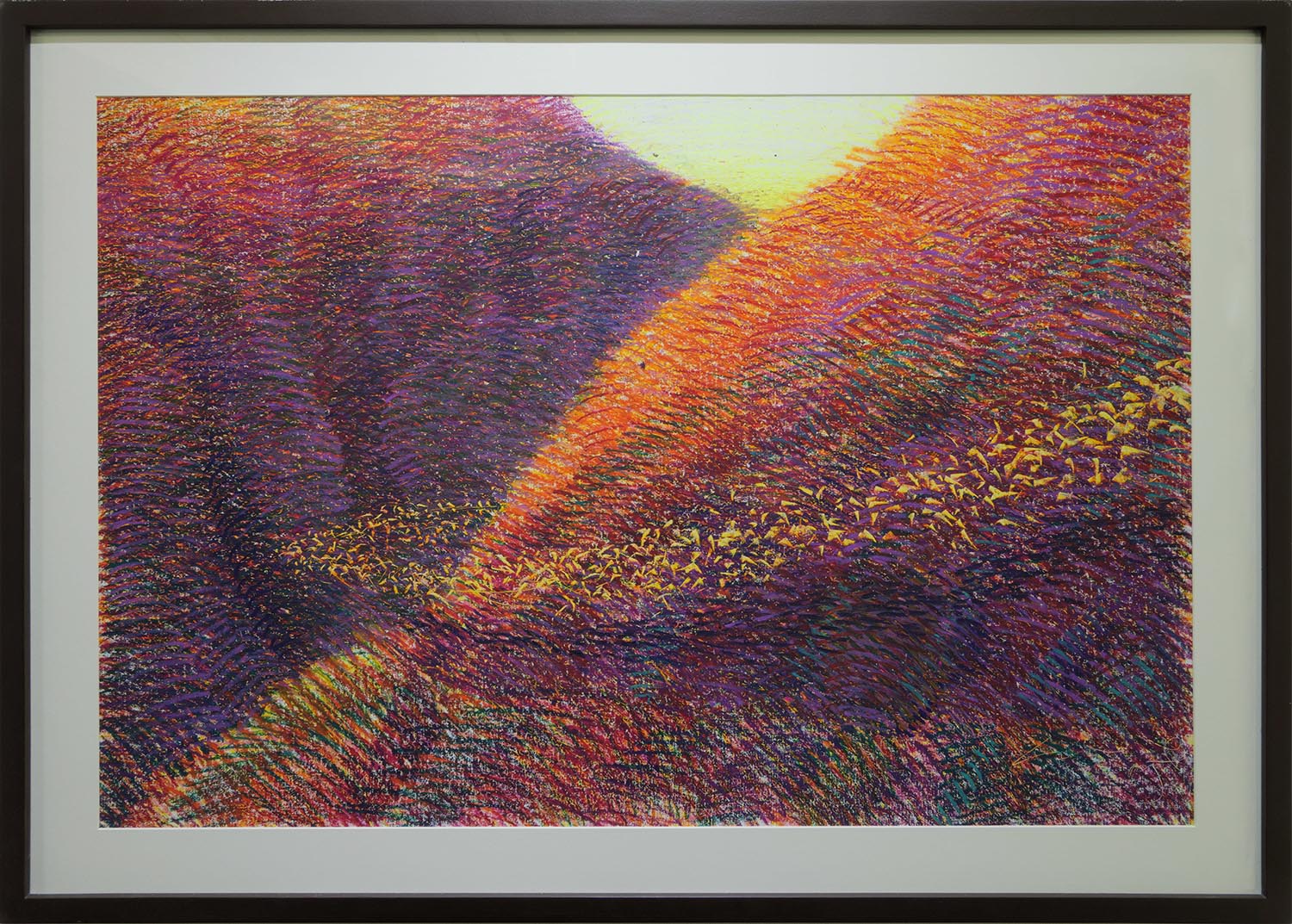
Back to his abstraction, we detect a rather unique piece, mostly because of its title ‘Ouiiiiiiiiiiiiiiiii’ and equally because of its form.
A half-horizontal curve of a hill overlapping a second one with a diagonal division depicts an asymmetrical dynamic contrast between light and dark fields. A bright, radiant light source of the setting sun lies near the top-centre notch, drawing the eye immediately upward before tracing through the magenta, blues, deep purples and violet tones of the hills. “It's the red glow of the setting sun,” says Maharjan. “Right after finishing the painting, I had the urge to shout Ouiiiiiiiiiiiiiiiii.”
With him shunning a distinctive form in most of his abstract paintings, this one stands out as he simply accepts the presence of the two hills with a remarkable light composition. This change feels as though he encountered something that he had chased for a long time. Perhaps it was his peace, a solicitude within the chaos of his abstraction.
Maharjan persistently carries the nature within him, letting it gently embrace his canvases, his memories, wonder, imagination, creativity, and also his profession.
“I am a full-time farmer and a part-time artist,” he says.




 23.1°C Kathmandu