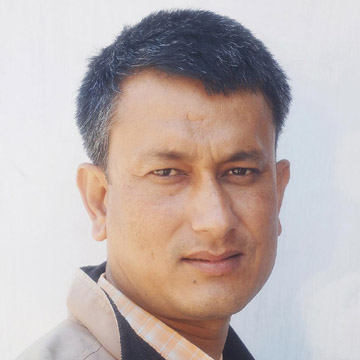
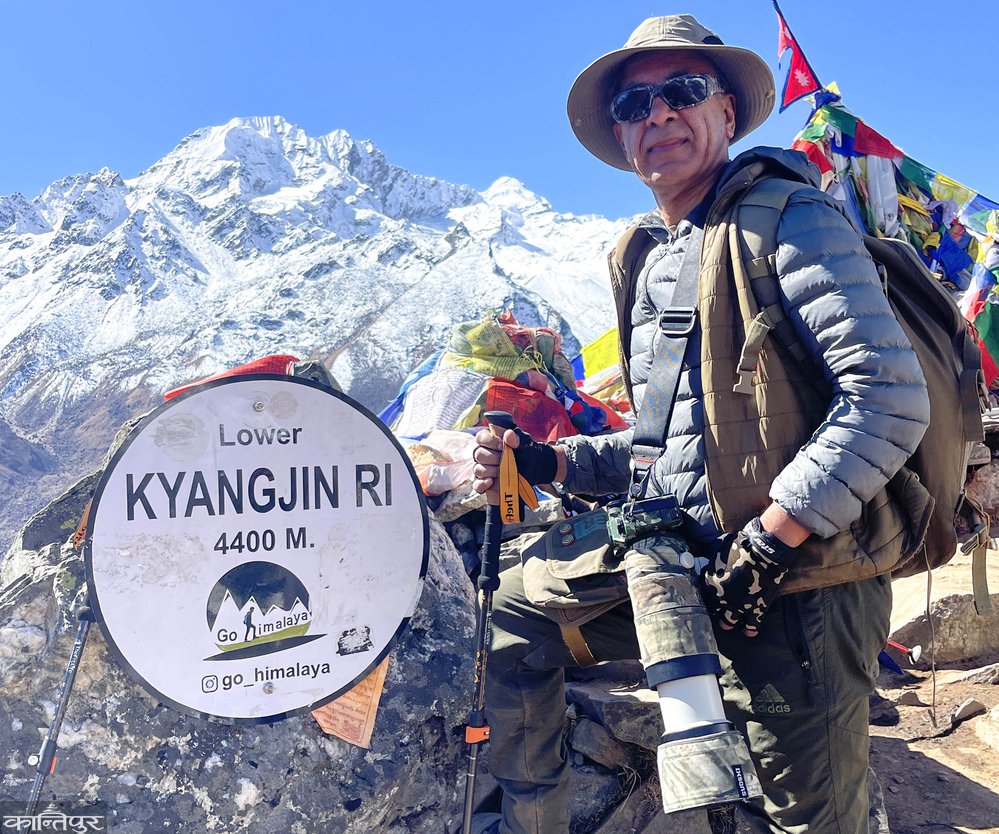
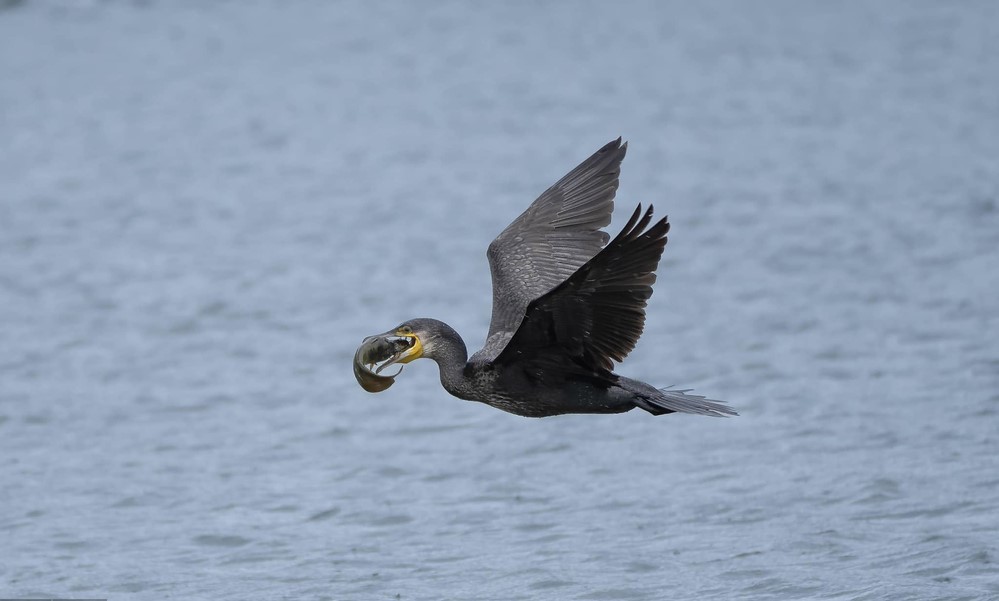
After 26 years in the Nepali Army, retired colonel Sudeep KC now uses the precision he honed as a soldier to track and photograph Nepal’s rare birds, mammals and landscapes. Photo: Courtesy of Sudeep KC
For 26 years, Sudeep KC trained his eyes on targets through the iron sights of an SLR rifle. Today, he uses the same discipline and precision to frame wildlife through the viewfinder of a camera.
The 58-year-old former Nepali Army colonel has spent the past seven years documenting Nepal’s birds, mammals and landscapes, transforming a military skill set built on patience, observation and accuracy into a career in wildlife photography.
His ability to locate elusive species, work in difficult terrain and capture wildlife in challenging conditions has earned him recognition among nature enthusiasts in Nepal and abroad. International photographers now travel to Nepal seeking his guidance on tracking wildlife and photographing species in their natural habitats.
A resident of Basundhara in Tokha Municipality-5, Kathmandu, KC retired from the army after a 26-year career and turned to wildlife photography full-time in 2019.
His interest in conservation began much earlier, during military postings to national parks where army units were deployed for security operations. Working alongside park officials, conservationists and nature guides introduced him to Nepal’s biodiversity and deepened his interest in wildlife.
Since taking up photography professionally, KC has photographed 595 bird species in Nepal.
“I have sighted more than 630 bird species in the wild,” KC told Kantipur. “But because of timing, weather conditions and physical limitations, I have not been able to photograph all of them.”
Nepal has officially recorded 903 bird species.
KC’s search for rare species has also taken him beyond Nepal. During photography expeditions to Malaysia, Singapore and Thailand, he documented 378 bird species, many of which are not found in Nepal.
Among his most memorable achievements is photographing the Himalayan Monal, Nepal’s national bird.
“Capturing a clear image of the Monal required the greatest effort and persistence,” KC said. “I had been tracking the bird for a long time.”
He photographed the colourful pheasant at an altitude of 2,600 metres inside Shivapuri-Nagarjun National Park, and believes he was the first wildlife photographer to capture the species within the Kathmandu Valley.
“We had walked through dense forest for nearly four hours and were completely exhausted,” he recalled. “Just as we were about to turn back disappointed, the bird appeared right in front of us. Others with me also saw it, but I managed to frame and capture it first.”
Photo: Courtesy of Sudeep KC
From the Tarai plains to the Himalayas
KC spends three to four months every year travelling across Nepal in search of wildlife, moving from the grasslands of the Tarai to the high-altitude landscapes of the Himalayas.
When in Kathmandu, he regularly visits local wetlands, ridgelines and forest patches to photograph birds.
His portfolio includes grassland species, migratory winter and summer visitors, forest birds and farmland species. He has photographed the Spiny Babbler, believed to be Nepal’s only endemic bird species, as well as rare sightings such as the Mandarin Duck.
Beyond birds, KC has documented 25 species of mammals and reptiles, including the Royal Bengal tiger, sloth bear, leopard, one-horned rhinoceros, Asian elephant, spotted deer, barking deer, blackbuck, otter, Gangetic dolphin and Indian python.
Since beginning wildlife photography, he has encountered 12 wild tigers, successfully photographing most of them.
“I prefer photographing tigers in their natural habitat rather than taking close-up portraits,” he said. “Habitat photography requires patience, tracking skills and long hours in the field. The excitement of seeing a tiger in dense forest never disappears.”
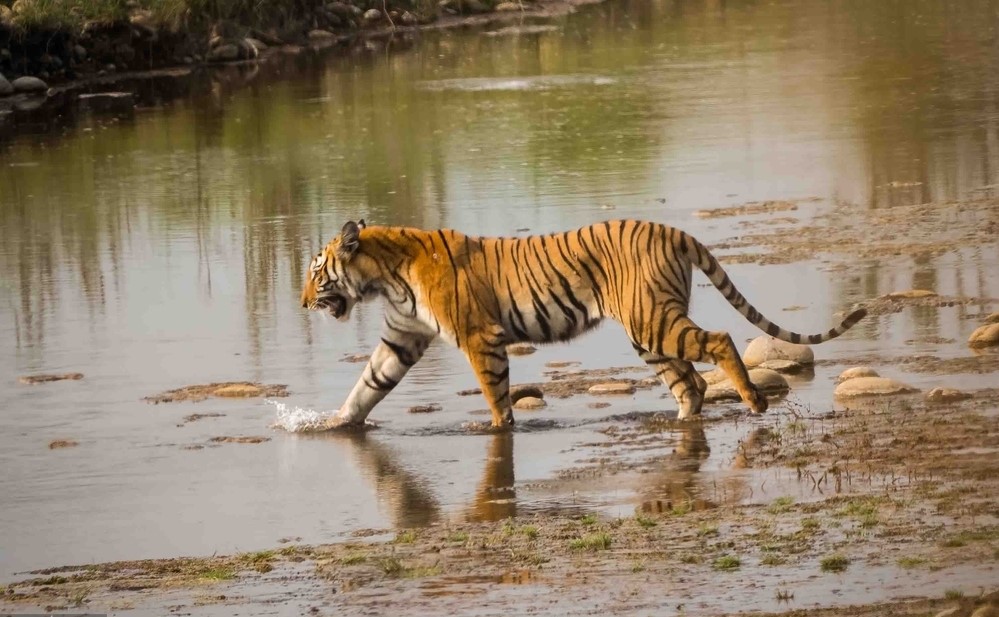
He recalled following tiger footprints for four days inside Bardiya National Park before capturing an image of an adult tiger crossing a river at Tinkune, Bardiya.
But wildlife photography has also brought moments of danger.
“While on a full-day jungle walk with ornithologist Ram Shahi in Bardiya, a full-grown tiger appeared on the trail just three to four metres ahead of us,” KC said. “Adrenaline took over. Instead of raising the camera, our first instinct was to find safety.”
Two hours later, when they spotted the same tiger from a safer distance, KC said his hands were still shaking.
In another encounter in Sukebar, Chitwan, he had to climb a tree after unexpectedly coming across a one-horned rhinoceros.
Photographing the elusive Red Panda in the snow-covered forests of Nanggin Got inside Langtang National Park required waiting in freezing conditions for three consecutive days.
“Wildlife photography demands immense patience,” KC said. “Every second matters. You have to move quietly, understand animal behaviour and capture angles that make your work different.”
His assignments have taken him to more than 40 districts across Nepal, from the plains of the Tarai to Upper Dolpa.
Guiding international photographers
KC’s wildlife photographs shared on social media have attracted international photographers interested in Nepal’s biodiversity.
“Two months ago, a group of four Japanese photographers visited Nepal,” he said. “I guided them to key habitats where they successfully photographed several native bird and mammal species.”
Two years ago, KC was appointed Nepal Country Representative for the Asian Wildlife Photography Club (AWPC).
Through the organisation, he leads annual photography tours for visitors from Singapore, Malaysia, India and Sri Lanka to biodiversity hotspots including Chitwan, Bardiya and the Kathmandu Valley.
“When visiting photographers capture high-quality images here and display them abroad, it helps promote Nepal’s ecotourism,” KC said. “Nepal has rich wildlife resources that can attract nature enthusiasts from around the world.”
His photographs have been featured in calendars, brochures and books published by the National Trust for Nature Conservation, Bird Conservation Nepal, the Nepal Tourism Board and international journals.
KC sees a strong connection between his military training and photography.
“In both disciplines, you aim with one eye, stabilise your body, hold your breath and act at the right moment without shaking,” he said. “In the army, we use camouflage and concealment so the target does not detect us. In wildlife photography, camouflage helps prevent disturbing animals.”
“Pulling the trigger of a rifle fires a bullet; pressing the shutter of a camera captures an image.”
Photo: Courtesy of Sudeep KC
From soldier to conservationist
KC’s photographs of landscapes, cultural heritage and rural life have won recognition in national competitions.
In 2025, he secured first place and a cash prize of Rs50,000 in the non-military category of a national photography competition organised by the Nepal Army. Three years earlier, he won second prize in a national contest organised by Kia Motors.
KC joined the Nepal Army as a Second Lieutenant in 1990, with his first posting at Chitwan National Park.
Working alongside park staff, conservationists and nature guides sparked his interest in wildlife tracking and species identification.
In 1991, he participated in the translocation of four one-horned rhinoceroses from Chitwan to Bardiya National Park.
“Before joining the military, I had a general interest in birdwatching,” he said. “My time in Chitwan deepened that interest. During long patrols, I carried binoculars and field guides to identify species along the trail.”
After two years in Chitwan, KC was transferred to Kathmandu, where he served for more than 12 years as a close protection officer for the royal family. During royal visits to Bardiya and Chitwan, he often informally guided visitors on wildlife.
Following the 2001 royal palace incident, KC was posted to Bardiya National Park as a major, commanding an army company responsible for park security during the Maoist conflict.
Photo: Courtesy of Sudeep KC
“Operating from national park barracks during the conflict brought different challenges,” he said. “We had to secure our positions, protect military assets and safeguard wildlife from poachers at the same time.”
During his military career, KC spent more than 14 years stationed in protected areas, including Shey-Phoksundo National Park, Rara National Park and Parsa Wildlife Reserve, now Parsa National Park.
While commanding forces in Bardiya, he led anti-poaching operations in coordination with park authorities.
In 2011-12, joint operations in the Surkhet-Barahatal buffer zone recovered 242 illegal muzzle-loading firearms.
Later, in 2015, during a military health camp in Upper Dolpa, his unit confiscated illegally stored snow leopard pelts based on local intelligence.
The photographer’s tools
KC began his photography journey with a Canon 6D Mark II paired with a 150-600mm zoom lens.
After consulting international wildlife photographers, he upgraded his equipment.
He now uses a Sony Alpha 1 camera body, valued at around Rs900,000, with a 100-400mm G Master zoom lens worth approximately Rs350,000.
The equipment, he says, allows him to capture fast-moving wildlife with improved autofocus tracking and high-speed shutter performance.
For KC, however, the most important tools remain the ones he developed long before he picked up a camera: patience, discipline and the ability to wait for the right moment.




 16.45°C Kathmandu