PM’s remarks on ‘mutual encroachment’ draw concern of border experts, government in ‘damage control’ mode
Cultivation across Nepal-India border stems from shifting rivers and missing pillars, not territorial seizure, say officials and former survey chiefs.Prime Minister Balendra Shah answers lawmakers’ questions in the House of Representatives in Kathmandu on Sunday. Post photo
Prime Minister Balendra Shah was facing criticism for not speaking. Then he spoke. And he is now facing even fiercer criticism.
On Sunday, Shah expressed his desire to respond to lawmakers’ questions. In response to one question regarding Lipulekh, Limpiyadhura, and Kalapani, Shah said Nepal too has “encroached upon Indian territory,” causing an uproar in Parliament.
“You might find it strange, but I also learned only recently—after becoming prime minister—that it’s not just India; Nepal too has encroached upon Indian territory in many places,” Shah said.
The statement drew sharp reactions and criticism. Opposition lawmakers demanded that the prime minister’s remarks be expunged.
Diplomats and experts on border matters said that Nepal has not encroached upon Indian territory in the way the prime minister suggested in Parliament.
Shah’s remarks came in the context of what Nepal has been doing with regard to Lipulekh, Limpiyadhura, and Kalapani, a region on the northwestern frontier that is disputed between Nepal and India, with both countries claiming it as their own.
Shah said that the Nepal government has already sent diplomatic notes to Delhi and Beijing.
“We have spoken not only with India and China but also with the British government. Our view is that England [UK] should also take an interest, as the issue dates back to the period when the British ruled India,” Shah said. “So all these matters should be resolved through dialogue and diplomatic negotiations.”
An aide to Shah told the Post that a few weeks ago, Shah’s chief adviser, Kumar Byanjankar, held talks with British Ambassador Rob Fenn and discussed how the United Kingdom could help resolve the dispute as the boundary row in the Kalapani region began after the 1816 Treaty of Sugauli between the East India Company and Nepal.
Nepali border experts claim that, on the basis of the 210-year-old treaty and historical maps possessed by Nepal but prepared by the Survey of British India in 1819, 1827, 1834, 1835, 1837, 1846, 1850, 1856, 1860, and 1879, the strategic 372-square-kilometre area comprising Lipulekh, Limpiyadhura, and Kalapani belongs to Nepal.
Since the British were party to the Treaty of Sugauli, Byanjankar, according to Shah’s aide, had taken up the issue with the British ambassador.
“Since the UK was a party to the Treaty of Sugauli, it may possess crucial evidence and maps that could help resolve the dispute with India and China,” the PM’s aide added. “The discussion with the British envoy was an effort to permanently resolve the boundary dispute with India.”
In response, Fenn, according to the aide, told Byanjankar—albeit indirectly—that the issue is a bilateral matter concerning Nepal and India and that the UK would rather not interfere.
But Byanjankar, the aide said, insisted that since the dispute is a historical legacy of the Treaty of Sugauli, the UK should support Nepal’s efforts to resolve it.
The Lipulekh, Limpiyadhura, and Kalapani region — around 372 square kilometres of land located east of the Mahakali river (known as Sharada River in India) — has been occupied by India since the Sino-Indian War of 1962.
According to sources at the Prime Minister’s Office, Shah was briefed on the ongoing boundary-related work, particularly that undertaken by the Nepal-India Boundary Working Group (BWG) after he became prime minister. The BWG is tasked with the construction, restoration, and repair of boundary pillars, the clearing of no-man’s land, and other technical tasks, excluding the disputed areas of Susta and Kalapani.
Ministers and officials also briefed Shah on cross-border occupation and ownership of properties between Nepal and India.
Deepa Dahal, Prime Minister Shah’s press and investigative expert, confirmed that Shah had discussed the matter with experts.
Responding to the Post’s query on whether Shah had recently held discussions on Nepal-India boundary issues, Dahal said: “He has held extensive consultations with experts.”
According to Toya Baral, former director general of the Department of Survey, around 1,200 hectares of Nepali land is currently occupied by Indian citizens, while 1,250 hectares of Indian land falls within Nepali territory, according to the latest boundary survey conducted by the two sides in 2007.
“In 2007, we finalised 182 sets of boundary maps between Nepal and India using the Global Positioning System, excluding Susta and Kalapani,” Baral told the Post. “While finalising the updated boundary maps, we also found that citizens living on both sides of the border were occupying land across the boundary.”
Baral led the Nepali side in preparing the Nepal-India border maps that were completed in 2007.
According to Baral, issues related to encroachment, cultivation, and possession on both sides of the international border remain unresolved. “The BWG is working to resolve them,” he said. “However, Nepal has not encroached upon Indian territory. The prime minister’s statement is technically incorrect.”
The BWG is now working to determine the extent of land being cultivated by citizens of both countries.
“Susta and the Kalapani sector are different issues. Susta is a case of Indian encroachment, whereas the Kalapani sector is fundamentally a territorial dispute,” said Baral.
The Lipulekh dispute, a long-standing irritant in Nepal-India relations, resurfaced most recently when Indian authorities announced the Kailash Manasarovar Yatra via the region.
Kathmandu reacted by sending diplomatic notes to both India and China on May 3.
“The response from India was that both governments would form teams comprising historians, surveyors, and experts familiar with the territory and seek a resolution through dialogue,” Shah said on Sunday.
When Buddhi Narayan Shrestha was director general of the Department of Survey in 1988, Nepal and India had reached an understanding on the fixed-boundary principle and transboundary rivers.
Shrestha said Nepal has never encroached on Indian land, nor has it crossed or violated the border.
“However, in some border areas, there are cases of cross-holding occupation — where people cultivate or occupy land across the border,” he told Kantipur. “This means that in some places Indians are using land belonging to Nepali farmers, while Nepalis are using land belonging to Indian farmers.”
On Shah’s claim that the government has spoken with the UK, Shrestha said, “There has been no public information that the Nepal government has formally raised Nepal-India border issues with the UK.”
“If the Prime Minister has indeed held such discussions, they have not been reported publicly. If he has been engaging privately, that could be seen as a positive step,” he added. “Seeking mediation may be worthwhile because Lipulekh, Limpiyadhura, and Kalapani have been under Indian control for 64 years. If the prime minister has asked the UK to mediate and India agrees, it would be a significant and positive development.”
“We had designated rivers and small streams as boundaries,” said another former director general of the Department of Survey. “That created controversy between Nepal and India and effectively contributed to boundary disputes in Susta and other areas.”
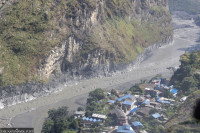
The official’s reference is to the fact that several sections of the Nepal-India boundary were historically defined by rivers and smaller streams. Over time, natural shifts in river courses, changing channels, erosion, and differing interpretations of historical maps complicated efforts to determine the exact boundary line on the ground. These challenges have been cited as contributing factors to disputes such as Susta, where changes in the course of the Gandak (Narayani) River have influenced competing claims over the border’s location.
What many found objectionable in Shah’s statement was his claim that Nepal has also “encroached upon” parts of Indian territory.
Opposition leaders, former diplomats, and survey officials have called on the prime minister to provide further clarification on his remarks.
“The prime minister of a country should think a dozen times before speaking,” Nepali Congress Vice President Bishwa Prakash Sharma wrote on X. “Restraint and maturity are even more essential when dealing with sensitive diplomatic issues.”
“Which carries more weight — the position of the Shah government or Shah’s opinion as an individual? What is the RSP’s stance on this issue? Are we the ones encroaching on someone else’s territory, or are we the victims of encroachment? Are we heading towards further division as a nation?” Sharma asked.
Nilamber Acharya, former Nepali ambassador to India, said that Nepal has not encroached on Indian land, contrary to Shah’s claim.
He said that around 97 percent of Nepal-India border issues have already been resolved.
“The Nepali state has not encroached on Indian land anywhere. It is not as the prime minister stated,” he said.
Acharya explained that problems can arise in certain areas when boundary pillars along the border go missing.
“In some border regions, Indian nationals are found cultivating land on the Nepali side, while Nepalis are cultivating land across the border in India. But that does not mean the Nepali state has encroached on Indian territory,” he said. “The other issues are not border disputes per se; they are problems that have emerged along the border. It is not clear in what context the prime minister said that Nepal has encroached on Indian land.”
It was unclear whether Shah was referring to cross-holding of land when he used the term “encroachment.”
An earlier survey had shown that Nepalis were cultivating land inside Indian territory at 274 locations. The report said people from Nepal had crossed into Indian territory and were farming or using the land. These included 43 locations in Ilam, Jhapa, Morang, and Sunsari; 211 locations across the eight districts of Madhesh province; one location in Banke; and 19 locations in Kanchanpur.
The report also documented Indians cultivating or occupying land inside Nepali territory at 668 locations across 15 districts, including Ilam, Jhapa, Morang, Sunsari, Saptari, Siraha, Dhanusha, Mahottari, Sarlahi, Rautahat, Bara, Parsa, Rupandehi, Bardiya, and Kanchanpur. Separately, it identified 15 locations that were categorised as cases of Indian encroachment.
Some of these cases were related to boundary-holding issues that could be resolved at the local level.
Shah’s remarks on Sunday came just a day before party president Rabi Lamichhane’s scheduled visit to India. He is expected to meet Indian Prime Minister Narendra Modi and other senior officials during his five-day stay in New Delhi.
Former foreign minister Kamal Thapa wrote on X that “it is one thing to acknowledge that there are border disputes in certain areas. But Nepal has neither encroached upon nor occupied Indian territory. Nepal remains firmly committed to the principle that it should not infringe upon the borders of its neighbours.”
“If the prime minister is convinced that Nepal has indeed encroached upon Indian territory, then he should clearly inform the public, with evidence, where such encroachment has occurred,” Thapa added. “He should immediately correct the mistake and return the land to India with due respect. The prime minister’s statement is exaggerated and incorrect.”
Later in the day, the Ministry of Foreign Affairs issued a statement clarifying what Prime Minister Shah meant, in what appeared to be a damage-control move following widespread criticism.
“The issue raised by the Prime Minister in Parliament was primarily related to encroachment in the Dasgaja area (no-man’s land) and ‘cross-border occupation’ — that is, the use or possession of land across the border,” the ministry said in the statement. “Because Nepal and India adopted the Fixed Boundary Principle in river-border areas during boundary demarcation, situations have arisen where citizens of one country cultivate land or reside on land that falls within the territory of the other country.”
With regard to the diplomatic notes sent to India and China on May 3, the ministry said Nepal has since received a response from India through a diplomatic note.
“Studies conducted by the technical committee have shown that, in some places, land currently being used and occupied by Nepal may actually fall on the Indian side of the border, while land currently being used and occupied by India may fall on the Nepali side,” the ministry said. “The Prime Minister’s statement in Parliament that ‘in some places, Indian land may be on Nepal’s side’ was made in reference to this technical reality and the issue of cross-border occupation.”
Anil Giri is a Chief Sub Editor covering diplomacy, international relations and national politics for The Kathmandu Post. Giri has been working as a journalist for more than two decades, contributing to numerous national and international media outlets.




 14.4°C Kathmandu