Sri Lanka emerges as new hub for cyber scam networks
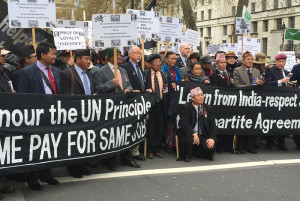
Authorities say organised fraud networks are shifting operations to Sri Lanka as crackdowns intensify in Cambodia and Myanmar, where dozens of Nepalis have been detained in recent police raids. Nepali and Indian nationals suspected of operating cyber scam centres are escorted by Sri Lankan police to a court in Galle on May 12, 2026. AFP/RSS
Scam centres running organised digital fraud networks have increasingly shifted their operations to Sri Lanka as authorities intensify crackdowns in countries such as Cambodia and Myanmar, according to international media reports. A large number of Nepalis have also been caught up in these operations.
Last month, Sri Lankan police raided suspected scam operations in Galle and Matara and arrested 192 Indian nationals along with 29 Nepalis.
According to Vijay Kumar Raut, acting Nepali ambassador in Colombo, 34 Nepali citizens were arrested in May alone on charges related to cybercrime and illegal call centre operations. They were detained in prisons in Galle, Boossa and Matara. Courts have since ordered bail for 30 of them.
“Ten individuals were arrested in Matara,” embassy information officer Sagar Bhandari told Kantipur. “They contacted us.” The embassy said it is still assessing how many Nepalis have been arriving at such centres.
“Cyber fraud and call centre activities have increased significantly in Sri Lanka’s southern coastal areas,” the embassy said in its records.
The embassy said 24 Nepali citizens were arrested on May 12 and 13 on computer-related charges and were initially sent to Galle prison. At the time, the detainees had not made any formal contact with the embassy.
Separately, 10 more Nepalis were arrested in Matara. “They are in Matara prison, and the nature of their case has not yet been clearly disclosed,” the record states, adding that the case could be linked to cybercrime operations.
After contact was established by phone, embassy officials visited both prisons on June 1 to facilitate consular access. During the visit, officials found 10 Nepalis in Matara prison, while the 24 detainees from Galle had been transferred to Boossa prison.
On June 5, a court ordered the release of the detainees on bail. Of the 10 Nepalis held in Matara, six were also granted bail, although formal approval documents are still pending.
The embassy said Nepalis held in Matara prison claimed they were not involved in cybercrime. They said they had travelled to Sri Lanka from the United Arab Emirates following the crisis in the Middle East. According to their statements, they were awaiting work permits for kitchen jobs in Sri Lanka, and their passports were being processed.
They said they did not know how to use computers and denied any involvement in cybercrime. On June 8, embassy officials again visited Matara prison and provided necessary supplies.
As enforcement and monitoring intensify across Southeast Asia, transnational cyber fraud networks are increasingly turning to Sri Lanka as a new base of operations. Investigations and policy pressure against such activities have increased in countries including Cambodia, Thailand and the UAE.
“We had also been seeking diplomatic solutions with Southeast Asian countries as Nepalis were increasingly affected,” said Foreign Ministry spokesperson Lok Bahadur Poudel Chhetri. “The Sri Lanka case is new, and we are studying it.”
According to monitoring of regional online scam operations and police data cited by Bloomberg, cases involving foreign nationals in cybercrime have risen sharply in Sri Lanka. Sri Lanka police said more than 1,000 foreign nationals were arrested from scam centres in the first five months of 2026, following 430 arrests in 2024 and fewer in 2025.
In an interview with The Straits Times, Sri Lanka police spokesperson Frederick Wootler said most of those arrested were Chinese, Vietnamese and Indian nationals. He also said that 29 Nepalis were among those detained during recent operations.
Wootler said an additional 280 foreign nationals were arrested during a raid in Colombo in the third week of May, while 135 Chinese nationals were detained from a single scam centre in March.
These scam centres typically target internet users through fake romantic relationships, cryptocurrency investment schemes and online betting fraud. Victims are often lured by false promises of high-paying jobs in information technology or call centre work.
Authorities say many young people are recruited through acquaintances or social media platforms such as Facebook and WhatsApp, where agents establish trust before arranging travel and employment.
Human trafficking networks are reportedly transporting victims through India, Bangladesh, Thailand and Myanmar to reach these scam operations.
“No official information about the Sri Lanka incident has reached us so far,” said Superintendent of Police Yogendra Khadka at the Central Investigation Bureau of Nepal Police. “If any details come to us, we will share them.”
Sri Lanka recently introduced 30-day free tourist visas and online authorisation for citizens of 40 countries, including Nepal. International media reports say the policy is being exploited by scam operators. Since the Covid-19 pandemic, such networks have expanded rapidly.
Large-scale crackdowns in Cambodia and along the Myanmar–Thailand border have resulted in thousands of arrests, deportations and raids on suspected scam centres. However, these groups have continued to relocate and establish operations in new locations.
Experts say the networks have adapted quickly to changing circumstances. Rather than disappearing, they fragment and move to jurisdictions with weaker oversight, easier entry requirements or stronger digital infrastructure.
Dilrukshi Handunnetti, director of the Colombo-based Centre for Investigative Reporting, Sri Lanka, said the groups are exploiting the country’s tourism visa system.
“In Sri Lanka, there are issues with implementing our laws, the fact that we do not necessarily crack down on these companies-they simply use tourist visas,” she told Bloomberg.
Reports from The Straits Times and Bloomberg suggest Sri Lanka’s relaxed visa policy, strategic location and reliable internet infrastructure have made it an attractive destination for these networks following crackdowns elsewhere.
In April, police raided a hotel in Chilaw and arrested more than 150 foreign nationals on suspicion that the site was being used for online fraud operations. Similar enforcement actions have been carried out in Colombo and the surrounding areas. Analysts say China has shown direct interest in such crackdowns, similar to operations previously seen in Cambodia.
Nepalis have previously been recruited into scam centres in Myanmar and Cambodia, with many later rescued. With Sri Lanka offering visa-free entry to citizens of several countries, experts have urged people to exercise caution over overseas job offers that promise high salaries and easy work.




 15.7°C Kathmandu