Bajhang traders resume Taklakot trade after seven years
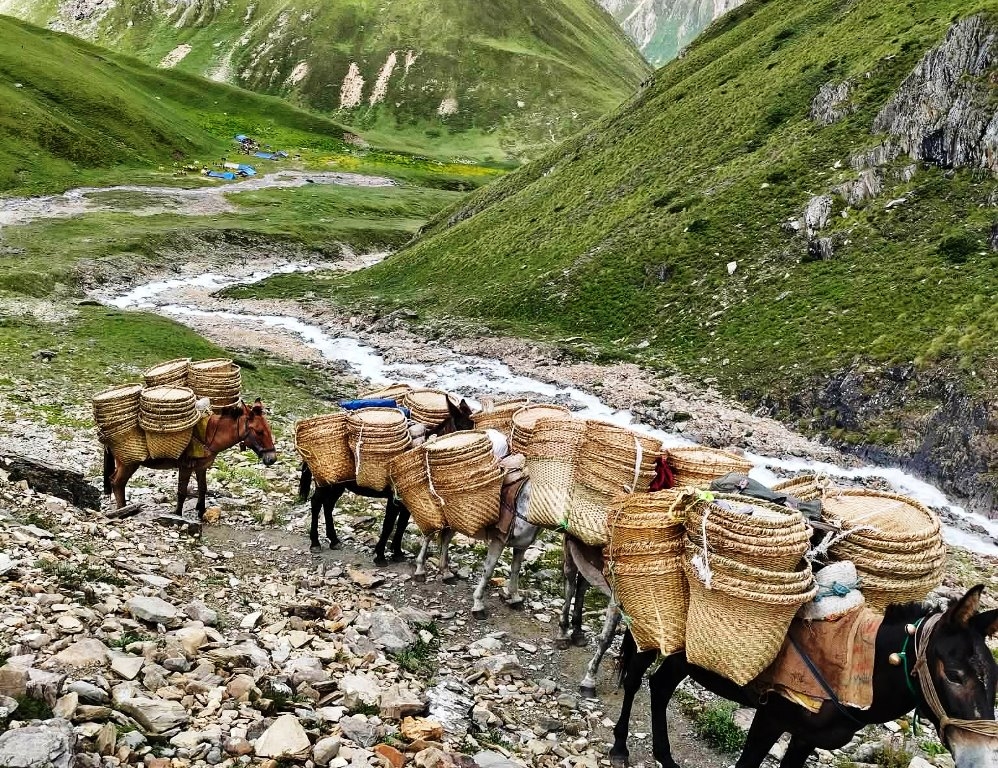
Forty-three traders have made a gruelling six-day journey across the 5,200-metre Urai Pass to sell traditional baskets, handicrafts, spices and other local products, reviving a centuries-old trade between Nepal and Tibet. Photo: Courtesy of Basant Bohara
After a gruelling six-day journey across one of the highest mountain passes along the Nepal-China border, 43 residents of Bajhang have reached Taklakot, a border market in Tibet, carrying traditional baskets, handicrafts, spices and other locally produced goods for sale.
The traders from Saipal and Talkot rural municipalities crossed the 5,200-metre Urai Pass on foot, while horses, mules and yaks carried their goods from Bajhang to the Tibetan market.
Their arrival marks the revival of a centuries-old cross-border trading tradition that had been suspended for nearly seven years after China restricted entry into Tibet during the Covid pandemic. The reopening has allowed residents of northern Bajhang to once again take part in the seasonal trade that has long linked communities on both sides of the Himalayas.
The traders received group permits to enter Tibet for the traditional trade and have set up stalls at a site designated by the Pulan County administration in Tibet. They have brought dokosand dalas (traditional bamboo baskets), bamboo grain containers known as lyakchya, wooden handles for axes and sickles, timur (Sichuan pepper), lentils, wooden products and other locally made goods.
“Altogether, we have brought around 3,500 dokos and dalas,” said Haribhan Bohara of Saipal Rural Municipality. “Some have brought wooden products, while others have brought timur and lentils. They have designated a separate place for us to sell our goods. Buyers come there and purchase them.”
Some customers, he said, were buying as many as seven or eight bamboo baskets at a time.
The goods are fetching significantly higher prices in Taklakot than in local markets in Bajhang, making the journey commercially worthwhile for some traders.
The highest price is being paid for lyakchya. It is selling for as much as 215 yuan, or about Rs4,900. An ordinary doko is selling for around 70 Chinese yuan, equivalent to about Rs1,600, while handles for axes are fetching up to 30 yuan, which equals around Rs700.
“We negotiate the price before selling. If someone really likes an item, they may even pay more,” said Bhim Jethara, who travelled from Talkot Rural Municipality. “The price also varies depending on the quality.”
He said some products were selling for roughly seven or eight times the prices they would fetch in local markets in Bajhang.
But the apparently attractive prices do not necessarily translate into large profits.
The traders from Saipal and Talkot rural municipalities crossed the 5,200-metre Urai Pass on foot, while horses, mules and yaks carried their goods from Bajhang to the Tibetan market. Photo: Courtesy of Basant Bohara
The traders, however, have found that the Taklakot market is no longer as busy as it was before the border was closed.
“There is not the same crowd of customers as before because the border has been closed for such a long time,” Bohara said.
In previous years, Nepali traders would regularly arrive in Taklakot around this time, during mid-July and mid-August, and customers would gather in large numbers to buy their goods. But the prolonged interruption has broken that trading cycle, and traders say it is taking time for news of the reopening to spread among villages on the Tibetan side.
The changing consumption habits of Tibetan consumers may also be working against the traditional trade.
Industrial products have increasingly replaced handmade household goods in Tibetan markets. Plastic, tin and other modern materials are now widely available, and demand for traditional baskets and other products from Bajhang has declined.
“In the past, everything we brought would be sold within a day or two. There is no such crowd now,” said Bhakta Bohara. “Plastic goods are cheaper, so perhaps people are less interested in buying our products.”
Even with fewer customers, he said, the business was not disappointing.
The traders reached Taklakot in the first week of August and plan to remain there for several more days to sell their goods. Most are expected to return to Nepal in the third week of August, said Kebjan Bohara, who is in Taklakot with the group.
On their return, they traditionally bring back Tibetan salt, liquor, electrical goods, clothing and shoes.
The reopening of the trade route, however, has not restored all of the activities that once connected communities in Bajhang with Tibet.
Residents are still not allowed to bathe in Lake Manasarovar or bring water from the lake back to Nepal. China’s restrictions on access to the lake have left lineage deity worship in Bajhang suspended for seven years.
The disruption also affects the seasonal movement of livestock.
For generations, residents have taken sheep, goats and yaks into Tibetan territory during the monsoon to graze in the region’s forests. But residents say Chinese security personnel have increasingly obstructed the practice and mistreated herders, leaving them increasingly reluctant to take their livestock across the border.
As restrictions have tightened around activities that were once routine, communities in northern Bajhang say the reopening of trade is only a partial restoration of their traditional links with Tibet.
Bajhang authorities have, for several years, attempted to coordinate with officials in China’s border areas over the restrictions on religious practices, the treatment of herders and other issues. Those efforts have so far failed to produce a resolution.
The traditional ritual in Bajhang requires water from Lake Manasarovar to be brought back and offered at a temple to complete the worship. That practice has remained suspended since access to the lake was restricted.
The resumption of trade has nevertheless raised hopes among residents of the border municipalities that the centuries-old relationship between Bajhang and Tibet can gradually be rebuilt.
“Taklakot market and the surrounding villages have ties with us that go beyond trade, religion and grazing. We also have traditional friendly relationships,” said Manbir Bohara, chairman of Saipal Rural Municipality.
“When the border was closed, everything was cut off. Now trade has reopened. We hope other things will gradually become easier as well.”
He said the government of Nepal should pursue meaningful diplomatic initiatives to strengthen the ties between communities on the two sides of the border that have been connected for generations.




 23.98°C Kathmandu