



 23.85°C Kathmandu

Mon, Oct 19, 2026
Money
IMF flags rising crypto adoption in Nepal despite ban, urges close monitoring
Fund warns of growing stablecoin and crypto flows, calls for regulatory framework to safeguard financial stability; praises reforms in cooperative sector oversight and governance.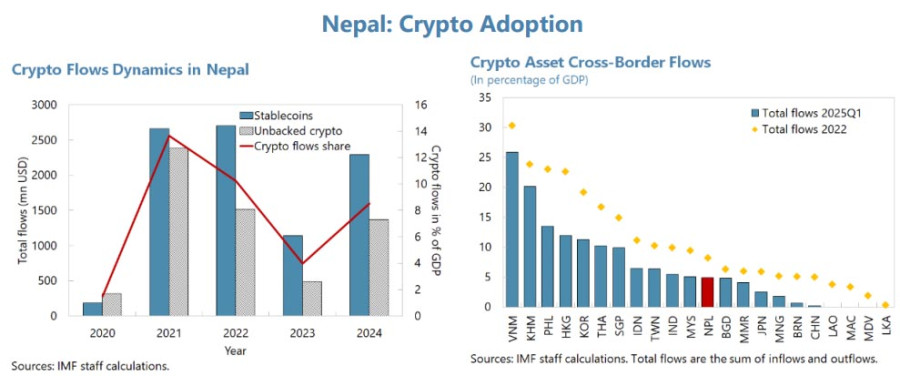
bookmark
Sangam Prasain
Published at : June 9, 2026
Updated at : June 10, 2026 12:45
Kathmandu
The International Monetary Fund has flagged the growing adoption of cryptocurrencies in Nepal despite a legal ban and urged authorities to closely monitor the sector to safeguard financial stability and prevent illicit financial flows.
“Flows of stablecoins and unbacked crypto assets grew markedly between 2019 and 2024, although adoption remains modest relative to peers, despite legal prohibition on crypto transactions,” the IMF said in a report released on Tuesday.
The IMF said a clear and well-sequenced regulatory framework aligned with international standards would help safeguard financial stability, financial integrity and consumer protection, while limiting the circumvention of capital controls and large-scale deposit outflows.
Nepal has banned cryptocurrency transactions, but law enforcement agencies have repeatedly uncovered illegal crypto trading networks in recent years.
In January 2022, the then Metropolitan Crime Investigation Division arrested several individuals in Baneshwar for cryptocurrency trading. In September 2024, the Central Investigation Bureau arrested 50 people, including foreign nationals, for operating an illegal investment and crypto scam call centre in Ekantakuna.
Authorities have also cracked down on other networks, including a Thamel-based operation linked to Starboy Solutions for illegal virtual currency dealings. In November 2025, Kathmandu Police arrested two men in Kalanki and Dallu for facilitating illegal cryptocurrency transactions, while previous operations dismantled major crypto rings operating from New Baneshwar.
In March 2026, police arrested three individuals, including an Indian national, for conducting illegal virtual transactions and cryptocurrency dealings worth more than $5.06 million. Another suspect was found to have conducted crypto and online betting transactions amounting to $16.27 million.
The IMF’s warning came as it completed Nepal’s Article IV Consultation and the seventh and final review under the Extended Credit Facility (ECF), enabling the country to draw an additional $42.9 million in budget support. Total disbursements under the ECF programme have now reached $384.1 million.
The IMF said Nepal had made tangible progress in implementing reforms under the programme, helping support economic recovery, preserve macroeconomic stability, build fiscal and external buffers, and protect vulnerable populations.
The report also praised recent progress in strengthening oversight of savings and credit cooperatives (SACCOs), a sector that has been plagued by governance failures and financial irregularities.
“The recently established National Cooperatives Regulatory Authority (NCRA) has begun developing a licensing regime, reporting requirements and regulatory standards for the sector,” the report said.
According to the IMF, the NCRA expects around 10,000 SACCOs to seek licences over the medium term, allowing for closer monitoring of their financial performance and contributing to greater stability in the cooperative system.
The IMF, however, stressed the need to develop an effective resolution framework for troubled cooperatives instead of relying primarily on mergers and acquisitions.
“Removing weak institutions from the system is critical to improving overall system stability,” it said.
The ECF arrangement for Nepal was approved in January 2022. According to the IMF, structural reforms implemented under the programme have strengthened institutions and improved policymaking.
Key achievements cited in the report include the modernisation of monetary operations, stronger financial sector supervision, completion of a banking loan portfolio review, improvements in fiscal transparency, and enhanced public investment management.
Governance and accountability have also been strengthened through reforms to the anti-money laundering framework, legal changes, enhanced external auditing of the Nepal Rastra Bank, and improved accountability of public enterprises, the report noted.
The IMF projects Nepal’s economy to grow by 3 percent in the fiscal year 2025-26 ended mid-July, reflecting the impact of protest-related disruptions, weaker agricultural production, subdued private investment amid pre-election uncertainty, and spillover effects from the conflict in the Middle East.
However, it expects economic momentum to improve gradually, supported by a smooth transition to a single-majority government, accommodative monetary policy and expansionary fiscal measures planned for the fiscal year 2026-27.
Inflation is projected to rise in line with higher global oil prices but remain close to the Nepal Rastra Bank’s target of 5 percent on average.
The IMF warned that downside risks remain significant, including policy uncertainty, under-execution of public capital expenditure and vulnerabilities stemming from the global economic environment.
Bo Li, the IMF deputy managing director and acting chair, said the completion of the seventh review marked the conclusion of Nepal’s reform programme under the ECF.
“The programme has helped safeguard macroeconomic stability, rebuild buffers and protect the vulnerable. Programme performance has been broadly adequate despite successive domestic and global shocks,” Li said.
The IMF urged Nepal to maintain reform momentum after the programme's conclusion, stressing the importance of preserving macroeconomic stability and strengthening resilience to future shocks.
It recommended improving capital expenditure execution by strengthening public investment management and enforcing revised National Project Bank guidelines. It also called for greater budget realism, implementation of domestic revenue reforms and rationalisation of tax expenditures to improve fiscal sustainability.
The Fund said social protection programmes should become more targeted and transparent, with greater focus on shielding vulnerable households from economic shocks.
It also urged Nepal to remain vigilant about rising financial-sector risks, strengthen bank lending practices and expand loan portfolio reviews across the banking system.
Implementing the Financial Action Task Force (FATF) action plan to strengthen anti-money laundering and counter-terrorist financing measures remains critical for Nepal’s efforts to exit the FATF grey list, the IMF said.
The report further highlighted governance reforms as a key driver of long-term growth. Strengthening transparency, rule-based administration, institutional effectiveness and anti-corruption measures would improve investor confidence and increase the returns from broader economic reforms, it said.
According to IMF estimates, reforms aimed at improving public investment efficiency, strengthening VAT collection and reducing distortions to private investment could raise Nepal’s real GDP by 13 percent over the next decade.
“These combined reforms could help stimulate private investment, create jobs, reduce inequality and improve public debt dynamics,” the report said.
Sangam Prasain
Sangam Prasain is Business Editor at The Kathmandu Post, covering tourism, agriculture, mountaineering, aviation, infrastructure and other economic affairs. He joined The Kathmandu Post in October 2009.



Most Read from Money

Nepal travel agents threaten to stop selling Thailand trips over visa rules

Why does an hour long flight to Dhangadhi cost more than a flight to New Delhi?
Malaysia rejects Nepal’s demand to open recruitment to all manpower agencies

No school, but a graduation cap for women dairy farmers
Nepal arrests four medical service providers as Malaysia recruitment row deepens
Editor's Picks




E-PAPER | October 19, 2026

×