It’s monsoon and Susta residents’ worries swell amid Indian pressure
Villagers are building makeshift embankments to protect their homes as erosion by Narayani River worsens and an Indian border force blocks construction of a permanent structure.
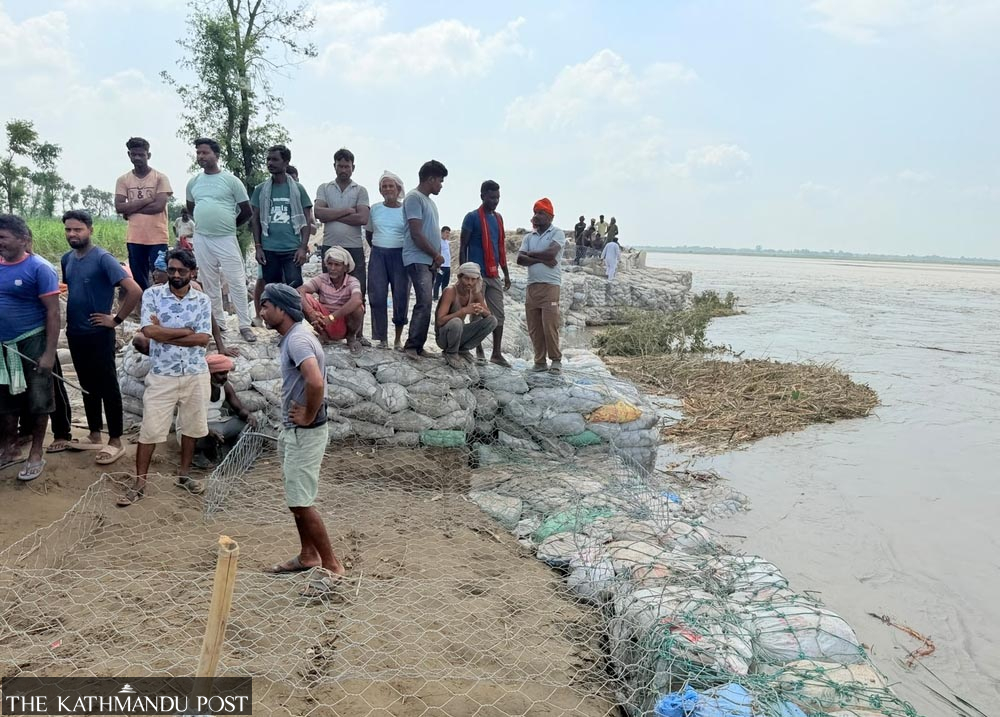
It’s 01:25 on the clock. In the dead of the night, young men are hauling sacks filled with soil on the banks of the Narayani river in Susta Rural Municipality-5 of West Nawalparasi. Those unable to carry the heavy sacks are busy arranging a wire mesh.
On Sunday night residents of Susta worked round the clock, racing to reinforce the riverbank for fear that floodwaters from the Narayani might spill into their settlement.
Sitting along the riverbank, residents, including Kamal Bhagat, were teaching other young men how to reinforce the embankment, drawing on techniques they had learned from previous efforts to protect the settlement.
This is not the first time that Susta residents have worked day and night to build makeshift embankments to protect their homes. But this year, the river has been eroding the bank more aggressively than ever. At the same time, residents say the Indian side has prevented them from building an embankment on their own territory.
The worsening situation has drawn renewed attention to the struggle of people in Susta to hold on to their land. Residents say they have long lived under pressure from India’s border security force, the Sashastra Seema Bal (SSB), which they accused of harassing them from time to time. Now the Narayani river is posing another threat.
The river is steadily eroding the settlement, raising fears that intensified erosion could eventually force residents from their homes.
For 11 days, people in Susta have been working along the river to build an embankment and protect their land.
“We are prepared for any struggle to protect our land,” said Osiya Khan. “We have received a lot of support now. We would be grateful if the government could negotiate with India and create an environment in which we can build an embankment up to the Nepal-India border.”
Residents say they were unable to feel secure during the monsoon despite the government allocating money for an embankment last fiscal year. An embankment stretching about a kilometre was completed before the start of the monsoon at a cost of around Rs150 million.
But work on an additional 132-metre section could not be completed after Indian security personnel objected to its construction, according to residents. The area has now become a major point of river erosion, increasing the risk that the Narayani river will enter the settlement.
With floodwaters threatening their homes, residents took an initiative to build a temporary embankment last week, filling sacks with soil and placing them along the vulnerable stretch.
Their relentless effort finally drew the attention of local, provincial and federal authorities. Chet Narayan Acharya, chief minister of Lumbini Province, and House of Representatives member Bikram Khanal have inspected the site.
During his visit, Acharya pledged that there would be no shortage of funds for immediate measures aimed at reducing the flood risk.
Residents are contributing labour and using soil, stones, fallen trees and other locally available materials to protect the settlement. But they say their efforts alone cannot solve Susta’s long-running problems of erosion and flooding.
Rabindra Jaiswal, spokesperson for the ‘Save Susta Campaign’, said the government needed to pursue diplomatic initiatives with India to allow a properly engineered embankment to be built along the Narayani.
Khanal said he had informed the federal minister for energy, water resources and irrigation about the flood threat in Susta and ensured that work in the area would not be halted because of a lack of funds.
Meanwhile, Home Minister Sudan Gurung told Kantipur that the Susta issue was longstanding and should be resolved through discussions between Nepal and India.
“This requires high-level talks. The two countries need to discuss all aspects of the issue, including its technical dimensions and history,” he said. “This is an issue that was not resolved in 2014, and the situation remains the same. We have now begun the process of granting citizenship to the people of Susta.”
Battling Indian encroachment and the Narayani river’s erosion
Surrounded by the Narayani river on three sides and India on the fourth, residents of Susta have long faced a combination of threats: alleged harassment by Indian border guards, disputes over encroachment and relentless erosion of land.
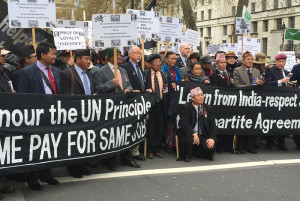
On August 2, Indian security personnel entered Susta village in Susta Rural Municipality-5 and attempted to dig into a temporary embankment, prompting residents to confront them.
At around 3 pm, Indian plainclothes personnel carrying shovels began digging into a temporary embankment that local residents had built at a point where floodwaters from the Narayani threatened to enter the settlement.
Residents protested and confronted the Indian personnel. Some took up sticks as the dispute escalated. After a brief confrontation, Nepali security personnel intervened and defused the situation by persuading both sides to stand down.
A similar confrontation occurred on June 12, when Indian security personnel stopped work on a planned 132-metre stretch of embankment along the Narayani river. Residents responded by chasing the Indian personnel away.
The government had allocated Rs14 million for the embankment, but the project could not proceed after objections from the Indian side. Residents subsequently began building their own temporary soil embankment.
The section where the Indian side prevented the construction of the permanent embankment is now the point from which floodwaters have been entering the Tharu settlement in Susta. Residents are currently piling soil around the same area in an attempt to hold back the river.
“For the people of Susta, fighting either Indian security personnel or the Narayani river floods has become part of everyday life,” Khan said.
The government has increased security presence in Susta, which lies along Nepal’s border with India. Following the June 12 incident, the home ministry wrote to the District Administration Office, Nawalparasi, directing it to deploy additional security.
There are currently 40 Armed Police Force personnel stationed in Susta under the command of an inspector.
Susta was inhabited in around 1965 when King Mahendra resettled around 400 families, including ex-servicemen, along the frontier to secure Nepali territory.




 15.33°C Kathmandu