



 23.39°C Kathmandu
Wed, Oct 21, 2026
Money
Traders complain of policy uncertainty, poor infrastructure in EV market
Ahead of NAIMA Nepal Mobility Expo 2026, traders raise concerns over tax changes, northern trade route disruption, and spare parts smuggling.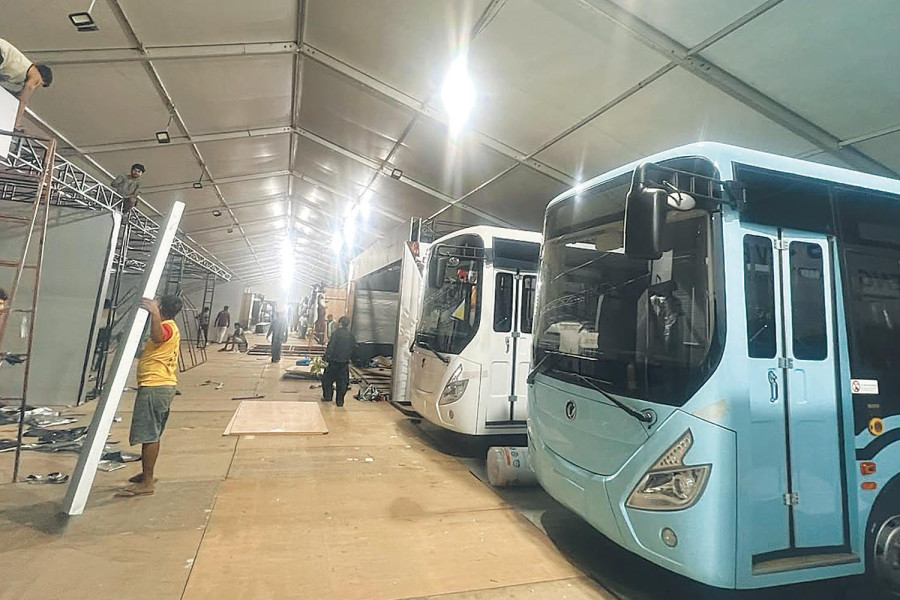
bookmark
Post Report
Published at : August 10, 2026
Updated at : August 10, 2026 06:55
Kathmandu
Policy uncertainty, inadequate infrastructure and the growing grey market for spare parts are emerging as major challenges for Nepal’s rapidly expanding electric vehicle market, according to automobile traders.
They said frequent changes in taxes on electric vehicles, poor road conditions along the northern trade routes and inadequate infrastructure for EVs are undermining the growth of the automobile sector despite rising consumer demand and expanding charging infrastructure.
Speaking at a roundtable organised by Kantipur Media Group in Kathmandu ahead of the NAIMA Nepal Mobility Expo 2026, automobile traders urged the government to bring greater stability to EV taxation and address infrastructure- and import-related problems.
“EV taxes have been unstable over the past four to five years,” said Sahil Shrestha, CEO of Cimex Inc., the authorised distributor of BYD EVs in Nepal. “Customers have now started to understand the pattern of changes in EV tax policy and have begun making early bookings to avoid possible tax changes.”
EVs now account for 80-85 percent of passenger vehicle sales, up from around 70-75 percent previously, Shrestha said, attributing the increase partly to the disruption caused by the conflict in West Asia since February-end.
The ecosystem supporting EVs has also expanded alongside the growth in sales. The Nepal Electricity Authority has set up nearly 52 charging stations, while the private sector has opened more than 1,000 charging stations with around 1,700 charging guns, according to Shrestha.
The passenger vehicle market has an annual turnover of around Rs50 billion, with approximately 15,000 vehicles traded each year, he said.
But infrastructure has not kept pace with the growth in vehicle numbers. Ramhari Pokharel, joint secretary at the Ministry of Physical Infrastructure and Transport, said Nepal has registered 6.3 million vehicles, including around 630,000 electric vehicles.
Of the country’s 104,000-km road network, only around 21,000 km has been blacktopped, Pokharel said. Timely maintenance has been hampered by resource constraints, while problems in the contracting system have also delayed road works, he said.
Problems are particularly acute along the northern trade routes used to import vehicles from China.
“Problems on the Tatopani and Kerung routes emerge as soon as the monsoon begins,” said Ritu Singh Vaidya, president of the Nepal Automobile Importers and Manufacturers Association. “There are systematic problems in importing vehicles, from customs clearance to transporting them to warehouses. These problems need to be addressed by the government.”
Government officials said the National Transport Policy has prioritised public transport and that a study has been conducted on the sector.
Traders also raised concerns over the growing grey market for automobile spare parts, saying illegal imports are hurting legitimate businesses, reducing government revenue and making it difficult for consumers to distinguish genuine parts from counterfeit or unauthorised products.
Nirakar Shrestha, executive director of Laxmi Group, official distributor of Hyundai vehicles, said the volume of spare parts entering Nepal illegally through the southern border is twice that of genuine spare parts imported through formal channels.
“There are a high number of illegal traders who bring spare parts from the Indian market in bags,” he said. “This has made it difficult for customers to know whether the parts are genuine or not. The government is losing revenue, while automobile traders are also being affected. The grey market for spare parts has been increasing gradually.”
The six-day NAIMA Nepal Mobility Expo 2026 begins Tuesday at Bhrikutimandap, Kathmandu. The expo will feature 55 automobile brands, including around 40 new vehicle launches, according to organisers.
The event will showcase vehicles ranging from Rs2 million to Rs35 million and will feature 52 stalls, including 18 two-wheeler and 29 four-wheeler brands. Banking and insurance companies will also participate, while sessions will be held on foreign direct investment, battery licensing, and ethanol blending.
More than 100,000 people visited last year’s expo, and organisers expect visitor numbers to rise this year.
Among the four-wheeler launches, Continental Trading Enterprise will introduce three Kia models, EV Ride will launch the Honri Boma, and Himalayan Motrox will introduce three Maxus models.
Laxmi Commercial will launch two Karry commercial vehicles, while Laxmi E-Mobility will introduce a Kaiyi model. Laxmi Motorhub will launch an Arcfox vehicle and a new motorcycle brand.
Sangrila Motors will introduce a Leapmotor vehicle, United Traders Syndicate will launch two Toyota models, and VG Impex will introduce two GWM EVs.
SPG Automobiles will launch new models from Omoda and iCaur, while Pioneer Motocorp will introduce a Nissan vehicle and Go Automobiles will launch a new MG EV.
Several electric two-wheeler brands, including Eco Infinity, Evoque, Hansraj and Hulaschand, Jagdamba Motors and Kuju Nepal, will also unveil new scooters and motorcycles at the expo.


Most Read from Money
Nepal travel agents threaten to stop selling Thailand trips over visa rules

Why does an hour long flight to Dhangadhi cost more than a flight to New Delhi?
Malaysia rejects Nepal’s demand to open recruitment to all manpower agencies

No school, but a graduation cap for women dairy farmers
Nepal arrests four medical service providers as Malaysia recruitment row deepens
Editor's Picks



E-PAPER | October 21, 2026

×