Nepal Airlines’ two wide-bodies are stuck in Japan and Italy. The bill is nearing Rs1 billion
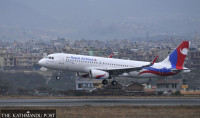
The grounding of both aircraft has disrupted international services, left passengers stranded and put further strain on the cash-strapped national carrier. Both wide-body aircraft are currently grounded, forcing the cash-strapped national carrier to cancel and reroute flights at a time when demand is at its highest. Post File Photo
The 2026 Asian Games in Japan are underway, offering a major revenue opportunity for Nepal Airlines, the national flag carrier.
The September-October period is also traditionally a peak revenue season, coinciding with Nepal’s festive period and the tourism season, when airlines operate with high passenger demand and flights are often nearly fully booked with full fare.
But Nepal Airlines, which has its debt up to its neck, is struggling to capitalise on the opportunity.
Both of its wide-body aircraft are currently grounded, forcing the cash-strapped national carrier to cancel and reroute flights at a time when demand is at its highest. The airline faced a similar problem last year when both aircraft were grounded during the peak travel season.
Analysts say the recurring disruptions have further damaged the airline’s reputation as an unreliable carrier, while its failure to expand and maintain an adequate fleet has limited its ability to support Nepal’s tourism industry and compete in the country’s nearly $2 billion (over Rs300 billion) international aviation market.
“There is a massive business in the international airlines sector, which the Nepal Airlines failed to tap on,” said Ashok Pokhrel, a former board member of Nepal Airlines who also runs a travel trade company. According to him, $1.5 billion comes from passenger tickets while the $500 million revenue is attributed to cargo fares. Nepal’s tourism potential is realised only if the national flag carrier commands over 50 percent share of the total travel market. Currently, Nepal Airlines has only 5 percent of this revenue pie.
Many passengers have experienced the consequences first-hand.
A Nepali national and professor at the University of Tokyo, who asked not to be named, was among passengers affected after Nepal Airlines abruptly cancelled its Tokyo-Kathmandu flight last week.
He and three family members had bought one-way tickets about a month and a half earlier to travel to Nepal for a rice-feeding ceremony and to celebrate Dashain, which begins later this month.
They had paid Rs95,000 one-way for each of the three adult tickets, a total of Rs285,000, and another Rs10,000 for an infant ticket.
“After our flight from Narita was cancelled, we spent four nights at a hotel near the airport. The bill was paid by the airline,” he said.
The family stayed at the Nikko Narita Hotel for four nights before being flown to Nepal via Cathay Pacific on Friday. The last-minute replacement tickets cost the three adults an additional Rs150,000 and the infant another Rs44,000.
The experience illustrates the broader problem confronting Nepal Airlines: inadequate fleet capacity and repeated technical failures involving the two aircraft that form the backbone of its long-haul operations.
Nepal Airlines Corporation has long faced criticism over corruption allegations, political interference and financial mismanagement. The procurement of two Airbus A330-200 aircraft in 2017 generated controversy and prompted an investigation by the Commission for Investigation of Abuse of Authority, which identified financial losses of more than Rs1.47 billion.
Nepal Airlines Corporation has long faced criticism over corruption allegations, political interference and financial mismanagement. Post File Photo
Airbus, the European aerospace company, admitted to paying at least 340,000 euros in bribe money to Nepali businessmen and officials to secure contracts involving two narrow-body Airbus A320 jets for the Nepal Airlines Corporation, according to a settlement document released by France’s National Financial Prosecutor’s Office in January 2020.
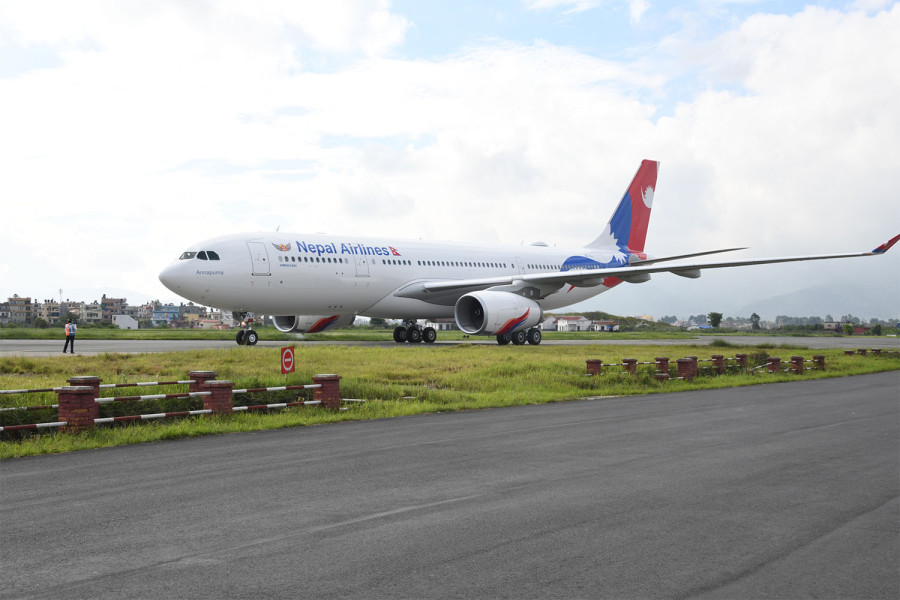
Now, both of Nepal Airlines’ 274-seat Airbus A330-200s—Annapurna and Makalu—are grounded simultaneously, leaving the carrier with little room to maintain its regular international schedule.
By Sunday, the airline estimated its financial losses at nearly Rs1 billion, according to preliminary calculations by its engineers.
“At least Rs500 million is expected to be spent on repairs, while the carrier has already lost an estimated Rs420 million in potential flight revenue from the two aircraft being out of service,” an engineer said.
“This is a preliminary estimate. The actual loss can only be established after the airline has its official financial figures, the final repair costs and a full account of passenger-management expenses,” he said.
The two aircraft are critical to Nepal Airlines’ international network.
Annapurna flew to Narita on September 13 and was scheduled to return to Nepal the following day. It has remained grounded in Japan for a week.
The problem was first detected in a blade inside one of the aircraft’s engines, a critical airfoil located in the fan, compressor and turbine sections that help move air, build pressure and produce thrust.
Initial estimates put the damage at 25 millimetres, but a detailed inspection found it was closer to 30 millimetres, according to officials.
The damaged blade has since been replaced, but another problem has been detected in the engine. Nepal Airlines is now waiting for technical approval from Rolls-Royce, the engine manufacturer, before the aircraft can return to service.
“We need to coordinate with Rolls-Royce to resolve another technical problem, so it could take a few more days before the aircraft returns,” a tourism ministry official said on condition of anonymity.
The airline is also considering whether Annapurna could be cleared to operate for a limited number of cycles while a permanent repair is arranged.
An engineer said the airline had received informal information that a technical variation allowing the aircraft to operate for 200 cycles could be approved through Rolls-Royce at a cost of about $41,000. The option, however, can proceed only after formal approval from the Nepal Airlines.
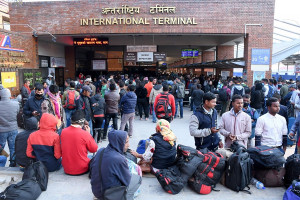
With both of its wide-bodies unavailable, flights to other destinations, including Guangzhou in China, Malaysia, Doha in Qatar and Dubai in the UAE, have also been affected. Post File Photo
The second aircraft, Makalu, has been grounded in Italy for about 20 days.
A new replacement part could cost about $2.7 million, according to preliminary estimates. With the cost, availability and delivery time of the part still unclear, the airline is weighing whether to repair the existing component or purchase a new one.
Its problem emerged during final testing after a C-check, a major scheduled maintenance inspection. The aircraft was due to return to Nepal on September 1, but a problem with its thrust-reverser system was detected during final tests.
“After the C-check, a problem was found with the thrust-reverser brake during the final test, so the aircraft has remained at the maintenance facility in Italy,” said Devendra Pun, the airline’s technical spokesperson.
The carrier is waiting for full technical approval from Safran, the French aerospace equipment manufacturer involved in the system.
Once the necessary approval is received, the repair is expected to take three to four days, officials said.
“Safran has given approval, but the repair has not been completed. They have emailed us offering to send the full technical details by Monday evening. We have been told the wide-body can then be repaired within three to four days,” the tourism ministry official said.
The Prime Minister’s Office has also shown interest in the issue, and the tourism ministry has been reporting to the office periodically.
The airline has also briefed Tourism Minister Khadak Raj Paudel on the situation.
Ministry officials said they had yet to make a final decision on the repair of either aircraft. Preliminary estimates from overseas maintenance, repair and overhaul companies suggest the combined repair bill could reach at least Rs500 million.
The financial impact is compounded by lost revenue.
In recent months, Nepal Airlines has been operating its wide-body aircraft for up to eight hours a day, generating an average daily turnover of about Rs15.6 million per aircraft, according to an airline official. During the peak season, when an aircraft can operate for up to 12 hours a day, daily turnover can rise to about Rs30.6 million.
At the average rate, Annapurna has missed out on about Rs109.2 million in potential turnover during its seven days on the ground in Japan. Makalu, grounded for about 20 days, has lost an estimated Rs310 million in potential turnover.
Together, the two aircraft represent about Rs420 million in lost potential business. The figure is a projection rather than a measure of net profit.
The disruption is also creating a growing logistical burden for the airline.
Nepal Airlines has been rerouting passengers through carriers including Air India and Cathay Pacific, according to acting general manager Janak Raj Kalakheti.
“Passengers whose visas are close to expiry, as well as children, elderly people, sick passengers and those facing urgent family matters, have been given priority,” he said.
The airline has not yet compiled a final figure for the number of passengers accommodated in hotels or the total cost of doing so, Kalakheti said.
The Narita disruption illustrates the costs passengers are bearing alongside the airline.
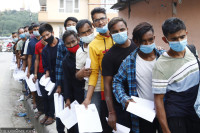
A total of 226 passengers affected by flight cancellations at Narita were accommodated in hotels, according to the passenger. They were subsequently sent to Nepal through different airlines and transit points.
Some travelled via Bangkok and others via Malaysia.
Nepal Airlines has since cancelled three flights from Japan. With both of its wide-bodies unavailable, flights to other destinations, including Guangzhou in China, Malaysia, Doha in Qatar and Dubai in the UAE, have also been affected.
Suraj Kunwar is a senior correspondent with over two decades experience covering Aviation, Tourism and Mountaineering. He received the IFJ Tolerance Award in 2005.




 17.35°C Kathmandu