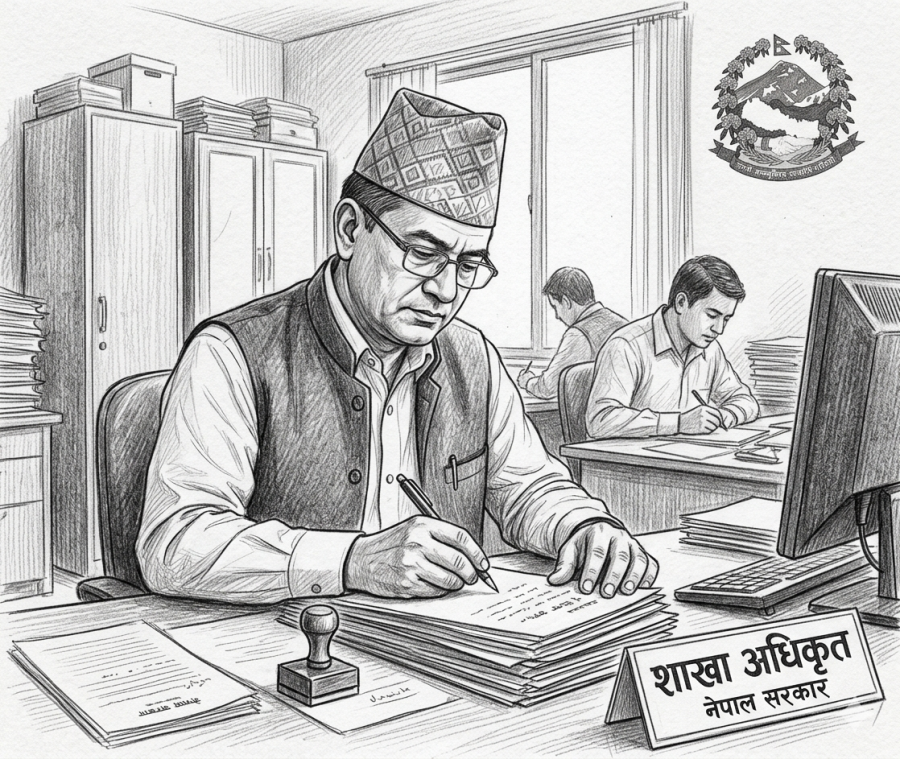
The government is preparing to introduce a legislative provision to summarily retire around 10,000 civil servants in a single sweep. The Ministry of Land Management, Cooperative, Federal Affairs and General Administration has drafted a fresh Federal Civil Service Bill containing a special, one-time provision targeted at bureaucratic downsizing.
According to this proposal, any civil servant who has either completed 30 years of service or reached the age of 55 will be forcefully retired upon the enactment of the law. Data maintained by the Department of National Personnel Records reveals the massive scale of this intervention. Normally, regular mandatory retirements account for only 2,000 to 3,000 personnel per fiscal year. For the current fiscal year of 2025-26, the scheduled number of mandatory retirees stands at 2,211. If the proposed 30-year service and 55-year age ceiling becomes law, an additional 10,000 employees will be sent home instantly.
The draft bill was officially forwarded to the Ministry of Law, Justice and Parliamentary Affairs on May 25. Ministry sources confirm that this sweeping clause is structured as a one-time provision.
"That provision is a one-time measure. For all other employees who escape this retirement round, the mandatory age limit will be 60," said a ministry official. "This proposal came directly from the political leadership. The government clearly wants to downsize the civil service to make the administration leaner and more efficient."
The aggressive restructuring stems directly from the political leadership’s desire to cut administrative costs. The executive’s 100-day action plan prioritises administrative reform, structural downsizing, and fiscal austerity. It set a mandatory 45-day deadline to formulate the civil service bill. Additionally, the government recently consolidated its cabinet framework, reducing the number of federal ministries from 22 down to 18, which created immediate structural pressure to slash the workforce.
The proposed law also reduces the maximum tenure of a chief secretary from three years to two, and cuts a secretary’s tenure from five years to three. A senior official at the Ministry of Federal Affairs said that these multi-layered cutbacks will cause an immediate departure of 52 secretaries. Currently, there are 70 high-level secretary positions and over 600 joint secretary positions across the federal administration. Out of 50,768 sanctioned federal positions, only 39,888 are currently occupied, within a wider pool of 85,240 civil servants serving across federal, provincial, and local levels.
Instead of offering employees a dignified farewell, the government's plan to force through mass redundancies has sparked widespread resentment across the civil service. Affected employees view the move as a direct attack on their career security and retirement predictability.
Legal experts within the ministries are equally alarmed, warning that the provision directly violates existing statutory protections. Critics point to Section 58 of the Civil Service Act, which strictly prohibits the government from altering service terms—such as salary, gratuity, and pension—to an employee's disadvantage without their explicit, written consent.
Law ministry officials have quietly informed Minister Sobita Gautam that the proposed text is unconstitutional. "A person enters the public service under a specific contractual guarantee," a senior official at the ministry said. "The state cannot arbitrarily shift goalposts and evict them early. If the Ministry of Federal Affairs refuses to amend this clause during our review, we will return the draft with a formal note indicating its illegality."
Former Chief Secretary Bimal Koirala criticised the approach, urging the state to respect natural justice. "The government cannot simply chase everyone out by force," said Koirala. "Those who entered through the Public Service Commission have a legal right to predictable service terms. If the state genuinely needs to downsize, it must design an attractive, dignified 'golden handshake' package. Forcing a purge without compensating for lost pension advantages is deeply unjust."
The Ministry of Finance has already provided its feedback on the draft prepared by the Ministry of Federal Affairs, and the document has been sent to the law ministry with those inputs included.
"Once we receive the law ministry's opinion, we will adjust the draft accordingly and forward it to the Cabinet. The Cabinet will then send it to the Public Service Commission for their review," said a joint secretary at the Ministry of Federal Affairs. "Only after receiving the commission's feedback and holding discussions in the cabinet's Legislation Committee will the cabinet officially decide to table it in parliament." He said because the proposed bill must clear so many stages, nothing is set in stone just yet.
The government is keen to introduce the Civil Service Act quickly. The official hinted that if the government considers it urgent, they might bring it in through an ordinance. Civil servants are due for a 10 percent salary hike starting July 17. Since implementing this in the upcoming fiscal year would place an extra financial burden on the state for both salaries and pensions, he mentioned that the government might opt to introduce the Civil Service Act through an ordinance by mid-July to retire tens of thousands of employees early.
This aggressive downsizing mirrors a highly controversial historical precedent in the 1990s, executed under the Girija Prasad Koirala administration. At that time, the Koirala administration capitalised on loopholes within the Civil Service Act of 1956.
Through the infamous 29th amendment to the regulations in 1992, the Koirala government lowered the retirement age from 60 to 58, and introduced a mandatory retirement trigger upon the completion of 30 years of service. It also granted the state arbitrary power to retire any employee eligible for a pension.




 14.4°C Kathmandu