Supreme Court convicts four men of gang rape, overturning acquittals
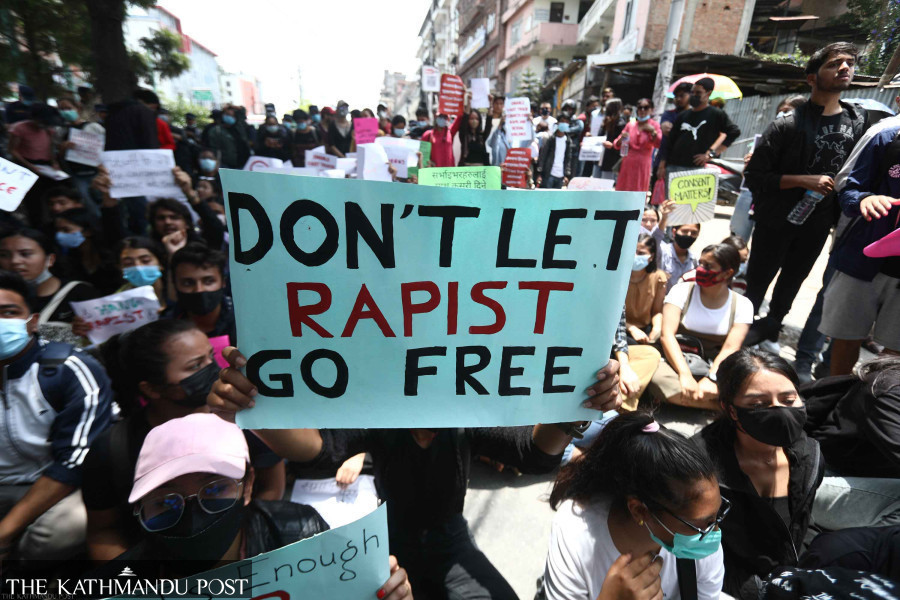
Court says a victim’s changed testimony cannot by itself justify acquittal when physical, scientific and circumstantial evidence establish the crime. Post file photo
The Supreme Court has convicted four men of gang-raping a woman in Morang nearly a decade ago, overturning their acquittals by the district and High courts and sentencing each to nine years in prison.
Ajay Paswan, Sujit Chaudhary, Rajesh Kamat and Rabin Kamat were convicted after the top court found that the prosecution evidence, including physical, scientific and circumstantial evidence, established their involvement in the crime.
The ruling also established that a rape victim’s decision to retract an earlier statement or become a hostile witness does not, by itself, weaken the prosecution’s case. Courts must assess such testimony alongside the other evidence on record, the Supreme Court said.
The woman, identified in court records by the pseudonym “Biratnagar Tha” to protect her identity, had initially told police that she was taken to a makeshift shelter beside a fishpond in Katahari, Morang, where she was restrained and raped by several men.
She later changed her account when the case reached the district court, saying that she had called her boyfriend, had consensual sex and did not know the other men. She told the court that none of the accused had raped her.
The Supreme Court, however, found that her changed testimony could not be considered in isolation.
A division bench of justices Hari Prasad Phuyal and Tek Prasad Dhungana delivered the verdict on June 24, 2025. The full text of the judgment was made public recently. The government had appealed against the decisions of the Morang District Court and the High Court in Biratnagar, which had acquitted the accused.
The Supreme Court ruled that victims or witnesses can contradict statements given during investigations because of social or family pressure or a desire to shield defendants from punishment.
In serious crimes such as rape and gang rape, judges must therefore examine the circumstances surrounding the case and assess all available evidence rather than relying solely on a victim’s testimony in court.
The Supreme Court specifically rejected the High Court’s reasoning that the four men should be acquitted because the woman had testified that none of them raped her.
It said that where medical reports and other independent evidence support the commission of a crime, an accused cannot be acquitted merely because the victim or complainant later gives contradictory testimony.
“In gang rape and rape, which are committed in secluded and private settings, the absence of direct evidence means that a chain of circumstantial evidence may itself be sufficient to establish the crime,” the judgment said.
The court found that the prosecution had presented physical, scientific and circumstantial evidence that, when considered together, established the involvement of the four men.
A government lawyer who argued the case said the lower courts had failed to assess the evidence in its entirety.
“In gang rape cases where victims and perpetrators are in proximity, victims do not always give a truthful account,” the lawyer said. “The court has to consider the circumstances of the entire incident.”
The Supreme Court, the lawyer said, considered the woman’s condition, the crime scene and the evidence as a whole before reaching its conclusion.
Alongside the prison sentences, the Supreme Court ordered compensation for the survivor.
It directed that Rs600,000 be paid to “Biratnagar Tha” immediately from the government’s Crime Victim Relief Fund. It also ordered the Morang District Court to ensure that another Rs100,000 is paid to her within 30 days.
The apex court also criticised the handling of the woman’s medical examination following the assault, finding shortcomings in the way the then Koshi Zonal Hospital and the doctors involved conducted and interpreted the examination.
During the proceedings, doctors Yogendra Yadav and Meluna Bhusal testified that the woman’s hymen could have been torn for various reasons and that the examination did not show signs indicating that she had been raped.
The Supreme Court questioned the conclusions drawn from the examination and found that the hospital and doctors had failed to discharge their duties with the honesty and professionalism expected of them.
“Describing as normal the condition of a victim who had been rescued unconscious after suffering gang rape appears to have been negligent,” the judgment said.
The court directed the government, the Ministry of Health and Food Safety and the chief registrar of the Supreme Court, through the Office of the Attorney General, to formally caution the hospital and doctors involved.
It said medical examination reports are key evidence in rape cases and other crimes involving women’s dignity, bodily integrity and physical autonomy and must be impartial, objective and scientifically based.
The court also stressed the state’s duty to prevent crime, help victims obtain justice and ensure that officials and service providers cooperate honestly with investigations and judicial proceedings.
The assault took place on January 23, 2017.
The woman, who worked as a waitress at a hotel in Biratnagar Metropolitan City-14, had travelled to Naya Bazar in Katahari to visit relatives. That evening, she was waiting at Katahari Chowk for a vehicle to return to Biratnagar.
Chaudhary and Rabin were travelling west on a motorcycle when they stopped and asked where she was headed. After she said she was going to Mahendra Chowk in Biratnagar, they offered her a ride.
It was already dark and she could not find another vehicle, so she accepted.
Instead of taking her to Biratnagar, they took her to a location south of the road in Katahari-1. After meeting Prakash Mandal, who worked there, they took her to the edge of a pond.
According to her statement to police, she was placed on an iron bed and told not to make a noise. She said more men subsequently arrived, bringing the group to eight.
She told investigators that the men pinned her down, prevented her from screaming and raped her one after another. She eventually lost consciousness and was later found unconscious at the scene, according to the police report.
Investigators recovered packets of noodles, a water bottle and cigarette butts from the site.
Police filed charges against all eight men. The district court acquitted the accused, and the High Court in Biratnagar upheld the decision.
The Supreme Court has now convicted four of them—Paswan, Chaudhary, Rajesh Kamat and Rabin Kamat—of the crime.
The full judgment has been sent, through the Office of the Attorney General, to the district police office and other relevant agencies for implementation.




 23.31°C Kathmandu