Sauraha elephant safari caught between animal welfare and livelihoods
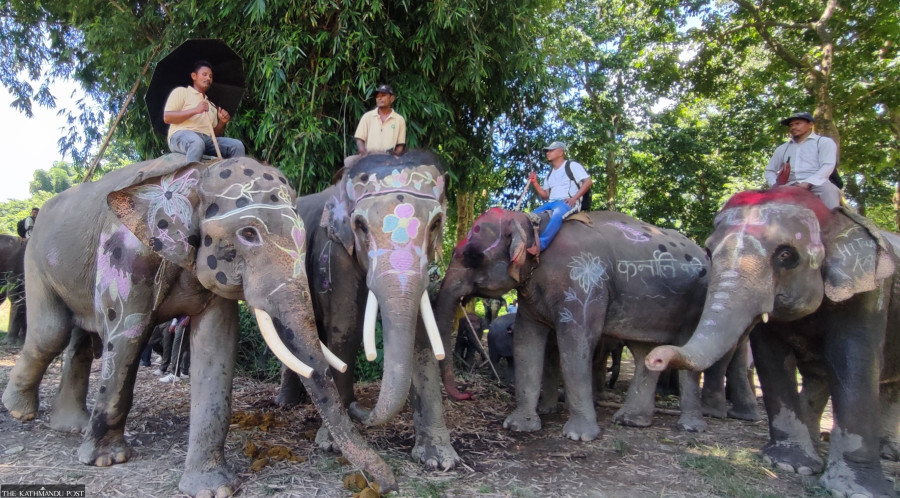
Local entrepreneurs call for phased transition after Supreme Court’s order to shift to ethical tourism. Painted elephants and their mahouts during the Elephant Day event at Baghmara Buffer Zone Community Forest in Chitwan, Wednesday. Ramesh Kumar Paudel/TKP
Sauraha, the country’s major tourist destination in Chitwan, has long been synonymous with elephant safaris. For decades, foreign and domestic tourists visiting Sauraha adjacent to the Chitwan National Park have mounted elephants to traverse the buffer zone’s community forests in search of rare wildlife.
However, the local entrepreneurs who have privately owned and domesticated elephants are worried with a recent Supreme Court verdict. They express their concerns stating that the future of the iconic practice of elephant safaris is in jeopardy. They argue an abrupt halt of elephant safari could devastate the local economy, tourism and harm the animals themselves.
Private elephant owners in Sauraha express readiness to shift toward ethical alternatives, such as elephant-friendly sanctuaries and bushwalks, but contend that a sudden ban is impractical. They are urging authorities to phase out elephants gradually so that owners have time and to adjust their businesses and protect livelihoods.
The delicate issue dominated discussions on Wednesday during the 15th International Elephant Day celebration in Sauraha, where stakeholders gathered for an ‘Elephant Picnic’ organised in the neighbouring Baghmara buffer zone community forest.
“We are prepared to transition to a sanctuary model as envisioned by the court, but it cannot happen overnight,” said Dipendra Khatiwada, the president of the United Elephant Management Cooperative Limited. “We are not in favour of stopping elephant safaris at once. We should instead pursue a dual-track approach: allow fit, working-age elephants to continue safaris for a few more years, while creating dedicated sanctuaries for elderly, sick, or disabled elephants and integrating them into tourism activities that do not disturb nature and local communities.”
The high-profile legal dispute stems from a writ petition filed on September 14, 2021, by advocate Sanjay Adhikari and others on behalf of the Janahit Samrakshan Manch. The petitioners demanded an end to animal cruelty, better record-keeping to curb illegal trading, a prohibition on chaining, and a complete phase-out of elephant rides in favour of observation-only tourism.
On December 17 last year, the Supreme Court ruled in favour of animal welfare reforms. The full text verdict was recently uploaded to the Supreme Court’s website, laying out comprehensive guidelines for elephant conservation and directing the government to seek alternatives to riding safaris.
“The anatomical structure of an elephant’s spine, legs, and body is not evolved to carry human passengers,” the court noted in point 48 of the verdict. “Subjecting these animals to heavy loads and continuous circular tours causes severe physical stress, foot rot, and joint ailments. Using an elephant merely as a tool for human entertainment contradicts our legal duty to respect its intrinsic worth and welfare as a living biological entity.”
In point 51, the justices instructed the government to establish clear legal policies transitioning Nepal towards ethical eco-tourism, drawing upon international precedents such as “elephant bushwalks” and observation platforms that maintain a safe distance between visitors and animals.
In the verdict, the Supreme Court has directed the government and agencies concerned to make the registration and management of privately owned and domesticated elephants more systematic. Under Rule 12 of the Regulation on the Control of International Trade of Endangered Wildlife and Plants, 2019, all such elephants must be registered and properly documented. Authorities must identify unregistered elephants and take action under existing laws. Any transfer of ownership, sale, purchase or movement of elephants must also be subject to legal approval and proper record-keeping.
The court has also called for stronger measures to control the illegal trade and cross-border smuggling of elephants. Security agencies, forest authorities and conservation bodies should coordinate effectively, particularly along the Nepal-India border, and maintain special surveillance. Individuals or organisations involved in the illegal sale, transportation or smuggling of elephants should be investigated and prosecuted in accordance with the law.
On elephant welfare, the court has ordered authorities to prevent torture, violence and other forms of inhumane treatment. It has called for scientific and animal-friendly methods of elephant management and urged that tourism involving elephants be made more welfare-friendly.
Mahouts and caretakers should receive training in elephant-friendly practices, while proper treatment and protection should be ensured for sick and ageing elephants. The court has also called for the establishment of elephant retirement and rehabilitation centres.
The court has directed authorities to move towards a chain-free and more natural system of keeping privately owned elephants. Elephants should be provided with open and natural surroundings, while management plans should take into account possible conflicts between people and elephants, as well as between wild and domesticated elephants. Drawing on international practices in elephant welfare and conservation, Nepal should gradually develop and implement scientific standards for elephant management.
The court has further called for ethical elephant sanctuaries where tourists can observe elephants only from a safe distance rather than ride or directly interact with them. The practice of keeping elephants unnecessarily chained, whether for training or other purposes, should be ended. Authorities have been asked to develop and implement policies and action plans to make elephant conservation centres and management systems more scientific and welfare-oriented.
The verdict also calls for better coordination among all agencies involved in elephant conservation and management. Regular monitoring of conservation activities should be carried out, and clear standards for the management of privately owned elephants should be developed and enforced.
The local operators argue that forcing an immediate shutdown without a transitional safety net would lead to financial ruin and widespread job displacement.
A single adult elephant commands a market price between Rs10 million and Rs15 million, while monthly maintenance, feed, and healthcare costs range from Rs100,000 to Rs120,000. Each animal requires at least two full-time handlers: a phaneta to manage feeding and grooming, and a mahout to handle movement and general care.
“If owners are forbidden from offering safaris, who will pay to feed and care for these massive animals?” asked Dipendra, who previously owned two elephants but now retains only one, Chanchalkali. “Following the Covid pandemic, when tourism collapsed, many owners were forced to sell their animals to buyers in India. In Sauraha, private elephant numbers dropped from 90 to around 45 today. A sudden ban without financial support will lead to complete abandonment.”
The looming ban has cast a shadow over the lives of local handlers. Jayalal Das, 48, a mahout from Rautahat who cares for an elephant named Sherkali, relies entirely on his income to support his six-member family. His grandfather was a mahout, and Das has spent 18 years in Sauraha driving tourist safaris.
“I do not know any other skilled work,” said Das. “If safaris close down tomorrow, I will have no way to feed my four children.” Nandalal Sah, who handles another private elephant named Ektakali, shared similar worries, adding softly, “If there are no elephants left to ride, I will have no choice but to do manual labour.”
Unlike government-owned elephants, which are strictly reserved for national park patrolling, research, and anti-poaching operations, all commercial safari elephants in Sauraha are privately owned and operate strictly within buffer zone community forests rather than the core protected park.
Addressing the gathering, Chief Conservation Officer of Chitwan National Park Dil Bahadur Purja Pun, acknowledged the binding legal reality of the ruling. He advised stakeholders to collaborate with park authorities to implement humanely managed elephant welfare practices while gradually aligning local tourism operations with the directives set by the Supreme Court.




 16.84°C Kathmandu
1.jpg)