Nepalis making treacherous trip to Europe through the Balkan route
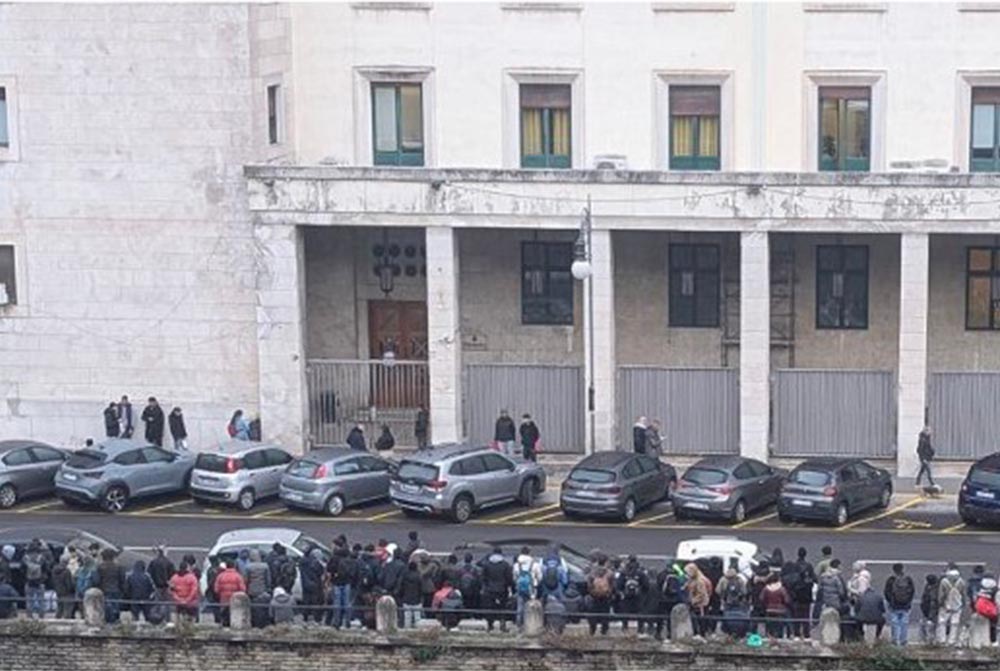
More than a hundred Nepalis are currently stranded in Trieste on the Italian-Slovenian border. This migration process has become almost routine. Migrants, including Nepalis, waiting outside the Trieste Police Headquarters for their appointment to submit refugee applications. Only a dozen migrants are allowed to apply here each day. Photo: Courtesy of No Name Kitchen
Every evening, at least 10 Nepalis arrive at a park outside Trieste Central railway station seeking help from Linea d’Ombra ODV, a volunteer organisation that provides food, clothes and basic medical assistance to migrants sleeping rough in the northern Italian city.
“At dusk every day, at least 10 Nepalis come looking for food and clothing,” said Lorena Fornasir, founder of the organisation. “Due to the administrative inefficiencies and delays within the local state apparatus, Nepalis are often at the bottom of the priority list when it comes to allocation of emergency institutional shelter.”
According to Fornasir, the daily presence of Nepalis around the square in front of the station has increased noticeably over the past year. There, until they are admitted into Italy’s reception system, many are left to survive on the streets.
More than a hundred Nepalis are currently stranded in and around the park, a number that has become almost constant. They are among the migrants who have reached Italy through the western Balkan route hoping to secure protection and build a future in Europe.
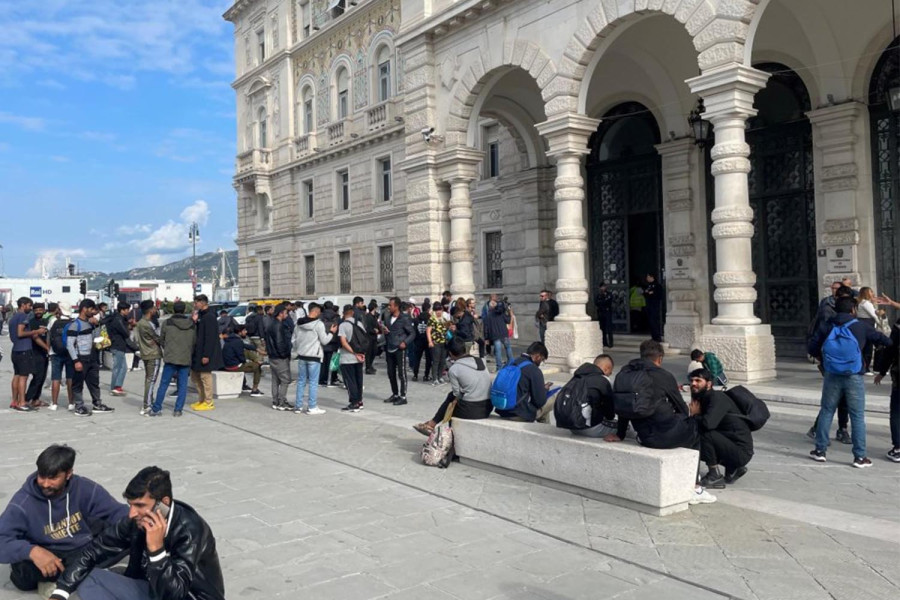
Trieste, on the Italian-Slovenian border, is one of the main gateways for people entering Italy overland. As migrants from around the world pass through the city, locals often refer to the area near the station as Piazza del Mondo—the square of the world.
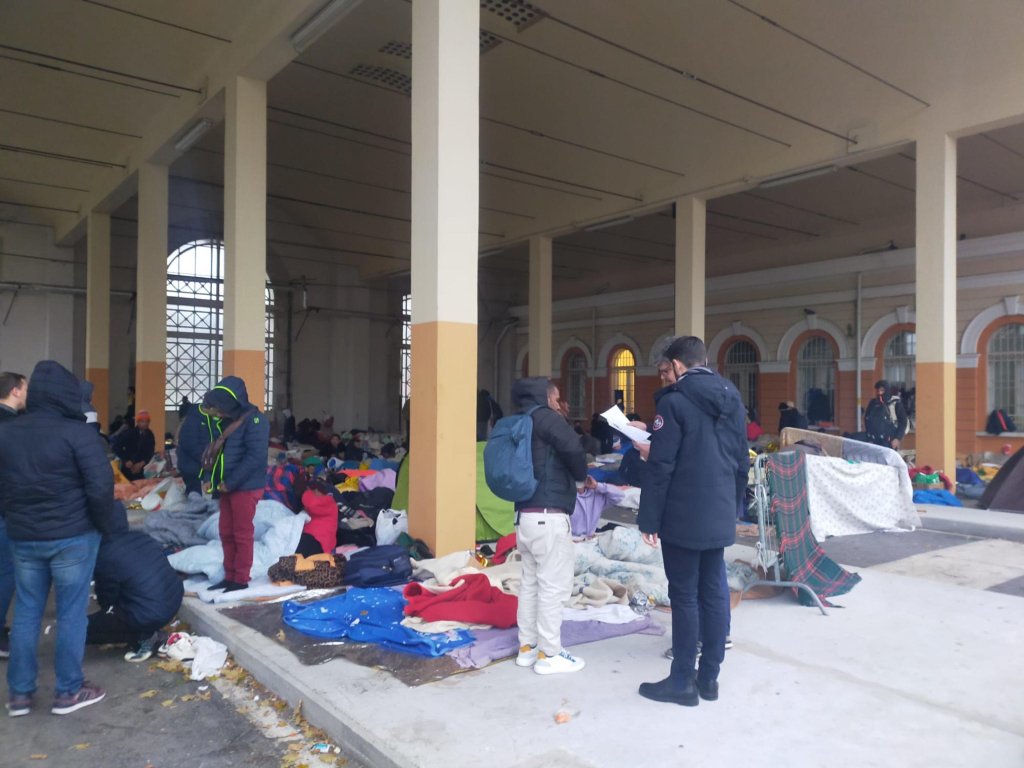
Those who arrive and connect with Linea d’Ombra usually receive food, blankets and, in some cases, tents. Yet that support is often all they have. For weeks or months, many sleep on cold concrete floors in parks, abandoned warehouses and derelict buildings in the old port area while waiting for their asylum claims to move forward.
“We are living inside an old building under a tent,” said Sita Rai from Sankhuwasabha district. “There are only two women among us. The rest are men. I cried often while sleeping on the ground, but then I reminded myself that this was the path I chose.”
Rai said the conditions are especially difficult for women.
“The weather is harsh here (Italy). When it rains, water leaks through the roof. The floor turns muddy. Sometimes even plastic sheets cannot keep the rain out. There is no proper place to use a toilet, nowhere to bathe and no safe environment to live in,” she lamented.
Trieste, on the Italian-Slovenian border, is one of the main gateways for people entering Italy overland. Photo: Courtesy of No Name Kitchen
A perilous way to Europe through the Balkans
Rai’s journey to Trieste took 18 days. She travelled from Cyprus through Turkey, Greece and France before reaching Italy.
The Balkan route refers to a network of irregular migration paths used by people from Asia, the Middle East and Africa seeking entry into the European Union. Migrants typically enter Europe through Turkey or Greece and continue north through countries such as North Macedonia, Serbia, Bosnia and Herzegovina, Croatia and Hungary before trying to reach destinations including Germany, France and Italy.
The route remains attractive to those looking to enter Western Europe without obtaining visas, but it is also among the most dangerous migration corridors on the continent.
Migrants often rely on agents and ‘dunkers’—guides who lead groups through forests, mountains and remote border areas.
Rai paid 4,000 euros, approximately Rs700,000, to an agent for the journey. She had saved the money while working as a domestic worker in Cyprus for three years. “Crossing the borders of Turkey, Greece and France was extremely difficult,” she recalled.
“We walked through forests, hills and streams. We drank water from rivers. Sometimes we walked nine hours straight. We crossed borders and then hid in forests waiting for taxis.”
According to Rai, missing a pickup could mean spending another night—or several nights—in the wilderness. “By the time we reached France, things became even harder. There was no guide with us. We had to navigate using mobile phones. Without internet access, we feared getting lost. The language barrier made everything worse.”
At one point, she said, a taxi driver left the group at the wrong location. They eventually found a bus stop for Italy in the middle of a rainy night. “We were soaked. We could not carry many clothes, so we just wore the same wet clothes until they dried on our bodies.”
Ramchandra Bishwakarma from Lamjung followed a different path. He arrived in Albania in 2022 after paying a recruitment agency around Rs600,000 to secure a labour permit. He worked in a shoe factory before deciding to leave.
“There were 22 Nepalis in the factory when I arrived. Many workers started running away. The workforce shrank and the company began delaying salaries,” he said. He and four others paid a Pakistani agent 2,500 euros each to reach Italy. Their journey from Albania took 22 days and passed through Montenegro, Bosnia, Slovenia and finally Italy.
“Sometimes we waited four or five days near a border. In some places we stayed in hotels, in others inside containers. Where police checks were strict, we had to walk 12 to 15 kilometres through forests and difficult terrain,” said Bishwakarma.
Unlike traditional smuggling operations, he said, guides often did not travel with migrants. “The agent would send a live location on a mobile phone. We followed that. The fear was constant. We never knew what would happen next.”
When he reached Trieste, he found dozens of Nepalis gathered around the railway station.
“One Nepali told me that if I applied for asylum, I could stay in a camp and get assistance,” said Bishwakarma. He abandoned plans to continue to France and stayed.
Today, he spends his days in uncertainty.
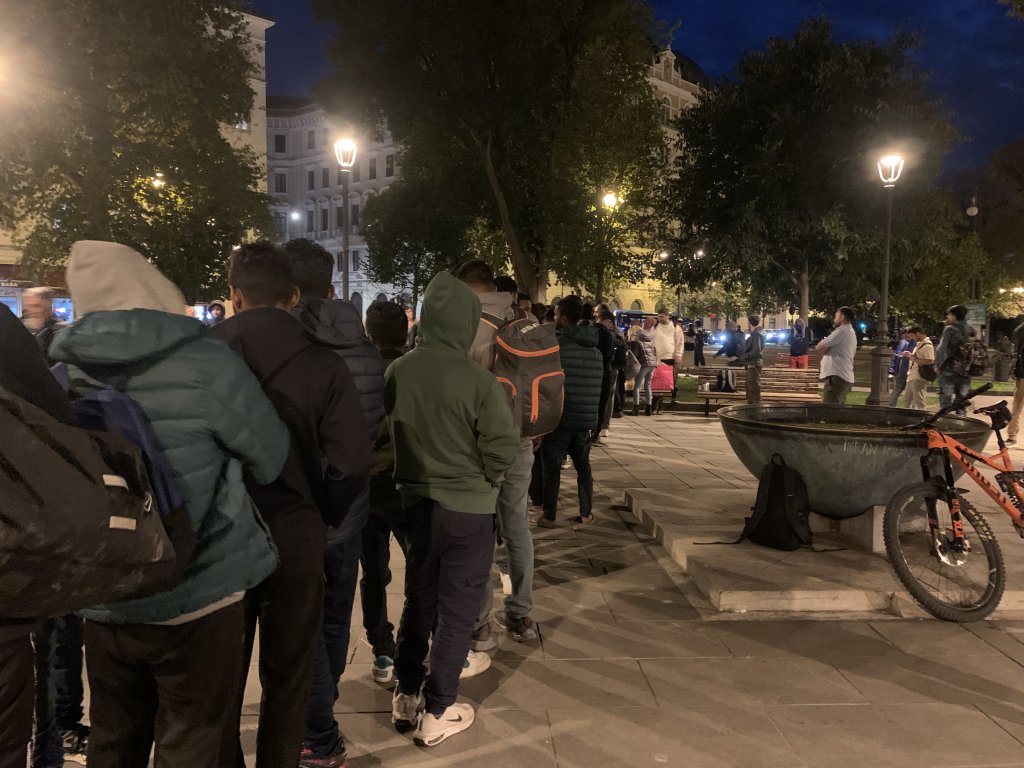
“It feels as though I escaped one hardship only to enter another. Even getting food entails standing in long queues with Pakistanis, Bangladeshis, Afghans and others. Sometimes I do not even want to eat the food provided, but I eat because I have to survive,” he said.
Migrants standing in line for food at Piazza del Mondo ("Square of the World") in Trieste, Italy. They arrived via the Balkan route to apply for refugee status at the provincial police office. Photo: Courtesy of Wallis/InfoMigrants via AP
European and international agencies report that migration through the Balkan route has fallen sharply in recent years. The European Border and Coast Guard Agency, Frontex, says detections along the route dropped by 42 percent in 2025. The agency attributes the decline to stronger border controls and improved cooperation among national authorities.
The United Nations High Commissioner for Refugees (UNHCR) has similarly reported a 39 percent decrease in mixed migration flows through the Western Balkans compared to the previous year.
Yet interviews with Nepali migrants and diplomats in Europe suggest a different trend for Nepalis. Over the past decade, growing numbers of Nepalis have travelled to eastern and south-eastern European countries such as Romania, Croatia, Slovenia and Portugal on work permits. Many subsequently leave their jobs and try to move to wealthier Western European countries, including Italy.
Concern over this pattern prompted Nepal’s Ministry of Foreign Affairs in March 2023 to request Nepali embassies in Europe to stop authenticating institutional labour demand letters from several European destinations. According to Nepal’s Department of Foreign Employment, around 35,000 Nepalis travelled to Europe through individual networks in the past fiscal year of 2024-25. Romania accounted for the largest share with 21,000, followed by Croatia, Portugal, Slovenia and Austria.
Labour migration experts say the actual figure is likely higher because many workers reach Europe through third countries. As formal recruitment channels have narrowed, migrants increasingly rely on informal agents, exposing them to exploitation, fraud and abuse.
A growing Nepali presence in Trieste
The International Rescue Committee (IRC) recorded 9,761 migrants arriving at Trieste railway station park through the Balkan route in 2025. Among them were 1,060 Nepalis. Of them, 92 percent were men and 8 percent women. The figures are based only on people who came into direct contact with aid workers and therefore represent only part of the overall picture.
Although the total number of migrants reaching the park fell 27 percent compared to 2024, the number of Nepalis increased. The IRC’s data show that Afghans remained the largest group, followed by Turkish, Nepali, Bangladeshi and Pakistani nationals.
Among women travelling alone, Nepalis formed by far the largest group. Aid workers say the visibility of Nepali women has grown markedly in recent years, reflecting a broader shift in migration patterns from Nepal. Nepalis accounted for the largest share of women travelling alone, making up 76 percent of the total.
The old port area in Porto Vecchio, where many migrants sleep, poses serious dangers. According to a report by the Italian news agency ANSA, a 43-year-old Sunil Tamang was found dead in an abandoned warehouse on January 13. He had returned there the previous day after submitting his asylum application.
Gianfranco Schiavone, president of the Italian Consortium of Solidarity, said the man had spent weeks exposed to freezing temperatures while waiting for accommodation. “He could have been saved with timely medical treatment and shelter,” the news report quoted Schiavone as saying.
Authorities periodically clear abandoned buildings, but migrants often return because they have nowhere else to go. “When access to housing is delayed, people are forced into dangerous shelters. The health risks are severe,” said Schiavone.
“Dozens of people living in such conditions visit our daytime clinic every day with respiratory illnesses and a range of other health problems. Many of these conditions are difficult to diagnose and treat properly without specialised equipment or adequate medical testing,” he said.
Local authorities evicting migrants staying in an old building in Trieste, Italy. Photo: Courtesy of ANSA/Michele Brusaferro
Long wait for paper
For many migrants, the first major hurdle is obtaining a document known informally as the ‘white paper’. Officially called the asylum registration certificate, it confirms that an asylum application has been formally lodged. Without it, migrants cannot access many reception facilities.
Sanjiv Thapa from Sindhupalchok spent five months waiting for the document. During that period, he slept in an abandoned building in the old port. “There were no doors or windows. The place felt like a jungle. People drank, used drugs and fought. We slept in fear,” he said.
Thapa arrived in Italy from Croatia in October 2023. He had paid Rs800,000 to an agent in Nepal to secure work in Croatia. “The work permit was only for one year. I tried warehouse work and delivery jobs, but I could not manage. Eventually I heard that a friend had reached Italy, so I followed,” he said.
Unlike migrants crossing borders on foot, Thapa still had a valid Croatian residence card, allowing him to travel by bus. Even so, the asylum process proved exhausting. “There is only one police office handling hundreds of people. I went five times before my application was registered,” he said.
Every morning, migrants gather outside the police headquarters before dawn.
They wait for hours in rain, heat or cold. “Often an officer comes out and simply tells everyone to come back tomorrow,” said Thapa.
Fornasir believes Nepalis face particularly long delays. “Sometimes the process is postponed for months. The current approach is based on deterrence. The idea is that if conditions are difficult enough, fewer people will come,” she told Kantipur.
Italian law requires asylum applications to be formally registered within three working days, or within 10 days during periods of heavy pressure. However, reports from asylum monitoring organisations indicate that migrants often wait between five and eight months.
Ajay Gautam, a Nepali volunteer interpreter assisting applicants in Trieste, said the process is quite long. “Officials need to collect personal information, travel history and reasons for leaving the country. Everything must be translated and documented,” he said.
An advocacy report published by eight Italian organisations in December 2025 found that dozens of people sought asylum daily in Trieste, yet only a small number gained access to the office each day.
As a result, many remained in legal limbo for weeks or months, unable to access housing, healthcare and other rights. Local police unions argue that staff shortages are partly to blame. Officials note that asylum arrivals have risen dramatically while police numbers have fallen.
Refugee status remains elusive
Receiving the paper from police opens the door to accommodation in reception centres operated by non-governmental organisations and private contractors under agreements with Italy’s interior ministry.
For Rekha Bhandari from Khotang, entering the reception system marked a turning point. She and her husband Lekh Bahadur reached Trieste separately through different migration routes before reuniting in the city.
“Families usually receive housing more quickly. We now live in a flat with another family. We each have our own room,” said Rekha. The couple have remained in the reception system since August 2023. Rekha now has a child and attends language classes.
“I thought I would find work immediately and get my documents quickly. That was not the case,” said Lekh Bahadur. He spent more than a year in a camp before getting a job. Even now, the family is waiting for a final decision on their protection claim.
Others have been waiting much longer. Bikash Chaudhary from Nawalparasi arrived in Italy in 2022. After receiving two rejections, he appealed through the courts. “Four years have passed and I still do not have refugee documents,” he said. The process has already cost him around 1,000 euros in legal fees.
To support himself, Chaudhary works in agriculture. Fourteen other Nepalis working alongside him are still waiting for decisions on their cases.
According to UNHCR data based on information from Italy’s interior ministry, more than 126,000 people lodged first-time asylum applications in the country in 2025. Only around 30 percent received some form of protection. And just 6 percent were granted full refugee status.
For Hari Sharan Wali from Rukum, the refugee process has become a source of regret.
He has not returned home in four years. His elderly parents remain in Nepal, along with his wife and children.
“I never imagined being separated from my family for this long. Sometimes I think I should not have come,” said Wali.
Hom Karki is a reporter with two decades experience covering migrant workers issues and the Nepali diaspora. He was previously based in the Gulf for Kantipur Daily.




 22.94°C Kathmandu