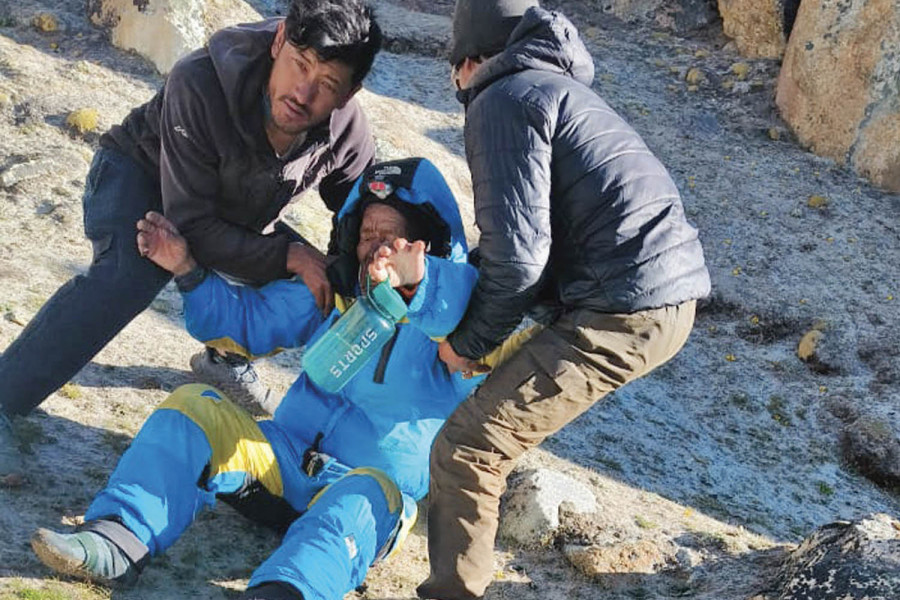
Polish climber Mariusz Chmielewski accuses Himalayan Traverse Pvt Ltd of negligence, mismanagement, alleging Dawa Sherpa was left for dead, and demands investigation. Dawa Sherpa is rescued near Everest Base Camp on Thursday. Photo: Courtesy of Sagarmatha Pollution Control Committee
In what many are calling a miracle in Mount Everest’s Death Zone, Nepali guide Dawa Sherpa (Hillary) was found alive six days after vanishing on the world’s highest mountain.
The 56-year-old Dawa from Okhaldhunga disappeared on May 29 in Everest’s extremely dangerous “Death Zone.” On the morning of the seventh day, he was found near the Khumbu Icefall at a place known as “Crampon Point,” crawling down towards Everest Base Camp.
According to mountaineer Tshiring Jangmu Sherpa, surviving for such a long period in extreme cold, with very little oxygen and without food, water, or shelter, is exceptionally rare in Himalayan conditions. “This is an extraordinarily rare event even for the Himalayan region,” said Sherpa, an internationally certified guide who currently operates Everest Sherpa Expedition Company. “It is an unusual case even for mountaineers and high-altitude medical experts.”
A helicopter was dispatched from Kathmandu on Wednesday to search for Dawa. Veteran rescue pilot Captain Bibek Khadka and two assistants conducted the operation. “We searched from the air for nearly 25 minutes, from Everest Base Camp up to the slopes of Camp III at around 7,300 meters. We found nothing,” Khadka told Kantipur on Wednesday evening.
On Thursday morning, employees of the Sagarmatha Pollution Control Committee (SPCC) who were working near the Base Camp, informed Dawa’s longtime friend Pasang Dawa Sherpa that he had been found alive. Pasang, also from Okhaldhunga, had been actively leading efforts to locate him. He said he immediately informed others after receiving the news.
After word spread that Dawa had been found, Captain Khadka, who was in Lukla, along with Lakpa Sherpa, who had arrived from Kathmandu, arranged a chartered helicopter flight to retrieve him. By that time, several people had already carried Dawa to Gorakshep. From there, Khadka flew him by helicopter to Surke, where he was given food before being flown to HAMS Hospital in Kathmandu at around noon. Lakpa Sherpa, owner of 8K Expedition, said his company had chartered the helicopter used in the final rescue effort.
While Dawa’s rescue has been celebrated, the incident has also raised serious questions about negligence, management failures, and potentially unprofessional practices by the expedition organisers, according to an official from the Mountaineering Operators Association of Nepal. The expedition appears to have been organised by Himalayan Traverse Adventure Pvt Ltd, based in Budhanilkantha, through the 8K Expedition in Thamel.
This season, five climbers, including British national and former Royal Marine Chris Thrall and Polish climber Mariusz Chmielewski, attempted Everest through Himalayan Traverse Pvt Ltd. Chmielewski, who turned back near the summit, has made serious allegations regarding the company’s management.
Currently undergoing treatment for frostbite in some fingers at HAMS Hospital, Chmielewski accused the organisers of running the expedition in a disorganised, dangerous, and unprofessional manner. “I have serious doubts about the company that organised this expedition. Everything, including the summit push, was delayed and poorly managed,” he told Kantipur.
According to him, the expedition was marked more by chaos and last-minute decisions than professional preparation. He said the high camps were established only at the last minute, communications were almost nonexistent, and food supplies were severely inadequate.
In one instance, he alleged that after a grueling 15-hour trek from Base Camp to Camp II, he was not provided with food or water until the following day. He also claimed that members of the support team were unable to operate cooking stoves.
After abandoning his summit attempt on May 28 at an altitude of around 8,450 meters, Chmielewski said that his fellow climber Chris Thrall successfully reached the summit but later returned to Camp IV with another team.
Weather conditions worsened significantly on May 29. According to Chmielewski, he had only about 20 bars of oxygen remaining in his cylinder—enough for approximately 30 minutes. Although he had purchased seven oxygen cylinders, he claimed management failures prevented him from accessing them when needed.
He alleged that one Sherpa had promised to provide him with spare oxygen while descending but instead kept the oxygen for himself and continued ahead. According to him, the last time Chris Thrall and Dawa Sherpa were seen together was after leaving Camp IV.
Chmielewski said he was forced to descend between 7,500 and 7,600 meters without supplemental oxygen before meeting Thrall on the route. Thrall reportedly told him that he had separated from Dawa, who appeared to be normal, and advised him to continue descending. Both foreign climbers then descended through the Khumbu Icefall during the night amid strong winds, heavy snowfall, and poor visibility. They reportedly shared a single headlamp and even shared oxygen for part of the journey.
According to Chmielewski, although Dawa had the expedition’s walkie-talkie and satellite phone, communication was lost after Camp IV. He alleged that the company managing the expedition quickly assumed Dawa was dead instead of launching an immediate search operation.
“There was no search mission for Dawa. No Sherpas were sent. I was told not to speak to anyone and not to talk to the media,” Chmielewski said from HAMS Hospital.
Believing Dawa had died, Chris Thrall posted an emotional tribute on Instagram, describing him as “a true warrior of the mountains.” Chmielewski also published a memorial message on Tuesday after assuming Dawa had perished.
According to Chmielewski, before the expedition began, company officials had assured him that only highly experienced Sherpas would be involved in summit operations. However, he said Dawa told him personally that he had never summited Everest before.
Dawa’s daughter, Mendo Lhamu Sherpa, confirmed to Kantipur on Thursday that her father had never reached Everest’s summit. She said he had been assigned support duties such as cooking and camp assistance during this expedition.
According to the allegations, Dawa was originally intended to remain at Camp II in a support and logistics role but was later assigned to the summit push due to a shortage of qualified personnel. Chmielewski accused company manager Dawa Sherpa and his son Ang Phurwa Sherpa of prioritising profit over safety and “playing with human lives.”
He also claimed that company representatives who visited him in the hospital informed him that his $1,500 deposit would not be refunded because it had been spent on rescue operations. The Polish climber has called for a comprehensive investigation into the matter.
Dawa remains in intensive care. His brother-in-law, Nima Ngati Sherpa, said he is speaking normally and is generally in stable condition. “I spoke with him for three or four minutes. He seems fine. Some of his fingers have frostbite,” he said.
According to Mendo, Dawa told family members that he became separated from the group at Camp IV. “My father fell behind the group at Camp IV,” she said.
Dawa reportedly survived by eating food left by other climbers at Camp III. He also told relatives that he had fallen into a snow depression and become trapped, and that finding the route was extremely difficult because the ladders and fixed ropes used on the climbing route had already been removed. Since doctors have not yet allowed him to speak extensively, his full account has not been made public.
The incident has sparked a broader debate about regulation, licensing oversight, and safety standards among Nepal’s commercial mountaineering companies. Ram Krishna Lamichhane, director general of the Department of Tourism, said a detailed investigation is already underway and that the expedition’s liaison officer, Madhusudan Pudasaini, was questioned on Thursday.
“We will conduct a thorough investigation. If wrongdoing is established, the company involved will face strict legal action,” Lamichhane said.
The spring Everest climbing season generally ends after May 29, and Dawa’s team was among the last groups attempting the mountain this year. Climbers have also called for an investigation into why ropes and ladders below Camp IV were removed while Dawa was still on the mountain, as well as into the roles played by the Department of Tourism’s temporary field office, the Sagarmatha Pollution Control Committee, and the Mountaineering Operators Association.
Dawa Sherpa’s survival is being hailed as one of the most remarkable survival stories in Everest’s history. At the same time, the incident has raised troubling questions about expedition safety, accountability, and rescue preparedness on the world’s highest mountain.
Suraj Kunwar is a senior correspondent with over two decades experience covering Aviation, Tourism and Mountaineering. He received the IFJ Tolerance Award in 2005.




 14.81°C Kathmandu