Lumbini avoids UNESCO danger list for third straight year
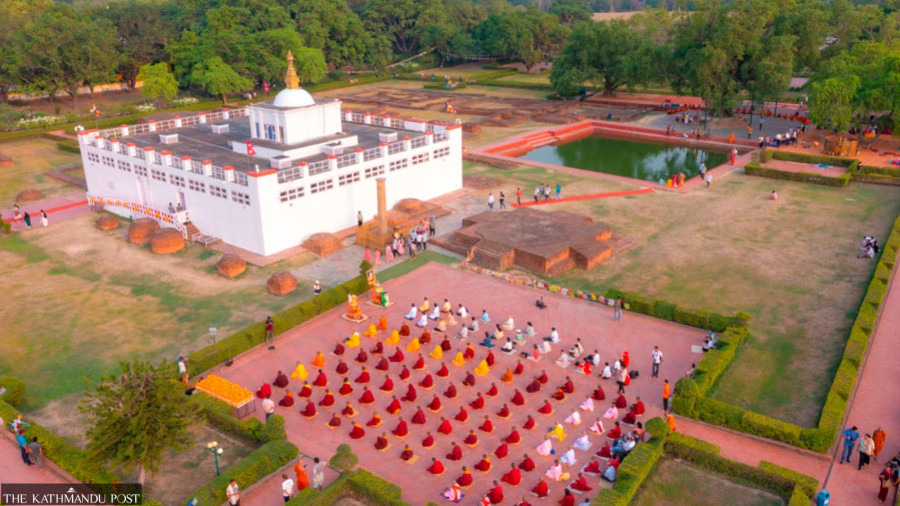
The UN agency recognises Nepal’s conservation efforts at the Buddha’s birthplace but warns that risks remain and issues 13 recommendations for stronger protection. Post File Photo
Lumbini has stayed off UNESCO’s World Heritage in Danger list for a third consecutive year, with the agency recognising Nepal’s efforts to protect and manage the birthplace of the Buddha.
The decision was made during the 48th session of the UNESCO World Heritage Committee, held in Busan, South Korea. Chaired by Lee Byong-hyun, the committee held a separate discussion on Lumbini and concluded that ongoing conservation and management efforts justified keeping the site off the danger list for another year.
However, the committee stressed that risks to the site have not been fully addressed and issued 13 recommendations aimed at strengthening long-term conservation and management.
The decision follows a Reactive Monitoring Mission carried out by UNESCO and the International Council on Monuments and Sites (ICOMOS) from February 4 to 7, 2026. The mission assessed conditions on the ground and submitted a report that formed the basis of the committee’s deliberations.
Gyanin Rai, acting member secretary for the Lumbini Development Trust, said the positive outcome reflected the trust’s conservation-focused programmes, policy reforms and management improvements implemented over the past two years.
According to Rai, Nepal’s efforts to address concerns raised by UNESCO in previous years had demonstrated tangible progress rather than remaining limited to written commitments.
Members of the Reactive Monitoring Mission, including Professor Roland Lin Chih-Hung, identified several major improvements. These included the organisation of an international heritage conference, the reactivation of the International Scientific Committee (ISC), regular monitoring and conservation of archaeological remains, and the establishment of a systematic reporting mechanism. The committee also commended conservation work carried out around the Maya Devi Temple complex.
Despite welcoming the progress, the World Heritage Committee directed Nepal to take further steps to safeguard the site’s Outstanding Universal Value.
Among its recommendations, the committee called for stronger protection of archaeological remains within the Sacred Garden, the use of archaeological risk mapping in future planning, the preparation of a long-term conservation strategy for the Maya Devi Temple, and a Heritage Impact Assessment before implementing the World Bank’s proposed development project in Lumbini.
The committee also urged Nepal to review the Kenzo Tange master plan, strengthen the implementation of an integrated management framework, improve the safeguarding of intangible Buddhist cultural heritage, increase the participation of Buddhist communities in services for pilgrims, and introduce stronger measures to control air and noise pollution.
Nepal has been instructed to submit a new State of Conservation (SOC) Report to UNESCO headquarters by February 1, 2027, detailing progress made in implementing all 13 recommendations.
Himal Upreti, chief of the archaeology section at the Lumbini Development Trust, said authorities had focused on conservation, legal reforms and policy improvements after incorporating recommendations made by UNESCO in 2024 and 2025.
He said the trust had prepared and begun implementing five sectoral strategies covering archaeology, visitor management, disaster preparedness, local development and engagement with Buddhist communities.
“We worked day and night, covering every aspect that needed improvement,” Upreti said. “The results have been encouraging, and we will continue prioritising conservation.”
The trust has also carried out conservation work on the Ashoka Pillar, the Marker Stone and structures surrounding the Maya Devi Temple. It has improved water leakage control, sanitation, painting, electrical systems and other basic infrastructure across the heritage site.
Officials say these measures helped rebuild UNESCO’s confidence in Nepal’s management of Lumbini.
Assistant Professor Prem Chaudhary Siri Vajira of Lumbini Buddhist University said the latest decision was an important achievement but warned that sustained long-term conservation efforts remained essential.
International scrutiny of Lumbini intensified after UNESCO and ICOMOS dispatched their first Reactive Monitoring Mission to the site in 2022 amid concerns that development activities were undermining its archaeological integrity.
Since then, the World Heritage Committee has reviewed Lumbini’s conservation status at its annual sessions in 2024, 2025 and 2026. On each occasion, Nepal’s corrective measures have prevented the site from being added to the List of World Heritage in Danger.
UNESCO’s concerns first emerged after the World Heritage Centre and ICOMOS concluded that activities at Lumbini were threatening the site’s archaeological values. In response, they sent a Reactive Monitoring Mission in 2022 comprising heritage experts Roland Lin and Professor Yuga Kariya.
Based on the mission’s findings, UNESCO considered placing Lumbini on the danger list during the 46th session of the World Heritage Committee held in New Delhi in 2024. However, an amendment proposed by India prevented the immediate listing.
Instead, the committee issued a 12-point decision and set of recommendations through Nepal’s Embassy in France, outlining measures needed to improve conservation and management.
Nepal subsequently undertook a series of reforms and submitted a detailed State of Conservation Report responding to UNESCO’s concerns.
“We studied every previous recommendation from UNESCO in minute detail,” Rai said. “We analysed exactly what the committee’s concerns were and addressed them comprehensively in our State of Conservation Report. That is why we achieved this positive outcome.”
He added that close coordination with national and international experts, the Ministry of Culture, Tourism and Civil Aviation, and the Department of Archaeology had also contributed to the result.
Nepal’s delegation to this year’s UNESCO session, held from July 19 to 29, was led by Culture Secretary Mukund Prasad Niraula. The delegation also included Nepal’s Permanent Delegate to UNESCO and Ambassador to France, Sudhir Bhattarai, spokesperson for Lumbini Development Trust Rai, Saubhagya Pradhananga, director general of the Department of Archaeology and other officials.
Tilaurakot not discussed
Tilaurakot, believed to be the ancient capital of Kapilavastu and currently on UNESCO’s Tentative List, was not discussed during this year’s World Heritage Committee session because Nepal did not submit a formal nomination.
Officials said Nepal is working to resolve technical and historical differences with India before resubmitting Tilaurakot’s nomination in 2027 in an effort to secure its inscription on the World Heritage List.
Meanwhile, UNESCO added India’s Buddhist site of Sarnath to the World Heritage List during this year’s meeting in South Korea. Sarnath is traditionally recognised as the place where the Buddha delivered his first sermon after attaining enlightenment.




 16.45°C Kathmandu