Nepal raises dismantling of Susta earthen barrier with New Delhi
Nepal’s Delhi embassy says villagers built the temporary embankment as a last resort against flooding. While 16 border pillars mark most of the Nepal-India boundary in Nawalparasi West, there are no boundary pillars along the roughly 24-kilometre Susta stretch. File Photo.
The Nepali Embassy in New Delhi on Sunday formally raised with India’s Ministry of External Affairs an incident in which Indian security personnel crossed into Nepali territory in Susta in Nawalparasi West and dismantled a mud embankment built by local villagers to protect their village from flooding.
The embassy raised the issue on the same day of the incident.
“Our officials raised concerns about the way Indian security personnel dismantled the makeshift embankment,” said a foreign ministry official, adding, “We told them that it was a last-resort effort by locals to mitigate flooding.”
Susta and Kalapani are two major boundary disputes between Nepal and India, with both sides acknowledging them as contested areas. In 2014, both sides agreed that the issue would be resolved through the mechanism involving foreign secretaries and the Boundary Working Group. However, in the past 12 years, no meeting at the foreign secretary level has been held to address the dispute.
According to two officials at the Ministry of Foreign Affairs, the Indian side insisted that Susta and where the Nepali side is building the mud dam are disputed territories and that both sides had agreed to maintain the status quo.
A similar dispute erupted two months ago when India's SSB personnel halted the construction of a permanent flood-control embankment being built by the Nepal government in the same area. Following a minor scuffle at the time, officials from Nepal’s Armed Police Force (AFP) and India’s SSB reached an agreement to maintain the status quo, stating that Susta is a mutually agreed disputed area.
On Sunday also, the Indian side reiterated the same position, calling the area disputed and saying no new structure could be constructed there, according to the two officials.
Besides regular meetings between the security agencies, the chief district officer and district magistrate of the Indian side do sit regularly if any dispute arises along the border.
Dipak Nepal, the chief district officer of Nawalparasi West, told the Post that the situation was normal on Monday.
As soon as Nepali media reported the matter on Sunday, the Nepali Embassy in New Delhi took it up with the Indian side, seeking a prompt resolution. However, the Indian side called for restraint and said the issue should not be turned into a national agenda.
The dispute intensified after Nepal awarded a contract to construct a 132-metre flood-protection embankment along the Narayani River. According to local officials, the project could not proceed after the Indian side raised objections, leaving the entire stretch without permanent protection. They said Nepal has already completed embankment construction downstream of the 132-metre section, while the disputed stretch remains the only unprotected gap.
Since then, the exposed riverbank has continued to suffer severe erosion caused by the Narayani River. Local residents say they attempted to build temporary protective structures to mitigate the immediate risk of flooding, but those efforts were also halted, despite the works being carried out within Nepali territory and outside the disputed section.
Officials and local communities warn that the unprotected stretch has become one of the main entry points for monsoon floodwaters into Susta. They maintain that Nepal’s objective in constructing the embankment is to protect its territory, farmland and settlements from river erosion and flooding. As Indian territory lies both upstream and downstream of this section of the river, some local officials also believe that coordinated embankment and river-training works on both sides would be necessary for effective flood management.
In the absence of protective measures, they say, riverbank erosion continues to reduce the area of Nepali land in Susta year after year.
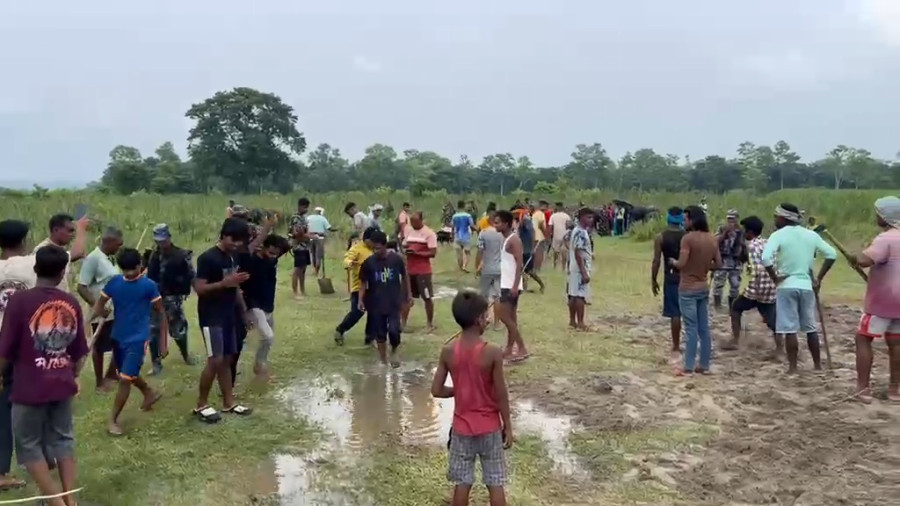
On Sunday, according to locals, a group of Indian security personnel in plain clothes entered Nepali territory carrying spades and began digging up the mud embankment that villagers had recently built to reduce the risk of floodwaters from the Narayani river inundating the settlement.
Residents rushed to stop them, triggering a standoff before Nepal’s Armed Police Force intervened to prevent the situation from escalating.
Later as per the past agreement, APF and SSB personnel quickly brought the situation under control.
On 8 December 1988 Nepal and India agreed to treat the Narayani River as a boundary river under the principle of a fixed boundary, according to former Director General Buddhi Narayan Shrestha.
Under this principle, the boundary remains fixed as it existed when the Nepal-India boundary agreement was signed, he added.
“Fixed boundary principle applies to the demarcation of the riverine sector of Tarai lowlands. It requires identifying the river’s course as it existed at the time of the agreement and demarcating the boundary by placing alternative pillars on both sides of the river, regardless of whether water or river channel exists there today. This principle was adopted as per the decision of Nepal government on 8 December 1988 and agreed upon by both countries,” said Shrestha.
However, over the last several decades, the Narayani River has changed course, creating complications over land ownership and leading to competing claims in the area.
Rabindra Jaiswal, spokesperson for the Susta Protection Campaign, said villagers had constructed the temporary earthen embankment only after Indian authorities blocked them from building a permanent flood-control structure along the Narayani River.
While 16 border pillars mark most of the Nepal-India boundary in Nawalparasi West, there are no boundary pillars along the roughly 24-kilometre Susta stretch.
Instead, the two countries rely on natural features such as rivers and trees to mark the boundary. As a result disputes over land ownership and cultivation recur frequently. A silk cotton tree currently serves as the de facto boundary marker in part of the disputed area.
Residents say the changing course of the Narayani river over the decades has further complicated the border.
Sunday’s incident followed a similar dispute on May 31, when India’s SSB entered ward 5 of Susta Rural Municipality and objected to the construction of a permanent embankment being built by Nepal’s Ministry of Energy, Water Resources and Irrigation.
According to Chief District Officer Nepal, the dispute centred on a new 132-metre section of embankment planned about 50 metres to the east of an existing structure, still within Nepali territory.
The project was initiated after then energy minister Kulman Ghising visited Susta about eight months ago and directed authorities to prioritise flood protection for the vulnerable settlement.
Susta is bounded by the Narayani river to the north and west and India’s Bihar state to the south and east.
India maintains three SSB outposts near the area, while Nepal has an APF border post commanded by an inspector.
Residents say Indian authorities have repeatedly objected to Nepal’s activities in the area, citing the absence of clearly demarcated border pillars.
Two weeks ago, 52 residents led by Susta campaigner Munna Khan travelled to Kathmandu and staged a protest at Maitighar Mandala, demanding stronger state protection.
During a meeting with Home Minister Sudan Gurung, they urged the government to establish a Nepali Army security post in Susta, alleging years of harassment by Indian security personnel.
Following the meeting, the home ministry instructed the district administration to reinforce security in sensitive areas of Susta and to begin processing citizenship applications for eligible residents who lack citizenship documents.
Anil Giri is a Chief Sub Editor covering diplomacy, international relations and national politics for The Kathmandu Post. Giri has been working as a journalist for more than two decades, contributing to numerous national and international media outlets.




 14.82°C Kathmandu