Weak arbitration defence costs government billions
State agencies’ ineffective counterclaims in disputes with construction firms have resulted in losses of at least Rs 5.5 billion over five years. A section of the Sikta Irrigation Project Photo: Courtesy of Sikta Irrigation Project
Two years ago, the Sharma/BKOI/Surya JV construction company claimed Rs 1.44 billion from the Department of Roads before an arbitration tribunal. The amount sought in the construction dispute was around Rs 100 million higher than the total contract value of the project.
The contractor for the Keshaliya–Chimadi–Laukahi Road Upgrading Project in Sunsari claimed losses, arguing that unexpected soil extraction costs and delays in relocating electricity poles left trucks and equipment idle.
According to records of the Nepal Council of Arbitration, which resolved the dispute, the tribunal awarded around 20 percent of the claimed amount, ordering the department to pay Rs 288.5 million to Sharma/BKOI/Surya JV, including Rs 57.6 million in interest.
The Keshaliya–Chimadi–Laukahi project is not an isolated dispute.
The case reflects a broader pattern emerging from Nepal’s public procurement disputes. A review of arbitration records and Auditor General reports shows that government agencies routinely enter arbitration without strong legal defences, rarely pursue counterclaims against contractors and operate within a system criticised for inconsistent decision-making and weak oversight. The result has been billions of rupees in payouts from public funds.
Over the past five years, construction companies, suppliers and consultants have claimed around Rs 14 billion from the state, with tribunals ordering payments of at least Rs 5.5 billion.
In the past two years, 84 percent of 89 disputes resulted in contractors receiving full or partial compensation through arbitration.
The Office of the Auditor General has identified weak government defence as one of the key reasons behind the high rate of contractor victories. In its latest report, it found that only 27 of 160 disputes involved formal counterclaims by government agencies.
Auditor General Toyam Raya told Kantipur, referring to the report, that government bodies rarely file counterclaims.
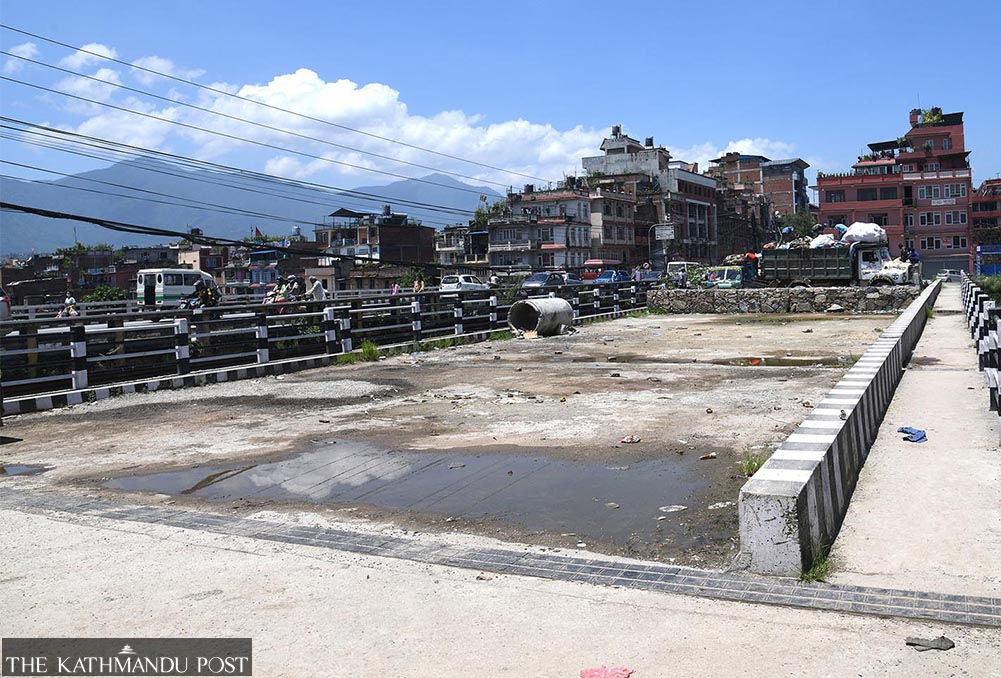
The 62-metre Teku bridge, built by Pappu Construction, was declared substandard immediately after it was handed over to the Department of Roads in 2019. Post File Photo
The report states that government agencies often fail to defend cases effectively, sometimes do not respond at all, and are unable to present sufficient evidence and documentation before arbitral tribunals. As a result, decisions that could have favoured state agencies end up benefiting contractors.
Baburam Dahal, a former general secretary of the council, said he had seen very few instances of government agencies filing counterclaims, describing it as a major weakness.
“There is no proper mechanism for them to work on this. Employees do not put in effort and lack expertise,” said Dahal, also a senior advocate . “If a contractor fails to complete work, the law allows recovery of the remaining cost. But since agencies never claim it, tribunals cannot award it.”
According to him, there is no proper mechanism to work on this.
“However, since they (the government agencies) never file such claims, the arbitrator cannot award or recover those amounts on their behalf,” he added.
Arbitration is an alternative dispute resolution mechanism used to settle commercial and contractual disputes outside the formal court system.
In Nepal, the main legal basis is the Arbitration Act, 1999. The Public Procurement Act, 2007, and related regulations also require disputes between government agencies and contractors to be resolved through arbitration if mutual settlement fails.
Due to its ability to provide speedy dispute resolution, binding decisions, and confidentiality, arbitration has emerged globally as a widely recognised alternative dispute resolution mechanism for commercial disputes.
Under these legal provisions, construction companies often take disputes to independent institutions such as the council rather than the courts. Hearings are not public, and claims and evidence remain confidential, with decisions made by appointed arbitrators in confidential arbitral proceedings.
The data suggest contractors are securing substantial payouts while government agencies rarely pursue counterclaims.
In the Keshaliya–Chimadi–Laukahi project, the contractor’s first and largest dispute concerned soil availability.
The contract stated that the contractor was responsible for arranging the soil required for road filling. However, soon after construction began, the contractor claimed that the government had failed to provide a nearby extraction site free of charge, forcing it to purchase soil.
During arbitration, the government’s defence remained weak. Officials failed to argue effectively that the contract placed responsibility for sourcing materials on the contractor. The tribunal subsequently ruled in favour of the contractor.
Another dispute in the same project involved 110 electricity poles. The contractor claimed that delays in removing the poles restricted the movement of heavy vehicles and equipment.
The tribunal ruled that “idle equipment costs” should be shared equally between the government and the contractor, ordering the department to pay Rs 46 million, along with Rs 8.4 million in interest. However, the report noted that the claimed losses were based on estimates rather than objective measurements.
Data from the council show arbitration claims have increased nearly fivefold over the past four years. In the 2020-21 fiscal year, claims stood at Rs 1.22 billion, rising to around Rs 6 billion in 2023-24. Government counterclaims, however, remained minimal. The clearest imbalance came in 2021-22, when contractors claimed more than Rs 2.5 billion while the government filed counterclaims worth only Rs 10 million, just 0.4 percent of the claimed amount.
Arbitral decisions also appear mutually conflicting. For example, in one case under the Department of Roads’ Kathmandu Sustainable Urban Transport Project involving the construction of Teku Bridge, a tribunal awarded Rs 16.6 million to the contractor, citing losses arising from a reduced scope of work and overhead costs.
However, in another case under the Postal Highway’s Birgunj–Thori Road Section Upgrading Project, a similar claim worth Rs 13.8 million was rejected claiming “the contractor had accepted variation orders.”
In another claim of a similar nature, the arbitrator rejected the claim on the grounds that it could not be presumed that a business would necessarily earn a profit and that the claimant had sought 15 percent compensation for lost profits based merely on speculation, without supporting documents.
A report by the Auditor General’s office, however, commented that in similar cases, arbitration decisions have sometimes awarded compensation based on estimates rather than objective evidence of actual loss or overhead costs incurred. Such differing decisions in disputes of a similar nature create a lack of the expected consistency and reliability in the arbitration system, the office said.
Under Nepal’s legal system, decisions made by the regular courts serve as precedents for subsequent disputes. When deciding similar cases, courts are required to follow the reasoning and principles established in earlier decisions.
If a court finds it necessary to depart from a previous precedent, a larger bench of judges must hear the matter and explain the jurisprudential reasons for overturning the earlier position, stating that a new approach will be adopted going forward. Subsequent decisions must then follow that new precedent.
Arbitration, however, is not subject to any such obligation to follow previous decisions or precedents. As a result, disputes of the same nature can produce different outcomes—as seen in the cases of the Teku Bridge and the Birgunj–Thori Road projects.
Auditor General Raya stated that arbitration decisions should be consistent and that standardised criteria need to be developed to achieve this.
“The work should be carried out by qualified experts with a mechanism to evaluate their performance,” he said. “There must be consistency in decisions as well. In disputes of the same nature, some claims are upheld while others are not. That aspect needs to be standardized to some extent.”
One of the reasons for this problem is related to who is appointed as an arbitrator and how such appointments are made. Under the law, each of the two parties to a dispute selects one independent arbitrator, and the two arbitrators so selected jointly choose a third arbitrator. This panel then decides the dispute.
Regardless of who appoints them, once they have taken the oath, arbitrators are expected to act independently and impartially, rather than representing the interests of the party that selected them.
Matrika Niraula, a senior advocate and an independent arbitrator, said that one of the main causes of the problem is the government's tendency to appoint arbitrators based on personal connections and affiliations rather than competence and expertise.
“The situation is truly alarming. When it comes to appointing arbitrators, the government is reluctant to select the right people,” he said. “What it needs are competent and credible professionals, yet that is often not the priority. In fact, individuals within the government itself are contributing to the erosion of the integrity of the very forum entrusted with resolving disputes.”
Recent rulings also show cases in which poorly performing contractors have been rewarded.
One example is the Sikta Irrigation Project.
Under the project’s Duduwa Irrigation System, a contract for canal reconstruction and expansion was signed with Coastal-Pappu JV on June 26, 2016, with a completion period of two and a half years.
However, the contractor was not present at the site even by mid-December 2016. The work did not progress even after agreements reached in tripartite meetings. On October 11, 2017, the company admitted its failure and submitted an apology. After repeated deadline extensions and continued non-performance, the government terminated the contract. Under procurement law, performance guarantees are forfeited and compensation can be recovered from the contractor. The firm was subsequently blacklisted for three years.
Despite this, the blacklisted contractor later filed an arbitration claim worth Rs 333.9 million in May-June 2023. The Sikta project filed a counterclaim of Rs 1.14 billion covering project continuation costs, first-bill payments and consultant fees.
The counterclaim was one of the few exceptions, accounting for more than 40 percent of the Rs 2.5 billion in counterclaims filed by the government across 27 projects over five years.
On June1, 2024, a majority of tribunal members, with one dissenting opinion, ruled in favour of the contractor and awarded more than Rs 150 million. About a month later, the tribunal revised its decision and ordered an additional payment of more than Rs 10 million. The Arbitration Act permits corrections only of typographical or mathematical errors, not substantive changes to a decision.
Project director Raju Acharya said they challenged the decision in the Patan High Court. Judges Lal Bahadur Khatri and Shyam Kumar Bhattarai overturned the revised award on September 5, 2025 and ordered the tribunal to reconsider the case.
“After that, the tribunal again ruled in favour of the contractor,” said Acharya. “We have now gone to court again.”
Council records show Coastal-Pappu JV received Rs 165 million from the project despite failing to complete the work.
The Office of the Auditor General has described some arbitral decisions as “not impartial or reasonable”, recommending the creation of a regulatory body to oversee arbitration through legal amendments. It has also proposed institutionalising counterclaims and establishing clear standards for the appointment of arbitrators.
Raya said problems exist throughout the process, from contract design to implementation. He said governments must properly defend claims and appoint qualified arbitrators when disputes are resolved through arbitration.
“Strict regulation is needed across the system. The state cannot bear losses caused by individuals (officials),” he said.
There have been allegations of collusion between contractors, government officials, and in some cases arbitrators, resulting in weak or absent counterclaims.
Council Secretary Gandhi Pandit acknowledges these concerns.
“Since arbitrators cannot issue an award in favour of the government if no claim has been filed by the government side, the primary responsibility for preventing misuse of public funds rests with the contracting authorities themselves,” he said.
He added that the amended Arbitration Act allows corruption cases to be filed against those who improperly influence arbitration awards.
“This should help curb such malpractices and abuses.”




 13.68°C Kathmandu