Landslides pile on the misery in Jajarkot settlements
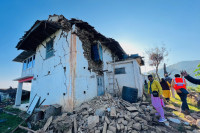
The disasters highlight an escalating crisis across Jajarkot, where extreme weather is battering fragile communities still reeling from the earthquake. When a massive landslide struck the settlement, survived by 6.4 magnitude earthquake three years ago, on Saturday evening, the rickety house turned into a deadly trap. Jyotee Katuwal/TKP
Kedar Karki, a resident from Jajarkot, one of the remotest areas in western Nepal, survived the devastating 6.4 magnitude earthquake three years ago.
Following the earthquake, Karki’s family of seven spent nearly two years inside a flimsy temporary shelter. A month ago, driven out by relentless monsoon rains, they ventured back into their half-ruined mud-and-stone house.
When a massive landslide struck the settlement on Saturday evening, the rickety house turned into a deadly trap. Kedar, 52, sustained severe injuries in the landslide and died en route to a hospital in Nepalgunj.
The disaster highlights an escalating crisis across Jajarkot, where extreme weather is battering fragile communities still reeling from the earthquake.
“This landslide has devastated our entire village, causing huge human casualties and physical destruction,” said Bhim Bahadur Karki, ward chair of Bheri Municipality-2. The landslide has killed four and left six people injured, all of whom are currently undergoing treatment at the district hospital.
Nearly 90 percent of the 300 households in Risang were already affected by the 2023 earthquake. The recent landslides have damaged the majority of surviving structures across Paldanda, Chyaumuda, Chisapani, Neta, and Jhyalkhet, according to the ward chief.
Alongside Karki, search teams recovered the bodies of Om Singh Khatri, his mother Rati Khatri, and Bhim Bahadur Karki, on Sunday morning after they went missing on Saturday night.
Local authorities face a daunting rescue effort amid widespread infrastructure destruction.
“Landslides have occurred in almost every single neighbourhood, making it impossible to move from one cluster to another,” said ward chief Karki. “The area is entirely shattered, and it is impossible to assess everyone’s status right now.”
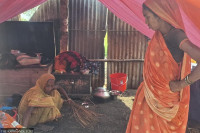
Displaced residents are currently taking shelter at various community buildings.
The District Disaster Management Committee, the Nepal Red Cross Society and Bheri Municipality have provided tarpaulins, tents, utensils and emergency food supplies such as beaten rice, instant noodles and biscuits for the displaced.
“We have distributed non-food items from the supplies available with the committee and by coordinating with non-governmental organisations,” said Chief District Officer Khadananda Adhikari. “The municipality has arranged dry food, including instant noodles and biscuits, for the displaced families.”
Local community leader Dhan Bahadur Karki said the displaced families were in a desperate situation. “None of us has been able to eat a proper meal,” he said. “We neither had enough to eat nor could we sleep properly yesterday. A single tarpaulin has been distributed to each family, but the rain has continued. We have been forced to stay awake again today.”
Deputy Superintendent of Police Buddhi Sagar Puri said that approximately 150 people remain trapped in various isolated locations across the ward.
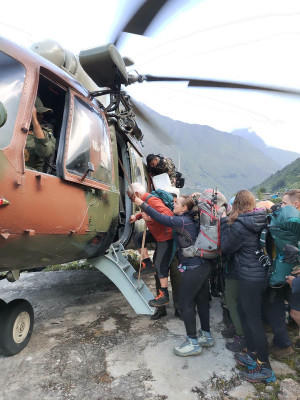
Security forces, including 200 personnel from the Nepali Army, Armed Police Force and Nepal Police, have been deployed for search and rescue operations.
Several quake-hit settlements in Jajarkot are at high risk of landslides. According to the District Disaster Management Committee in Jajarkot, 68 earthquake-affected settlements in the district are at high danger of landslides.
“The earthquake had already cracked the surrounding terrain,” said Chief District Officer Khadananda Adhikari. “The tremors weakened the land’s initial structure, and continuous rains exacerbated the instability, leading to further destruction.”
Adhikari stated that rescue teams evacuated 16 people from Jhyalikhet, 20 from Chisapani, 15 from Rauterata Danda, and three from Pharula to safer ground.
According to the District Disaster Management Committee, settlements severely damaged by the earthquake—including Sagachaur, Libal, and Detkule in Chhedagad; Laikham in Barekot; Chaur, Chaupani, and Maide in Bheri Municipality; Dungara, Luppakha, and Bhius in Shivalaya; and Chiuri and Pali in Nalgad—are also at high risk of landslides.
Displacements are mounting rapidly in Junichande Rural Municipality-3 as well. The authorities relocated 12 families from Syala due to the landslide threat.
Thousands of earthquake survivors were forced to construct temporary huts on high-risk slopes, riverbanks, and edge-of-cliff farmlands. Geologists had previously warned that post-earthquake landscapes suffer up to an 80 percent higher risk of landslides due to deep structural fractures in the soil.
“Earthquakes shake the rock formations and loosen the topsoil, creating wide fissures,” said geologist Santosh Sharma. “Consequently, even brief rain showers or minor shocks can cause entire hillsides to give way.”
The water-induced disasters wreak havoc in the quake-affected settlement each monsoon season. On July 13, 71-year-old Jasi Kumari Shahi died and three others were injured inside a temporary hut in Bheri Municipality–2. Eight people perished in Jajarkot landslides last year alongside seven individuals in neighbouring Rukum West.
For survivors, the disaster compounds years of administrative neglect and delayed rebuilding support. “Before the pain of the earthquake could even heal, these landslides have destroyed our remaining homes,” said Ramesh Karki, a local teacher at Tribhuvan Basic School. “Without permanent housing, we were already living painful lives in temporary huts. The rain has not stopped, risks are rising, and displaced families are sitting here hungry.”
Despite 48,517 beneficiaries being identified in Jajarkot and 34,954 temporary shelters erected, Chief District Officer Adhikari admitted that formal reconstruction work has yet to begin.
The devastating earthquake, with its epicentre in Ramidanda of Barekot Rural Municipality, killed 154 people and damaged around 76,000 houses across Jajarkot and Rukum West. Thousands of earthquake-displaced families continue to live in temporary shelters or quake damaged houses due to the delay in reconstruction and rehabilitation of the victims. The quake victims are exposed to threats from landslides and floods during monsoon while they are left shivering under flimsy huts in winter.




 23.73°C Kathmandu