Rusted pontoon bridge left unused for 13 years shifted from Bardiya to be installed at flood-hit Phurkekhola, Dhading
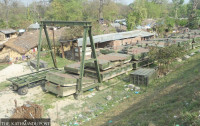
The pontoon bridge, which once connected Rajapur with other parts of Bardiya, is being refurbished to restore transport links between Gajuri and Siddhalek after floods swept away the concrete bridge. Parts of the pontoon bridge that lay unused for 13 years at Kothiyaghat in Bardiya district. Post Photo
A pontoon bridge that lay unused for 13 years at Kothiyaghat in Bardiya district is being transported to Dhading for installation over the Trishuli river in Phurkekhola, where floods washed away a concrete bridge and disrupted travel between neighbouring local units.
The bridge reached Phurkekhola in Gajuri Rural Municipality-2 on Friday. It will be installed near the Jaladevi temple, linking Gajuri-2 with Siddhalek Rural Municipality-6. Floods on August 26 swept away the motorable bridge, leaving communities struggling to reach the district headquarters and the Prithvi Highway.
Jagadish Prasad Joshi, chief administrative officer of Gajuri Rural Municipality, said the loss of the bridge had severed direct links between the district headquarters and all 13 local units in Dhading. The local people have since faced longer journeys and higher costs.
The destruction of the Phurkekhola bridge had cut the direct road link between Dhadingbesi and the Prithvi Highway. Floods also damaged other roads and bridges along the Trishuli corridor, disrupting essential services and trade.
Representatives from all 13 local units in Dhading visited the Rajapur Irrigation Management Project’s site camp at Kothiyaghat to inspect the equipment. They asked the project to assess whether it could be installed at Phurkekhola.
Two project employees subsequently examined the river’s flow and the feasibility of installation, said Shashidhar Wagle, a technician responsible for the pontoon bridge.
“As the pontoon bridge consists of floating units, we measured the water flow at Phurkekhola and found that it could be installed there,” said Wagle. “It has been left exposed to the sun and rain at Kothiyaghat for 13 years and has rusted. Three units have holes, but they can be repaired, painted and brought back into use.”
The crossing Phurkekhola is about 80 metres long. Wagle said the 24 pontoon units transported so far were expected to be sufficient to span it. The bridge has 33 units in total, with a combined length of 145 metres. The project plans to repair and paint 24 units for immediate use.
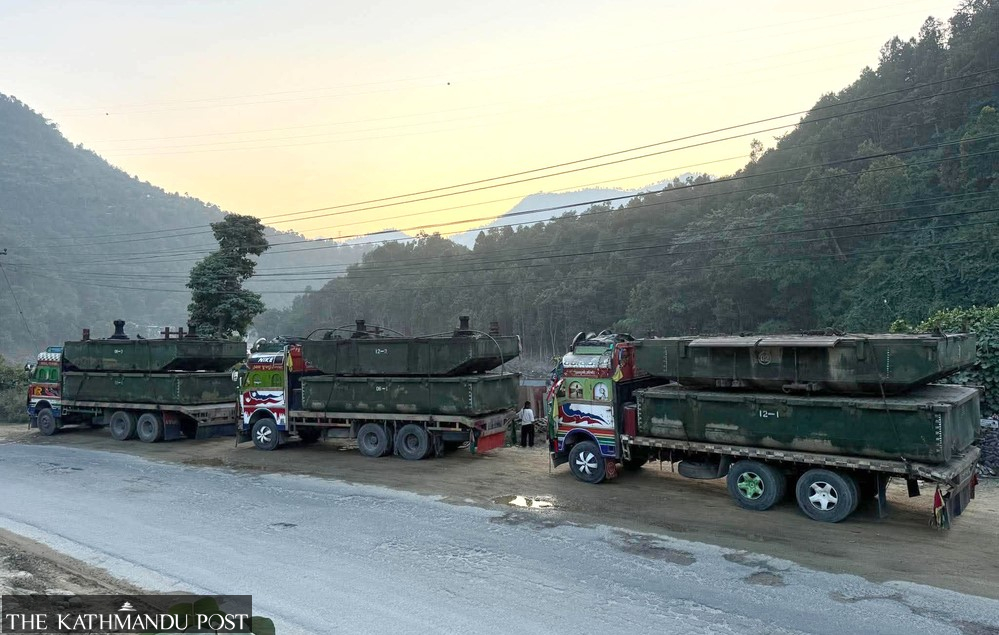
By Friday, 24 units had reached Dhading in four trips, transported from Bardiya on trailers brought from the district. Wagle said the project would send two technicians and 10 workers experienced in installing pontoon bridges to Dhading immediately after Tihar.
The pontoon bridge being transported to Dhading for installation over the Trishuli river in Phurkekhola. Post Photo
Installation is expected to take at least a week. The team will also train local workers to handle the units. “We are preparing to install the pontoon bridge at Phurkekhola immediately after Tihar,” he said. “Our technicians and workers who have previously worked on this bridge will carry out the installation.”
The project submitted an inventory of the bridge and its components to the Dhading District Administration Office on Wednesday. The total cost has not yet been determined.
The bridge was used at Kothiyaghat, on a bifurcation of the Karnali river in Geruwa, from 1997 to 2010. It was installed during the dry season and removed before the monsoon. A motorboat was used to assemble and dismantle the floating units.
Before a concrete bridge was built at Kothiyaghat, the pontoon crossing connected Rajapur with the rest of Bardiya during winter. During the monsoon, people crossed by steamer boat.
Locals from 11 former village development committees used the pontoon bridge, which helped farmers transport and sell produce. The Rajapur Irrigation Project bought the Chinese-made bridge with a loan assistant of Asian Development Bank. Local resident Birbal Shahi said it had eased transportation until the permanent bridge opened.
The pontoon bridge remained unused after the concrete bridge at Kothiyaghat opened. Its relocation is now seen as a way to restore a local crossing in Dhading.
The floods also washed away the main bridge connecting Dhadingbesi, the district headquarters of Dhading with the Prithvi Highway and affected access to parts of Gorkha. Residents have been using the 19-kilometre unpaved Parewatar-Mastar road, making travel difficult and increasing freight charges. Higher transportation costs have pushed up the prices of daily necessities.
Jwalamukhi Rural Municipality chair Yamnath Danai was assigned responsibility for bringing the bridge to Dhading. Work is underway to paint the units and build approach roads.
Ganesh Lal Shrestha, chairman of Gajuri, said preparations would take three to four days before installation begins after Tihar. Ward 2 chair Drona Kandel will oversee the approach roads and local arrangements.
All 13 local units in Dhading have established a common fund to cover transportation, installation and management costs, said Bhim Prasad Dhungana, chair of the Municipal Association of Nepal and mayor of Nilkantha Municipality, Dhading. Each local government will contribute according to the expenses incurred, under a joint procedure.
Once installed, the pontoon bridge is expected to ease travel and the transport of goods between settlements on either side of the Trishuli river. It is expected that the bridge will help restore daily life after months of disruption.
Ram Prasad Chauhan and Kamal Panthi in Bardiya and Poshnath Adhikari in Dhading contributed to this news.




 18.78°C Kathmandu