



 23.12°C Kathmandu

Fri, Aug 28, 2026
Money
Nepal’s labour market caught between jobless workers and worker shortages
Weak skills recognition, poor job information and low wages are widening the gap between Nepal’s workers and employers.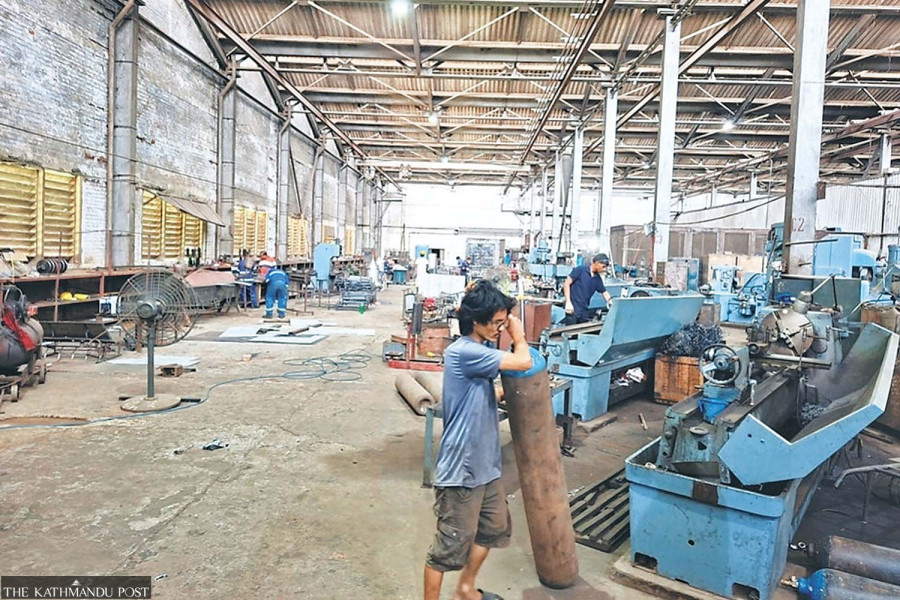
bookmark
Hom Karki
Published at : August 16, 2026
Updated at : August 16, 2026 06:37
Kathmandu
After spending 18 years working in the United Arab Emirates and Saudi Arabia, Nil Bahadur Khadka of Banke returned to Nepal seven months ago hoping to settle back home.
Armed with certificates proving his skills, he went from one construction company to another looking for work as an overseer. No one hired him.
After nearly seven months without a job, Khadka received a call from his former employer in Saudi Arabia.
“We have secured a new contract in Kuwait. We can offer you the same position with a higher salary. We have already sent a demand letter to a recruitment agency. Go there and submit your passport,” the company told him.
Khadka immediately agreed.
He is now preparing to leave for Kuwait after being assured that he will be able to save around Rs100,000 a month.
“Over there, companies actively seek us out and call us. Here, even after going from door to door looking for work, nobody trusts us,” Khadka told Kantipur. “My children have not finished their education. At a time like this, I cannot just sit idle at home.”
His flight is expected to be booked within a few days.
Thirty-year-old Rupal BK of Dang, who returned from Malaysia just three months ago, has had a similar experience.
“There are no large industries in our area hiring 300 to 400 workers. There are only small companies that employ five to seven. When we approach them, they say they have no vacancies,” BK said. “Labour work is not available all the time. I need at least Rs20,000 to Rs30,000 a month to support my family, but I cannot find a job that pays that much.”
Unable to find reliable work, he too is preparing to leave, this time for Qatar.
“I have found a labour job at a hotel in Qatar,” he said. “They say it will cost me Rs250,000 to go there. I am waiting for my visa.”
While Khadka and BK are preparing to leave the country again because they cannot find work at home, employers complain that they cannot find enough workers.
Shivahari Ghimire, secretary-general of the Federation of Contractors’ Associations of Nepal, estimates that the construction sector alone needs an additional 300,000 to 500,000 workers.
“The construction sector needs 1.1 million workers directly. Only around 800,000 to 900,000 are currently available in the market,” Ghimire said. “A large number of skilled workers have already left the country. We have had to hire workers from Bangladesh and India.”
Nepal’s labour market appears caught in a paradox: citizens cannot find jobs while employers struggle to find the workers they need.
According to the 2021 National Population and Housing Census, 15.7 million people, or 65.5 percent of Nepal’s population, were classified as economically active, or part of the labour force. They included 8.2 million men and 7.5 million women.
The largest age group within the economically active population is 25 to 29, with about 1.9 million people. Another 1.8 million are aged 20 to 24, while around 1.78 million are aged 35 to 39.
Much of this 20-39 age group is searching for productive employment and decent work.
According to the Ministry of Youth, Labour and Employment, more than 745,000 unemployed people registered with employment service centres established in 746 local units last fiscal year.
Prabal Jung Pandey, chair of the Employers’ Council at the Federation of Nepalese Chambers of Commerce and Industry, said the shortage was particularly acute among skilled workers.
“We can regularly find unskilled workers. But there is a huge shortage of skilled and semi-skilled workers,” Pandey said. “The skilled workers we find are mostly those who have been unable to go abroad for work.”
According to Pandey, construction, hotels and manufacturing are among the sectors facing shortages of skilled workers.
Of Nepal’s employed labour force, the largest share, 57.3 percent, works in the primary sector, including agriculture, forestry and fishing. Another 12.7 percent works in manufacturing and industry, while the remaining 30 percent is employed in services.
A large proportion of skilled workers with experience in construction, manufacturing, hotels and other services are employed abroad.
Nepal does have legal and institutional mechanisms for recognising the skills workers acquire overseas. The National Skill Testing Board, Recognition of Prior Learning system and National Skill Academy Nepal provide mechanisms to assess and certify skills and experience gained abroad.
But many returning workers are unaware of these options. Certificates also have limited recognition in the domestic labour market. Weak coordination with employers means the skills of workers returning from abroad are not being fully utilised.
Forty-three-year-old Arjun Gautam of Bardiya, who returned after 18 years working in the construction sector in Saudi Arabia, said Nepal had not recognised the skills he acquired there.
“I have a certificate for surveying work that I learned in the Gulf. I am proficient in it. I also have a skills certificate issued by the Saudi government,” he said. “But if I want to do the same work here, employers ask for educational certificates, which I do not have.”
Gautam said the failure to recognise his skills had reduced him to the status of a labourer in Nepal.
Pandey said the government and employers needed to carry out comprehensive “skill mapping” to identify the workers available in the country.
“We should record the skills of workers returning from foreign employment at the airport itself,” he said. “Only after skill mapping can we find the workers we need.”
For some, the problem begins even before they leave the country.
Ayush Upadhyay of Dodhara-Chandani in Kanchanpur, who is considering foreign employment, said he had few opportunities in Nepal to acquire practical skills for running a business. Even as he runs his own canteen and hotel in Dodhara-Chandani, he feels he needs to better his skills for potential employment abroad.
The labour ministry established the National Vocational Training Academy Development Committee in December 2023, saying it would produce skilled, competitive and entrepreneurial workers to meet demand in both domestic and international labour markets.
The committee has developed training programmes in various trades, with courses lasting six months or at least 730 working hours. The programmes also have international recognition.
Yet the academy has struggled to produce workers with the skills sought by private employers.
Ramesh Prasad Bakhati, a former executive director of the committee, said training centres were not sufficiently connected to actual labour market demand and that closer coordination with the private sector was essential.
“We cannot prepare workers according to the needs of the private sector without taking the private sector into confidence,” he said. “At present, federal, provincial and local governments are conducting training programmes independently. People who take such training often fail to find jobs.”
Bakhati said procedures for testing and certifying the skills of workers returning from foreign employment had also yet to be approved.
Unemployed workers have limited access to up-to-date information on where jobs are available, how many workers different sectors need and which skills are in growing demand.
The labour ministry established employment service centres at the local level in 2018 to collect and manage labour market information, connect employers with workers and provide support to unemployed people.
Young people across the country have been registering at the centres, hoping to find work based on their qualifications and skills. But only 28,346 of those registered have been given jobs through local government projects, for a maximum of 83 days.
Other businesses and institutions operating at the local level have done little to provide jobs through the system.
Meanwhile, about 51 percent of employment service centres do not even have an information technology-based registration system. Among centres that do, many report using the system only partially.
The ministry has plans to develop a national labour market information system, but it has yet to become fully operational.
According to ministry spokesperson Pitambar Ghimire, the government is trying to develop the “Shram Sansar” platform into a national employment information system. But limited participation by both employers and workers, weak digital capacity at employment service centres and poor management of labour market data have prevented the system from delivering the expected results.
The Shram Sansar portal has been operating for two years. A total of 2,558 employers have registered on the platform and can post their demand for workers. On the other hand, 125,057 unemployed people have registered in search of jobs.
Only 78 of them have found job placements.
An ILO report titled Evaluation of Public Employment Services and Labour Market Policies in Nepal, released on January 16, 2026, identified weak coordination and engagement with employers as one of the main obstacles to effective public employment services.
“Sixty-three percent of employment service centres do not register any type of job vacancy,” the report said. “Where vacancies are registered, most are from the public sector.”
The report said this underscored the need to win the confidence of private-sector employers, bring them into the system and expand services tailored to their needs.
Binod Shrestha, chair of the Joint Trade Union Coordination Centre, said connecting workers with the right skills to jobs offering fair wages remained a major challenge.
“The real gap is not between workers and employers. The problem is the mismatch between the labour market system, workers’ skills, wages and the information available about jobs,” he said.
“Until skilled workers receive fair wages, employers will continue to complain that they cannot find workers, while workers will continue to say they cannot find jobs and head abroad.”
Minister for Youth, Labour and Employment Ramjee Yadav said the government was focusing on jobs and skills development to make Nepali youth more self-reliant and competitive over the next decade.
He said the government had given top priority to the “Employment Promotion Decade”, covering fiscal years 2026-27 to 2036-37.
“The goal is to create enough opportunities at home and engage young people in nation-building,” Yadav told Parliament on Monday. “Employment service centres at the local level have now been transformed into employment, skills and entrepreneurship centres to connect young people with entrepreneurship.”
But while the minister promoted the government’s plans, 27-year-old Anita Urao of Itahari said she had been unable to find work that matched her experience.
“I want to work in sales. I have experience working at clothing and shoe shops,” Urao said. “I registered on Shram Sansar looking for work, but no one contacted me. I also applied for jobs advertised there, but I was never called for an interview.
“Unless you know someone, nobody trusts you.”
Hom Karki
Hom Karki is a reporter with two decades experience covering migrant workers issues and the Nepali diaspora. He was previously based in the Gulf for Kantipur Daily.




Most Read from Money
Nearly 400 Kailash-bound pilgrims out of contact after Rasuwa flash flood
What is the Nepal government’s ‘one-door policy’ for flood relief?

I left New York for Kathmandu. Did the egg crisis follow me?

Rasuwa floods weigh on Nepal’s stock market as hydropower, insurers slide

How Nepal is mobilising funds in flood response
Editor's Picks


E-PAPER | August 28, 2026

Enter The Kathmandu Post
Advertisement

×