From horoscope apps and digital puja guides to robotic monks and chanting boxes, a small group of Nepali developers is testing whether technology can turn ancient religious practices into modern services.
For centuries, religious knowledge in Nepal has travelled through priests, scriptures and oral traditions. Increasingly, it is also travelling through smartphones.
A growing group of Nepali developers is building apps and devices that put rituals, mantras, astrology and religious texts on demand, betting that technology can make practices rooted in centuries-old traditions fit more easily into modern life.
The market is still small. But the experiments are multiplying.
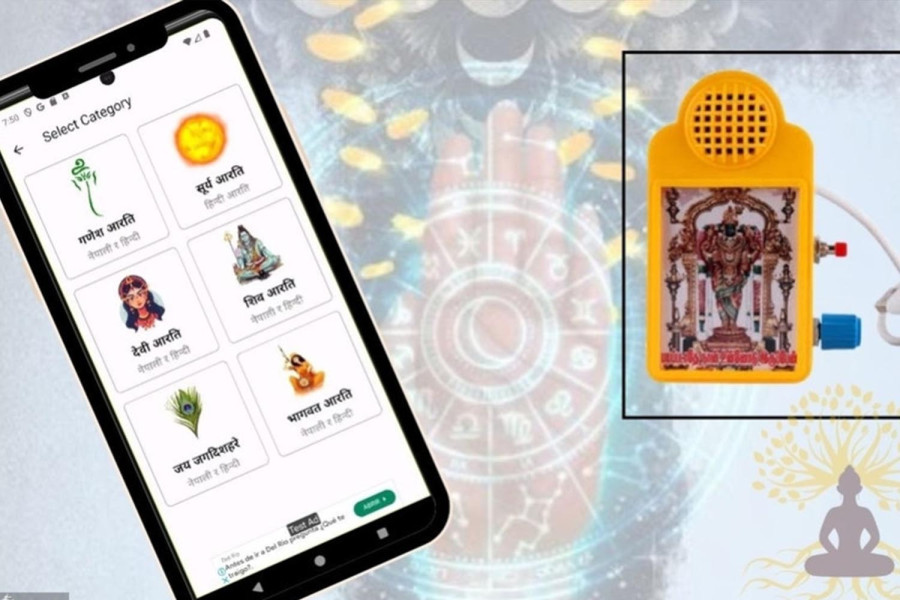
Five years ago, Nabin Khatiwada and Yubaraj Dhungel, two Sanskrit students from eastern Nepal who studied in Vrindavan, India, started with an unusually simple idea: put a Hindu ritual book on a phone.
Their project, Brihat Karmakanda, has since evolved into a business. The app now offers digital religious texts and horoscope readings, has over 50,000 downloads and attracts over 37,000 monthly active users.
Its newest paid feature suggests where the business may be heading.
Nearly 500 people subscribed to its horoscope service within days of its launch. Annual membership costs Rs299, while five-year and 50-year plans cost Rs999 and Rs2,999 respectively.
“We started by digitising a book,” Khatiwada said. “Then we realised there was much more we could do.”
The path from Sanskrit text to software was not straightforward. Khatiwada initially struggled with the technical requirements for publishing an app, including obtaining a dollar card to pay Google Play Store fees. After the developer helping him left following the release of Android 13, he taught himself coding and backend programming.
Today, the two-person operation is split between technology and text. Khatiwada handles programming; Dhungel prepares and types Sanskrit material.
The app initially relied on Google advertising for revenue. Paid astrology has opened another stream, and Khatiwada plans to add artificial intelligence to the platform.
Brihat Karmakanda is one small example of a broader shift: religious practice is beginning to acquire the logic of a technology product.
The same impulse is visible in hardware.
Pokhara-based Yarsa Labs has built a battery-powered “chanting box” that plays mantras and devotional songs for a set period. Founder NJ Subedi said the company developed the device after noticing that people often play music during morning and evening prayers.
Designed like a mirror and decorated with Hindu deities and traditional motifs, the device turns a familiar ritual accompaniment into a consumer product.
“We have not actively marketed the technology, but we make it when there is demand,” Subedi said.
Technology is also entering Nepal’s religious heritage sites, although in a different form.
Bikash Gurung, president of the Nepal Robotics Association, points to a robotic attraction at a Buddhist monastery in Lumbini that has been operating since around 2013. At the Buddha Gram Robotic Live Museum, robotic and animatronic figures recreate episodes from the Buddha’s life, from his birth and renunciation to enlightenment and death.
Gurung sees possibilities beyond museums and attractions.
“Automating some processes at monasteries, temples and cultural sites listed as heritage sites could make things easier,” he said. “It would not necessarily interfere with traditional practices.”
The bigger commercial opportunity, however, may lie in astrology.
Subedi considers astrology the strongest market for faith technology in Nepal, pointing to Hamro Patro’s service that connects users with astrologers by phone. Other Nepali platforms, including Bihebari, use technology to match couples based on horoscopes, gotras and nadi compatibility. Nepali developers have also experimented with building AI chatbots such as Prithvi AI and Jyotish AI around astrology and religious guidance.
“There is a sizeable market for faith tech in Nepal,” Subedi said.
What has held the sector back, he argues, is not necessarily demand but attitudes toward monetising religion.
“Our society is not as comfortable with making money from people’s faith,” he said. “So Nepal has not seen as many faith-tech apps as India.”
India offers a glimpse of what that market could become.
There, astrology, spirituality and religious practice have already spawned a substantial digital economy. AstroTalk, AstroSage AI and Astrosure.ai are among the platforms competing for users seeking everything from horoscope readings to spiritual advice.
AstroTalk, launched in 2017, now has more than 70 million users and over 18,000 astrologers, reported journalist Bhuvana Kamath for The Economic Times. Kamath has reported that the platform accounts for about 80 per cent of India’s online astrology market.
Meanwhile, Astrosure.ai has created a chatbot named Agastya to offer horoscope analysis and mental health advice, drawing around 1.8 million monthly active users.
Other products push the idea further, using generative AI to simulate conversations with religious figures or offer AI-guided spiritual assistance, including platforms like Gita GPT, Quran GPT, and Vedas AI.
Gita GPT, developed by Vikas Sahu using GPT-3.5 technology, lets users ask questions in separate chat rooms modelled on 11 religious figures, including Krishna, Ram, Shiva, Hanuman, Buddha, and Chanakya. The service is available in 16 languages, including Nepali.
Other platforms, such as Devaseva and Sri Mandir, aim for religious services themselves, offering virtual worship (e-darshan), delivery of prasad, and virtual participation in Vedic rituals.
The appeal is particularly strong among younger users.
A survey of 500,000 users by Indian faith-tech company Astroyogi found that most users of digital spiritual services were aged 25 to 35, with Gen Z accounting for a significant share. Some 53.8 percent of Gen Z respondents said they turned to astrology for answers about life and the world.
Their questions were not confined to traditional religious concerns. Love and relationships, careers, positive energy and “energy cleansing” were among their main interests.
Users were also willing to pay. The survey found that Indian consumers paid between IRs150 and IRs1,999 per consultation for spiritual guidance and counselling.
For Nepali developers, that points to both an opportunity and a question.
The technology is already available. The demand appears to exist. What remains uncertain is how far people will allow software, algorithms and machines to mediate practices that have traditionally depended on priests, astrologers and personal faith.
For now, Nepal’s faith-tech industry is still experimenting.
But the experiments suggest that the next priest, astrologer or religious guide may not always be waiting in a temple or sitting across a desk. Sometimes, they may be inside a phone.




 17.07°C Kathmandu